


 274 / 540

273
capital, incorporating an unprecedented number of
functions –presidential palace, national congress,
municipal seats, courts, central post office, nation-
al library, central police, cathedral, ministries, hos-
pitals, barracks, museums, etc.– but they also dis-
tribute them within the provincial capitals. In turn,
countries with limited resources must settle for the
monumentalization of the presidential palace or the
Palace of Justice, erected in the vicinity of the pre-
carious colonial buildings.”
17
In Santo Domingo, this analogy can be seen in
two structures erected within the context of the
Monumentalist rhetoric that underpinned the ide-
ological discourse of the Trujillo dictatorship (1930-
1961).
18
Both are “palaces,” following the inherit-
ed tradition of reifying and symbolizing power by
means of formal codes taken from classical forms. In these particular instances, they were filtered through a
sort of eclecticism that rendered the aesthetic intentions almost Baroque in their artistic effects. Created dur-
ing the Centenary of the Republic, a period of construction and commemoration, the Dominican National
Palace and the Palace of Justice are dissimilar in the use of resources for their imagery. Yet they reflect the
principles espoused by Roberto Segre, as demonstrated by their locations, which are not far from “the precar-
ious Colonial buildings,” and due to both of them having been created as part of a formal attempt to present
one single image, topped by a vaulted dome.
19
The Palace of Justice erected in 1944—based on a design by Mario Lluberes Abreu (1906-1967)—was built
on a block situated only a hundred meters from the walls that separated the original historic center from the
rest of the city, which was expanding to the west and to the north. In the residential neighborhood that would
grow at the beginning of the 20th century under the name of Ciudad Nueva, or New City—a clear allusion
to the fact that it was leaving the past behind—the rest of the city was built; it had grown only gradually and
within a very limited perimeter for almost four hundred years. The historicism of this building is very clearly
accentuated. Striated columns from the middle section adorn the façades, attempting to achieve an attractive,
texturized surface. The remainder consists of impeccable geometrization of the gaps and openings reserved
for the doors and windows.
In keeping with the commemorative nature of the Centenary of the Republic, the building resorts to a
formal code for identification that emphasizes the solidity and robustness necessary to provide a sense of sta-
bility and strength, as well as balance and security
(it is almost a perfect cube). In addition, its use and
purpose are by definition linked to the loftiest ideals
of humanism as the very foundation of all of society
itself. Thus, the impartiality of justice is represent-
ed by the invulnerability of forms that symbolically
guarantee its lofty purpose. Its colonnades affixed
to a sturdy and solid cubic structure, consisting of
slightly elevated planes and windows with Manner-
ist decorations, render it resistant to any attempts at
intrusion along its four façades. Its visible symmetry
is reflected in the rhythmic nature of the openings
for passage and ventilation, which are raised in com-
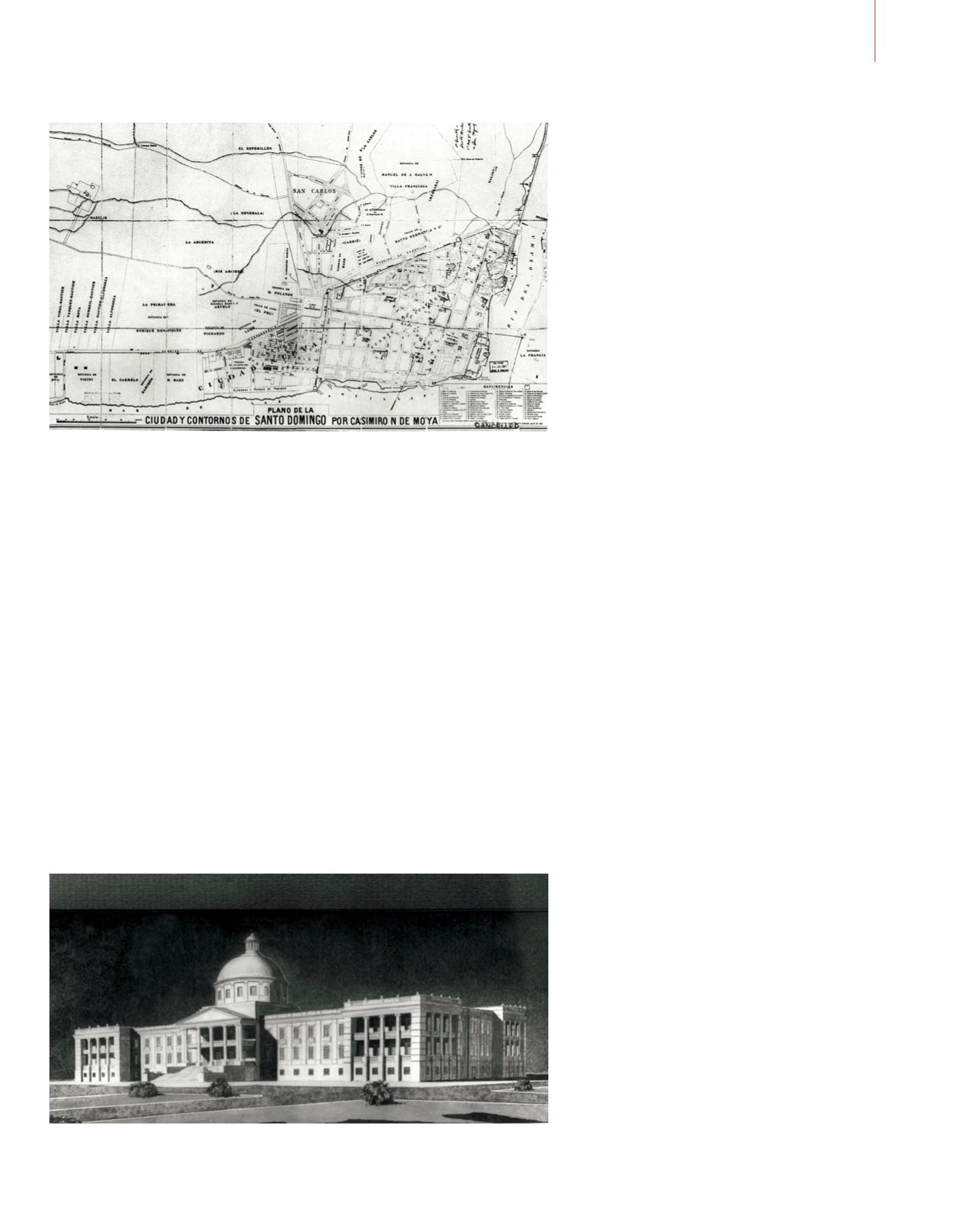
Map of Santo
Domingo showing
its boundaries, by
Casimiro N. De Moya.
© Public Domain
Scale model of the
original proposal
for the Dominican
Republic’s
governmental
headquarters.
© Collection of the
D’Alessandro Tavárez
family. Courtesy of José
Chez Checo
THE ITALIAN ENGINEER GUIDO D’ALESSANDRO LOMBARDI