


 269 / 540

THE ITALIAN LEGACY IN THE DOMINICAN REPUBLIC
268
First International Congress of Modern Architecture was held. Known as CIAM,
3
it took place at La Sarraz Castle in the Canton of Vaud in Switzerland. In Santiago,
Chile, the Pan-American Union – the predecessor to the Organization of Ameri-
can States (OAS or OEA) – moved forward with a resolution from 1923. It held an
international competition for the design of the Columbus Lighthouse to be erect-
ed on the coast of the Dominican Republic.
4
Meanwhile in Italy, a young D’Ales-
sandro Lombardi was still dreaming about Santo Domingo, for he had not left the
country permanently. While he worked in Montecristi, he had fallen in love with
the woman who would later become his wife. On April 26, 1930, at a ceremony
attended by generals Desiderio Arias and Rafael Leónidas Trujillo Molina, as well
as President of the Republic Rafael Estrella Ureña, D’Alessandro Lombardi mar-
ried Carmen Tavárez Mayer. Together they had seven children, six of them boys.
In the previous year, 1929, the results were announced in Madrid for the
first phase of the international competition for the Columbus Lighthouse.
5
Pub-
lications about international architecture started to proliferate. In London, the
prestigious magazine
Architectural Design
was launched, and in Paris the equally
prestigious
L’Architecture d’Aujourd’hui
was created. Meanwhile, in New York the
Museum of Modern Art (MOMA) was founded.
In the Dominican Republic, D’Alessandro Lombardi was obliged to become
a Dominican citizen in order to work in the country, and he was appointed as the
head of irrigation in the Northern Zone (1930-1932), based in Santiago de los Ca-
balleros. In the same year that Guido D’Alessandro Lombardi married Carmen Tavárez, one of the first two
Dominicans with degrees in architecture arrived in the country. He was Juan Bautista del Toro Andújar (1892-
1953),
6
a graduate of École Polytechnique in Paris. The other, architect Guillermo González Sánchez (1900-
1970), graduated from Yale University in the United States but did not return to the Dominican Republic until
1936. Meanwhile, in the Union of Soviet Socialist Republics (U.S.S.R.) in 1931, the results in the international
competition for the Palace of the Soviets in Moscow were announced. In Brazil, the Englishman J. L. Gleave
was declared the winner of the second phase of the international competition for the Columbus Lighthouse.
7
In Italy, the second Rational Architecture exhibition was held in Rome. Concurrently, in the United States,
Rockefeller Center (Hood-Fouilhoux; Reinhard
& Hofmeister; Corbet, Harrison & MacMur-
ray) and the Empire State Building (Shrever,
Lamb & Harmon) were unveiled in New York.
In Germany, the Columbushaus (Mendelsohn)
was inaugurated in Berlin.
In the Dominican Republic, D’Alessandro
Lombardi worked far from the capital. It was
in 1933 that he was assigned the official duties
related to his position. He was commissioned
to create the Army Corps of Engineers, and as
part of his duties, he would also build multiple
forts, primarily in the border zone. He was con-
sequently appointed as a Major for the National
Army, a position that he held until 1938. That
same year, the Golden Gate Bridge spanning
San Francisco Bay in California was unveiled.
While D’Alessandro Lombardi was serving
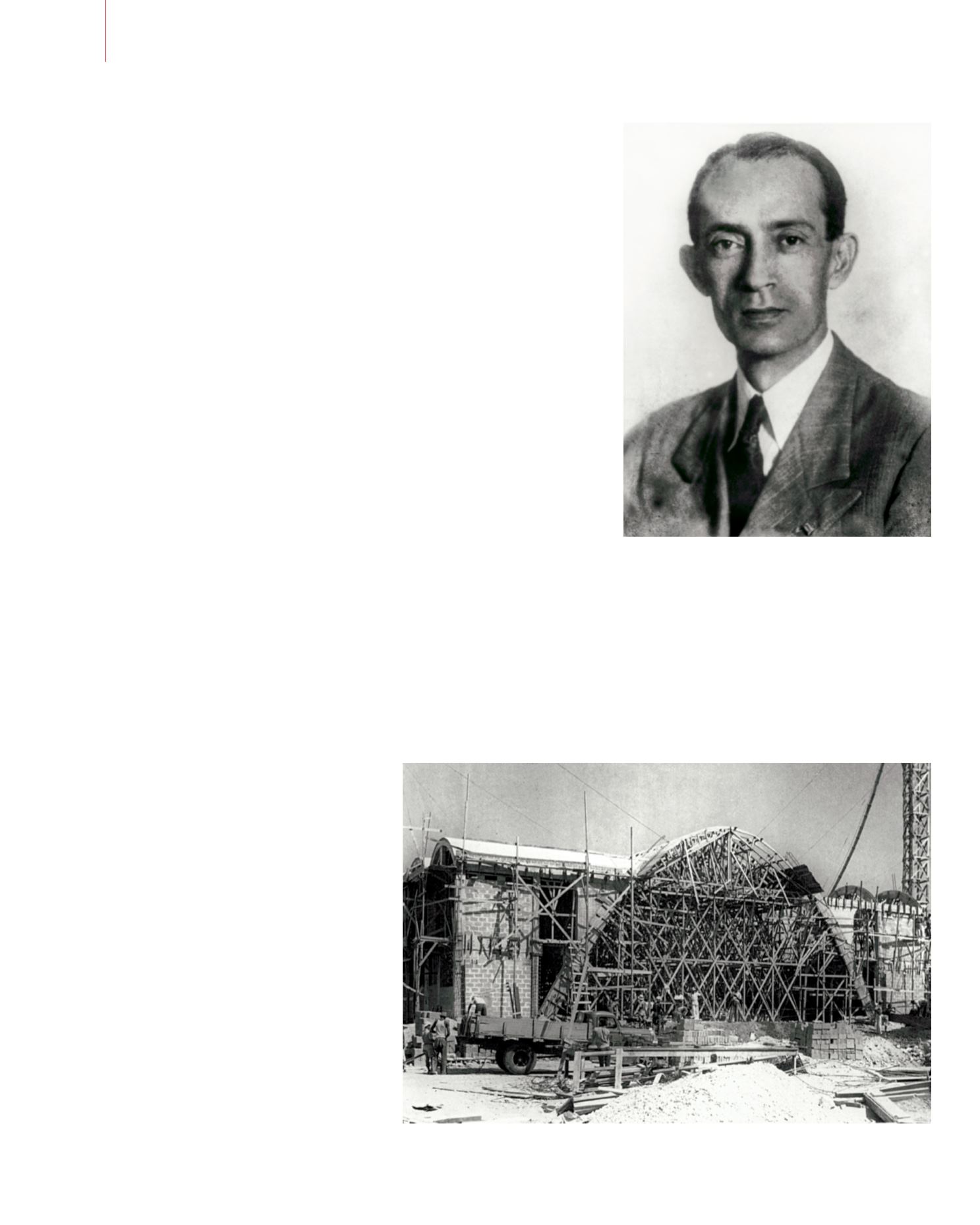
Engineer Guido
D’Alessandro
Lombardi.
© D’Alessandro Tavárez
family collection. Courtesy
of José Chez Checo