


 264 / 540

263
THE ITALIAN INFLUENCES ON THE “CATEDRAL PRIMADA DE AMÉRICA”
having been dismantled during the restoration of the cathedral in 1877. Alfredo J. Scaroina Montuori was born
in Avelino in the Campania region of Italy on July 17, 1864. He studied at the University of Milan and later at
the University of Rome, which enabled him to devote himself to civil engineering, bridge and road engineer-
ing, and architecture. He went to the Dominican Republic in 1890 on a vacation, but he decided to establish
residence in the city of La Vega, where he married Fresolina García Godoy in 1904. He was responsible for ma-
jor construction projects in the cities of La Vega, Moca, Cotuí, San Pedro de Macorís, and Santo Domingo.
10
On October 11, 1935, Pope Pius XII granted the miter of the Archbishop of Santo Domingo to Ricardo
Paolo Pittini Piussi, who was born in Tricesimo, Udine, Italy on April 30, 1876. During his ecclesiastical rule,
no major works were carried out on the Cathedral of Santo Domingo; work was limited to maintenance and
cleaning projects, the restoration of the organ from the upper choir, and the installation of new lighting fix-
tures. One significant project carried out during those years, however, was the restoration of the Cathedral
Archives, rescuing them from the termites and moths that were destroying the records.
11
In 1953 a huge organ was installed in the Chapel of the Souls. It had been built in one of the most reputa-
ble, specialized houses of Italy, in Fologno, but it had to be dismantled 30 years later due to destruction caused
by moths and termites, thereby enabling the clearing out of the chapel in which the mausoleum for the first
archbishop of Santo Domingo, Alonso de Fuenmayor López (in office 1546-1554), is located.
The Archbishop Nicolás de Jesús López Rodríguez (cardinal since 1991) created in 1984 the Office of Works
and Museums of the Cathedral of Santo Domingo, which immediately undertook major restoration projects
in anticipation of the celebration of Fifth Centenary of the Discovery and Evangelization of the Americas.
The completed works included the laying of a new Italian marble floor in the three naves of the temple
and in the atrium; this was done after archaeological research was carried out in those areas. These projects
were headed by Dino Campagna, an engineer of Italian descent born in Santo Domingo. He also coordinat-
ed the creation of six sculptures and the coat of arms for Carlos V in the workshops of
Ditta Enrico Arrighini
e figlio
, founded in 1870 in Pietrasanta (Lucca), Italy, to be placed on the main façade of the cathedral. These
marble masons also transported the mausoleum that held the remains of admiral Christopher Columbus to
the Columbus Lighthouse, which from 1898 through 1992 was located in the central nave of the cathedral.
This mausoleum was built with Italian marble from the quarries of Carrara.
In 2005, the architects Esteban Prieto Vicioso and Virginia Flores Sasso remodeled the presbytery of the
cathedral using Italian marble for both the flooring as well as the new altar, in keeping with the new Liturgy.
Two non-Italian professionals who received training in Florence and Rome are restorer Ángela Camargo
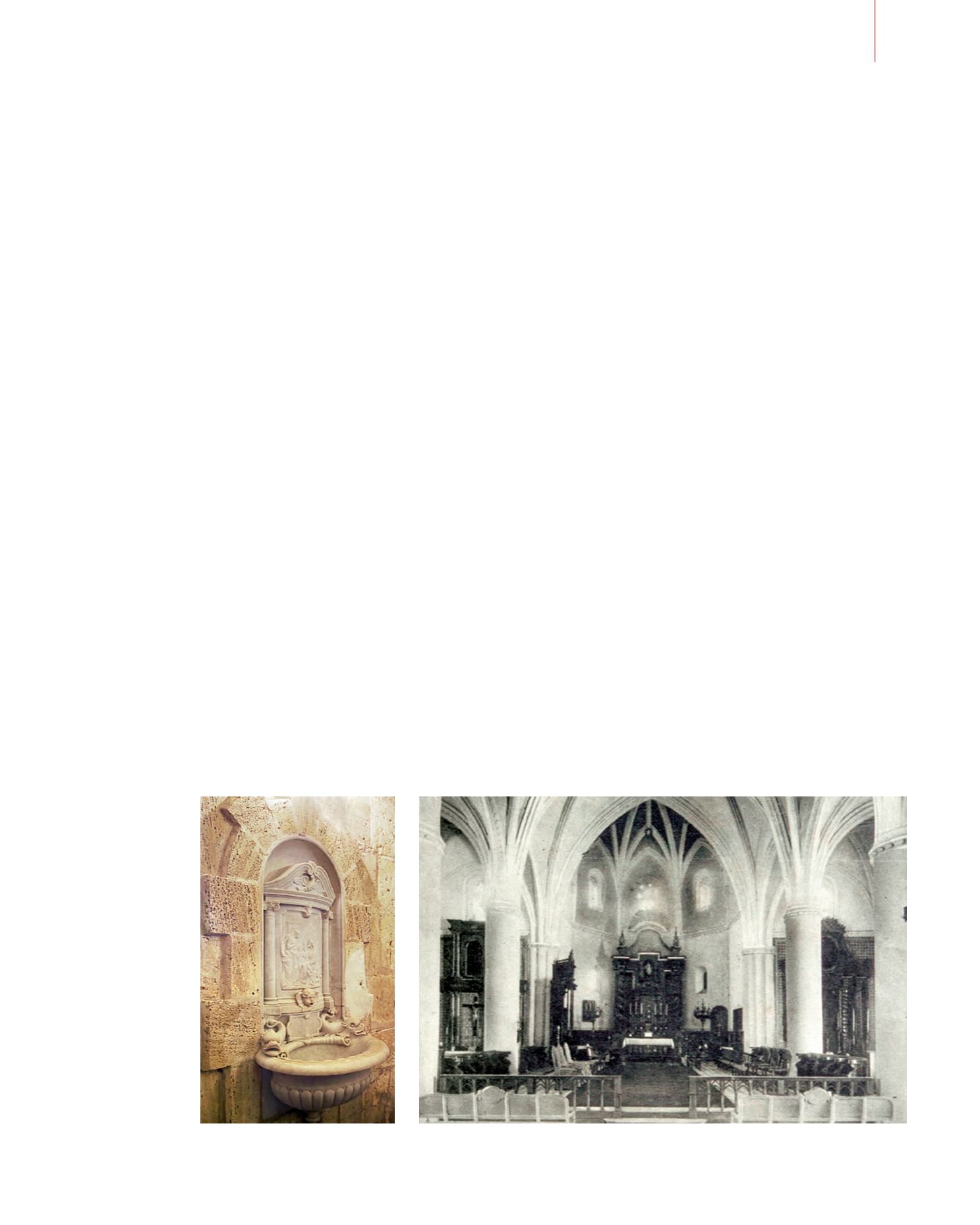
Marble basin in
the sacristy of the
cathedral (Borrell, P. J.).
© Courtesy of Esteban
Prieto Vicioso
Remodeling
of the presbytery
by the architect
Alfredo Scaroina.
© Photo by Mañón,
collection of the Office
of Works of the Cathedral
of Santo Domingo