


 262 / 540

261
THE ITALIAN INFLUENCES ON THE “CATEDRAL PRIMADA DE AMÉRICA”
heard for centuries within the vaults of this temple.
The stones will swiftly rise, mocking their immense bulk and
the immensity of their weight; because art shall free them
from their slow movement and they shall intertwine
like palms, covering your basilica.
The blazons that shone in Rome now appear, and now the Papal tiara
shines so incredibly bright; and if it wears three crowns,
it was no small feat when the Popes dictated the laws
onto the entire world. Here are the proud eagles of Cesar
adorned with the most beautiful crowns, memories of the Quirites,
that the left side illustrate; and to the right, the land and sea
ruled by Mars, and the splendid chariots covered in light and fire
shall be adorned with Phoebus.
And the noble Geraldinis, with generous ancestry, shall shine
with their own splendor, like the sun in the heavens and with the
flame of Minerva burning brightly on their heads: Minerva who brings
peace to the world and ensures its progress.
Alejandro built this temple, a pious and good bishop, who to
many Kings he will leave many wise documents; who worshipped
the Muses, through the Parnassus rising until reaching the
highest summits of the heavens.
On February 12, 1546, Pope Paul III created the ecclesiastical prov-
ince of Santo Domingo by means of the
Super
universas orbis ecclesias
papal bull, thereby bringing the Cathedral
of Santo Domingo to the city. He concurrently appointed Alonso de Fuenmayor as the first archbishop of the
Americas. Pope Paul III, whose secular name was Alessandro Farnese, was chosen as pope in 1467, and he died in
his native city of Rome in 1549. His remains are found in Saint Peter’s Basilica in a mausoleum designed by Mi-
chelangelo and built by Guglielmo della Porta. His papacy is considered to have been one of the most productive
in the annals of the Church.
4
Another Italian that made a significant impact on the Cathedral of Santo Domingo was Monsignor Rocco
Cocchia, the apostolic delegate in the Dominican Republic from 1874 to 1882. During his tenure, major works
were carried out at the cathedral, including the restoration of the presbytery, recovering its original areas lev-
els, and the installation of an Italian marble floor in the interior of the cathedral.
5
Upon his birth in 1830, Fray Rocco Cocchia was baptized as Angelo Antonio. In 1874 he created the Hon-
orary or
ad honorem
Council of the cathedral. He also consolidated the work of the seminary, merging it with
the Jesuit college of Colegio San Luis Gonzaga in 1875. He died in Chieti, in the region of Abruzzi
,
Italy, in
1901, and his remains were later transferred to the church of San Rocco, in his native city of Cesinali, Italy.
6
The restoration works done in the cathedral were commissioned by Monsignor Rocco Cocchia with the
priest Francisco Anatalio (Xavier) Billini, the son of Giovanni Antonio Billini Ruse, a native of Alba in Pied-
mont, Italy, who came to the island in 1805 as a soldier in the service of France.
7
On April 7, 1877, Father Billini initiated the repair and restoration works of the cathedral, which was one
of the main renovation projects carried out on the monument up until then. The works consisted of the resto-
ration and expansion of the presbytery, while recovering areas from the levels of the original presbytery. This
work enabled the discovery of the real remains of the Genoese admiral, Christopher Columbus, which were
still located in his crypt. Also, at that time, with the approval of the Executive Body of the Municipal Council
for the city and several prominent individuals, the deteriorated lower choir that occupied two sections of the
central nave of the cathedral was eliminated.
8
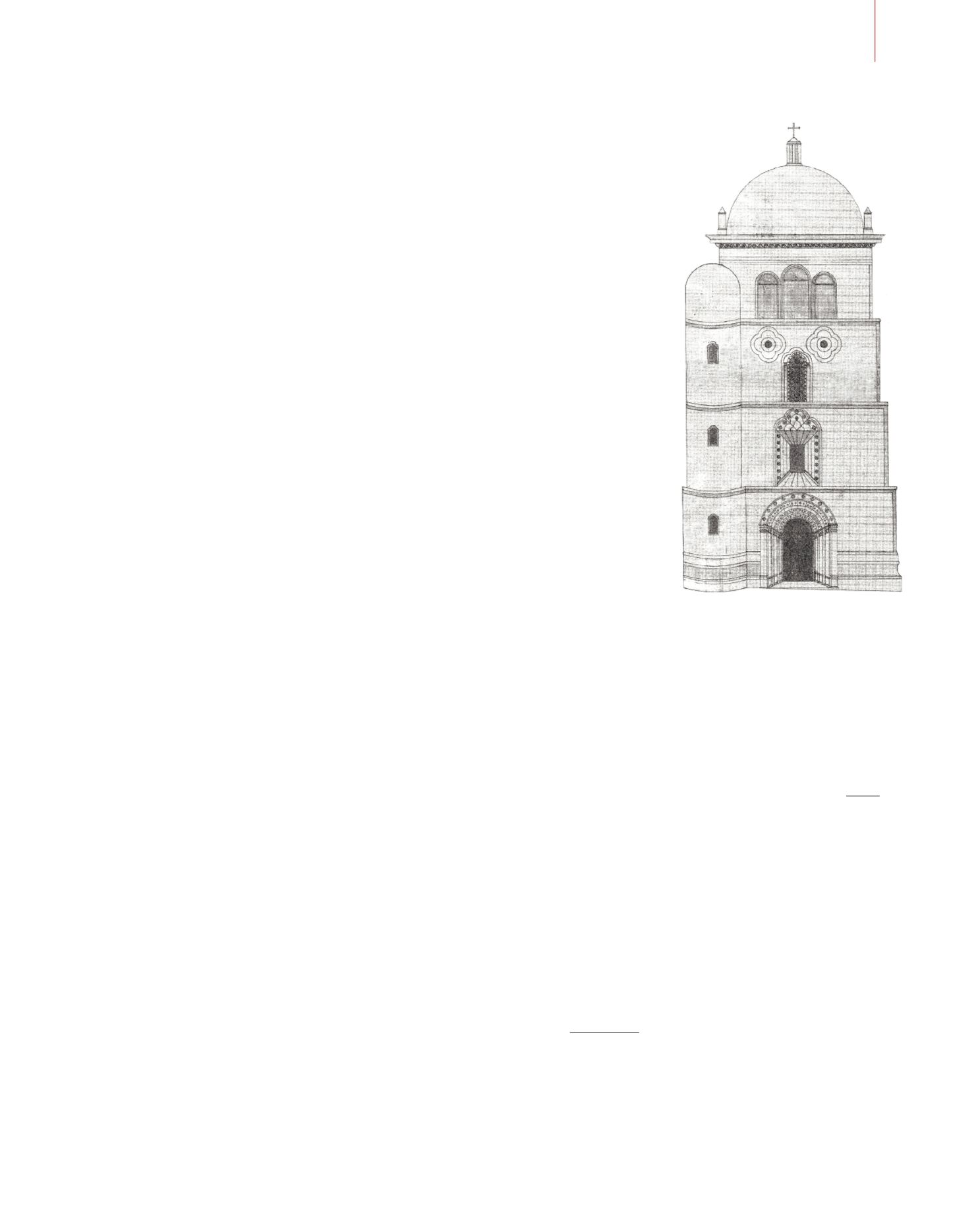
Plan for the bell tower
designed by Paolo
Medici. (Historical
Archives of the
Archbishop of Santo
Domingo).
© Courtesy of Esteban
Prieto Vicioso