


 263 / 540

THE ITALIAN LEGACY IN THE DOMINICAN REPUBLIC
262
Father Billini also placed new marble floors in the three naves and side chapels of the cathedral, for which
the tiles were imported from Italy by the L. Cambiaso y Co. trading house. All these works, in addition to the
general cleaning, painting, and repair of multiple furnishings were completed, thereby enabling the church
to be blessed by Monsignor Rocco Cocchia, then Bishop of Orope and Apostolic Vicar of the Archdiocese of
Santo Domingo. Monsignor Cocchia also displayed an interest in the clothing worn in the cathedral, sending
the white garments to be restored in Naples, Italy. This consisted of the set of vestments that were used by the
priests, the deacon, and the subdeacon during the solemn masses.
9
During the prelacy of Archbishop Adolfo Alejandro Nouel y Bobadilla (1906-1931), and particularly during
the 1910s, another important plan was implemented for the intervention and restoration of the Cathedral of
Santo Domingo. With the intention of enriching his cathedral, he commissioned a design from the Italian
marble mason Paulo Medici to complete the bell tower, which was delivered to him in 1907, though it was
ultimately never built.
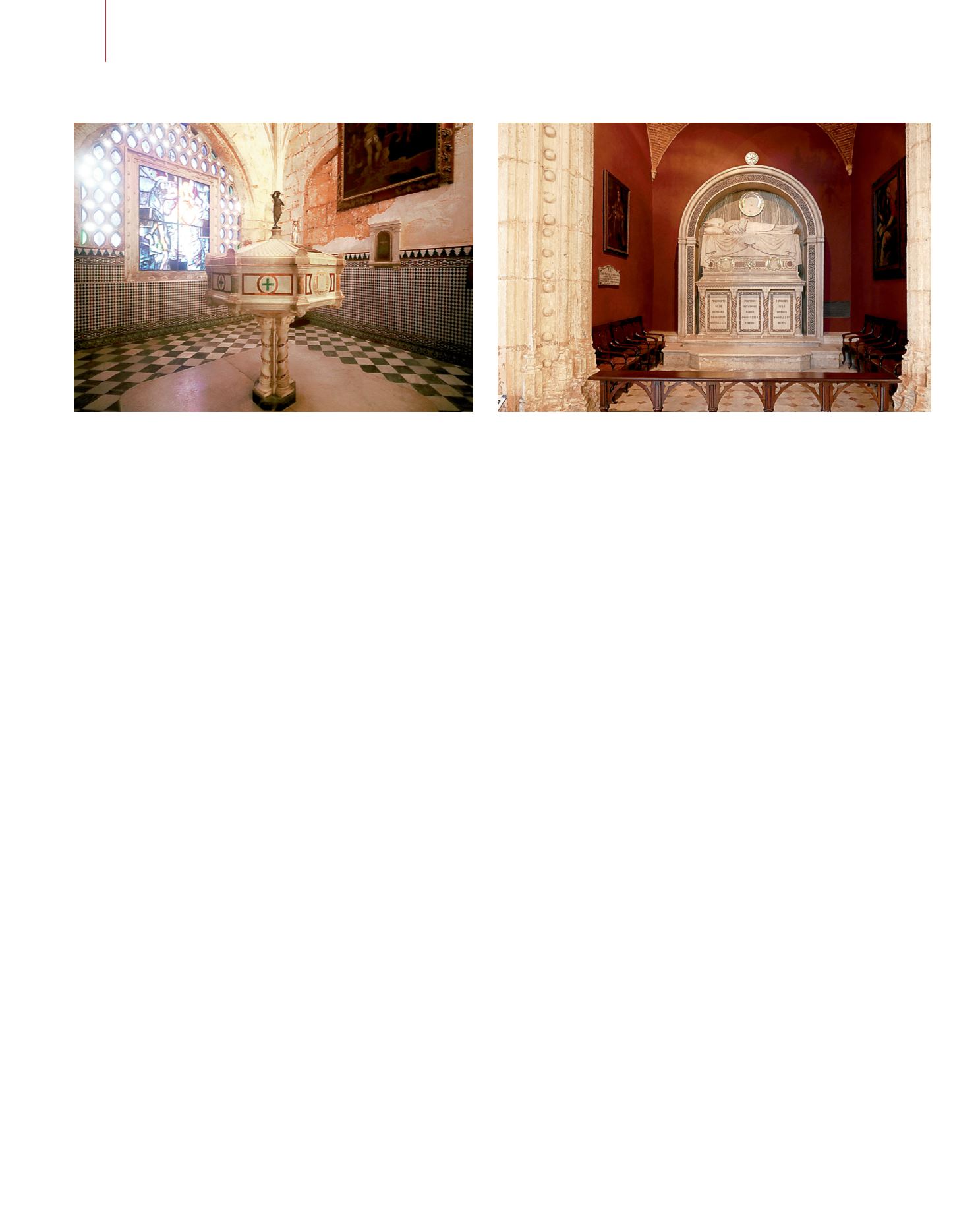
Just two years after his investiture at the Catedral Primada de América in 1908, two works created by Paulo
Medici arrived in Santo Domingo: the mausoleum of Archbishop Fernando Arturo de Meriño Ramírez and a
newmarble baptismal font, which was donated by Archbishop Nouel y Bobadilla for the purpose of commem-
orating the fourth centenary of the creation of the Bishopric of Santo Domingo on August 8, 1511.
The mausoleum is sculpted in white marble with golden inlays, with a figure on the upper section that rep-
resents Archbishop Meriño adorned in the vestments in line with his rank. On the right side of the mausoleum,
the sculptor’s signature can be seen. The inscription reads:
PAVLUS MEDICES MARMORARIVS ROMANUS
FECIT ROMAE MCMVII.
Also by Paulo Medici are the ornamented marble basin from the sacristy and the commemorative placard
from the pronouncement of the cathedral as a minor basilica and the coronation of Our Lady of Altagracia. On
this placard dated 1920, the signature of Pope Benedict XV appears; he was born in Genoa in 1854 as Giacomo
Paolo Giovanni Battista della Chiesa and died in Vatican City in 1922.
In 1916 and 1917, the Italian architect Alfredo Scaroina carried out important projects in the cathedral
following a general plan submitted by Archbishop Nouel to both him and the prestigious architects and en-
gineers Nechodoma, Báez, Medici, and García. As part of these projects, blueprints were drawn up for the
entire building; the foundations were underpinned; the old windows which had been walled in were rebuilt;
structural reinforcement works were carried out; and the bishop’s throne and the choir stalls were restored.
Another major project planned by Scaroina during those years was the modification and expansion of the
presbytery, which was extended to cover two sections of the central nave, as reflected in its current size today.
During this expansion, four sections of the old stalls of the lower choir were restored and then replaced, after
Baptismal font by
Paolo Medici in 1911
(Borrell, P. J.).
© Courtesy of Esteban
Prieto Vicioso
Mausoleum of
Archbishop Meriño by
Paolo Medici (Borrell,
P. J.).
© Courtesy of Esteban
Prieto Vicioso