


 270 / 540

269
THE ITALIAN ENGINEER GUIDO D’ALESSANDRO LOMBARDI
in the Dominican Army, international Western architecture witnessed the birth of one of its enduring land-
marks in 1936: Fallingwater (Kaufmann House) located in Bear Run, Pennsylvania, a project by Frank Lloyd
Wright. That same year, the architect Guillermo González Sánchez returned to the country.
A city plan named “The Urbanization of Ciudad Trujillo,” created in 1937 by G. D’Alessandro Lombardi
and J. A. Caro Álvarez, included a proposal for the capital building located on current Avenida Máximo Gómez
near the western section of the city. It was there in the 1970s that the monumental complex was created for the
Juan Pablo Duarte Cultural Center.
8
Based on the aforementioned plan, the entire designated area extending
to the sea was dedicated to institutional buildings. These would be arranged in keeping with the surroundings,
flanking the side streets that were shortened to create space for the capitol building. To the east in that same
plan, the site of “La Generala”
9
was intended to later become the Presidential Mansion. This was due foremost
to the fact that it had been already been located there until that time, and also because it appears that plans
were designed to rebuild a stately Government Palace on the site.
In the context of his personal research conducted and later published in local mass media outlets, Dr. Al-
cides García Lluberes, whose name is traditionally associated with the site, explained the meaning behind the
moniker “La Generala.” He noted that a hacienda there had once belonged to brigadier Juan Sánchez Ramírez.
In keeping with the gallantry and flattery of the time, he had called his wife Josefa Delmonte y Pichardo “La
Generala,” or “Madame General.” During the process of rebuilding the city in the aftermath of Hurricane
San Zenon, the plans followed a Monumentalist architectural style. They sought to introduce propaganda
throughout the urban landscape through buildings that would underpin the foundations of the new political
regime. Therefore, an area was set aside within this same city plan to create a monument to Generalissimo
Trujillo, situated at the site where the silos and buildings for Molinos Dominicanos are located currently. This
was done in order to connect the longitudinal axis of Calle El Conde located in the city’s historic center with
the Columbus Lighthouse, which was still in its drafting phase and awaiting completion of the final plans that
the winner of the international competition was preparing.
10
One year prior, in 1936, the Spanish Civil War
had erupted, and in Santo Domingo the Dominican Congress carried out a legendary act of obsequiousness.
Lawmakers asked to change the historic name of the city to that of the dictator’s last name. Amidst intense
criticism, they changed the name of the capital from Santo Domingo to Ciudad Trujillo, which it was called
until 1961. And at that same time, the obelisk of Santo Domingo was erected and built by engineer Rafael
Bonnelly García.
In Brazil in 1937, a novel contribution to modern ar-
chitecture was made. The architectural group Costa, Nie-
meyer, Leao, Moreira, Reidy and Vasconcelos with the
advising of Le Corbusier completed the building that was
the site of the Ministry of Education and Health in Rio de
Janeiro. Meanwhile, after having completed his work on
the Dominican forts on the border, D’Alessandro Lombar-
di departed for Italy with his family, in 1938. It was also
then that Frank Lloyd Wright established Taliesin West,
his independent teaching workshop in the United States.
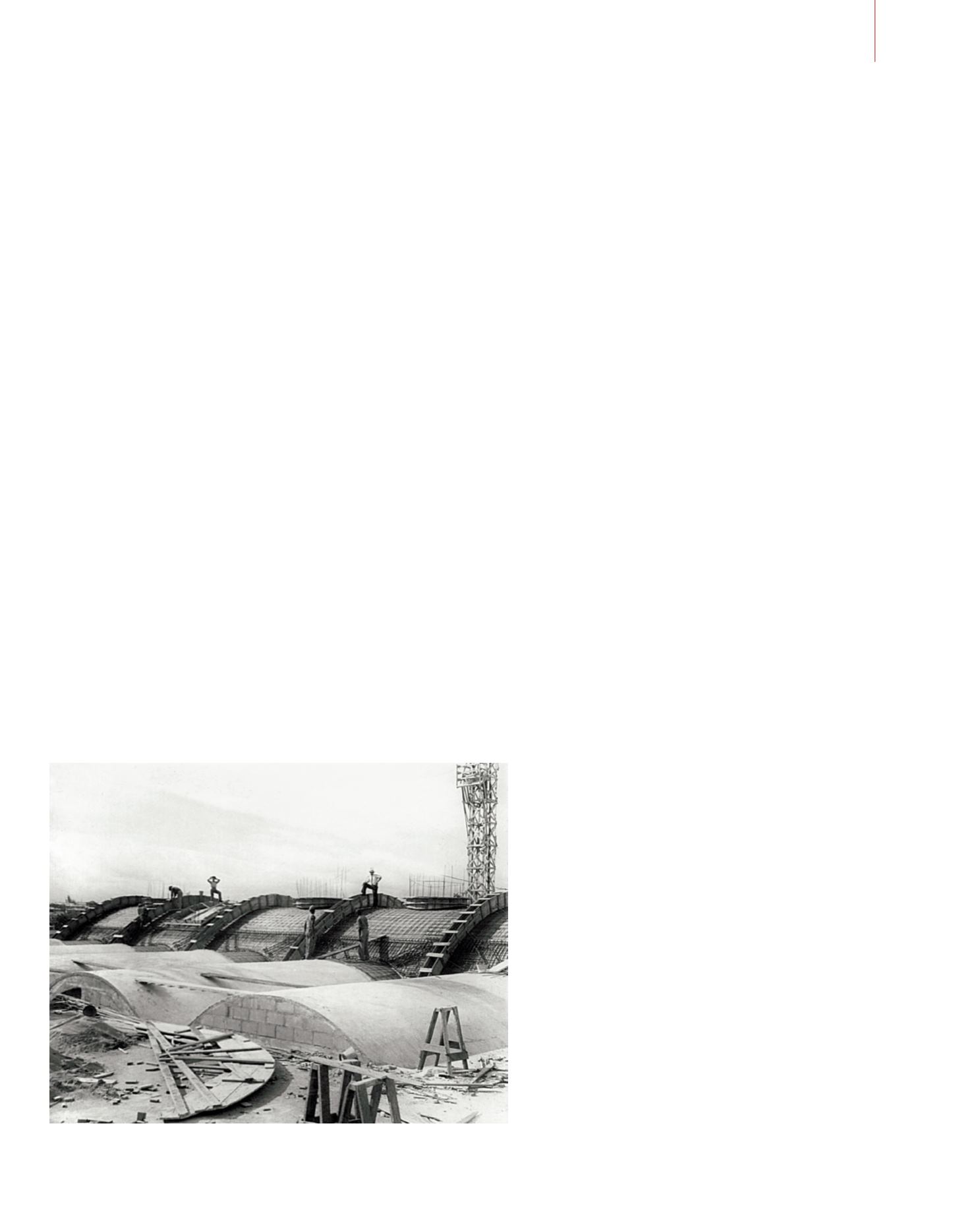
Upon his return the following year, 1939, D’Alessan-
dro Lombardi took part as a contractor in the construc-
tion of Santo Domingo’s Mercado Modelo, a project de-
signed by Henry Gazón Bona (1909-1982) and built by José
Ramón (Moncito) Báez López-Penha (1909-1994). That
same year, the local competition was held for the design
of Parque Ramfis park, which was won by architect G.
González Sánchez; the construction of the park was com-
Opposite page:
The Mercado Modelo
on Mella Avenue,
shown in the picture
the scaffolding of the
façade’s great arch.
© D’Alessandro Tavárez
family collection. Courtesy
of José Chez Checo
In the foreground,
already laid out, are
the small vaults of
the arches. In the
background, the final
casting is prepared on
the central vault of the
Market.
© D’Alessandro Tavárez
family collection. Courtesy
of José Chez Checo
Opening page:
Interior of the National
Palace. From the
main dome hangs an
impressive Florentine-
style lamp, which was
brought from Italy.
© Thiago da Cunha