


 273 / 540

THE ITALIAN LEGACY IN THE DOMINICAN REPUBLIC
272
using that last name. The “Presidential Mansion” was located at the edges of the neighborhoods of Gazcue and
San Carlos and served as a topographic high point for the entire city; the area that it occupied was also called
San Carlos Hill. The “Mansion” was used by the American armed forces during the U.S. occupation from 1916
to 1924, and it later became the famous Customs Administration building. In addition to the other sporting
facilities that were added during that period of its use, the majestic residence also had a large aboveground
circular pool and tennis court, which were indispensable embellishments for the comfort of its occupants.
Located at the periphery of the burgeoning urban-residential sector that was Gazcue, the traditional neigh-
borhood of the upper and middle class at the end of the 20th century, it underwent major transformations in
usage, and its presence was assuredly a constant social hub. We can thus assume that it was by consequence
and not by chance that on that promontory panoramically dominating the growing city of Santo Domingo,
after having been returned to national sovereignty following economic and political agreements that made
possible the American de-occupation of the territory, the Government arising from such a unique and critical
situation would be located.
16
Although the analysis is in the context of Venezuela, we are nevertheless able to make speculations and
form opinions that are perfectly applicable to the local Dominican setting. There are indeed some parallels be-
tween “La Generala” or the “Customs Administration Building” or the “Presidential Mansion” (as it was called
by the time that General Horacio Vásquez already lived there as President of the Dominican Republic from
1924 and 1930). These considerations are environmental, conceptual, and criterial aspects (due to the continu-
ity and permanence) that are familiar to us, and they therefore enable us to draw a certain connection between
Miraflores and Gazcue, in that both served as national palaces after having originally been private residences.
It is thus likely that the influence of that physical and symbolic presence would acquire tremendous signif-
icance, and would clearly impact the growth and development of the city and its real or utopian urban plan-
ning, given its location and immediate surroundings. As Roberto Segre Prando stated: “The growth of cities
in population and surface, and the increase in the functions identified with the State’s structures, projected
a classic typology beyond the historical Colonial area. The Beaux Arts style reigned for over a century from
one end of the North American continent to the other, expressing the institutionalization of national bour-
geoisies, the grandiloquent aspirations of liberal governments or military dictatorships. The choice to either
use fewer or more elements from the code – colonnades, friezes, pediments, domes, etc.– and the selection
of the stylistic forms depends on the cultural level of the ruling class, or on the degree of dependence with
regard to the metropolitan centers, as well as the resources available and the functions that such symboliza-
tion demand. Rich nations such as Mexico, Argentina or Brazil not only concentrate the buildings within the
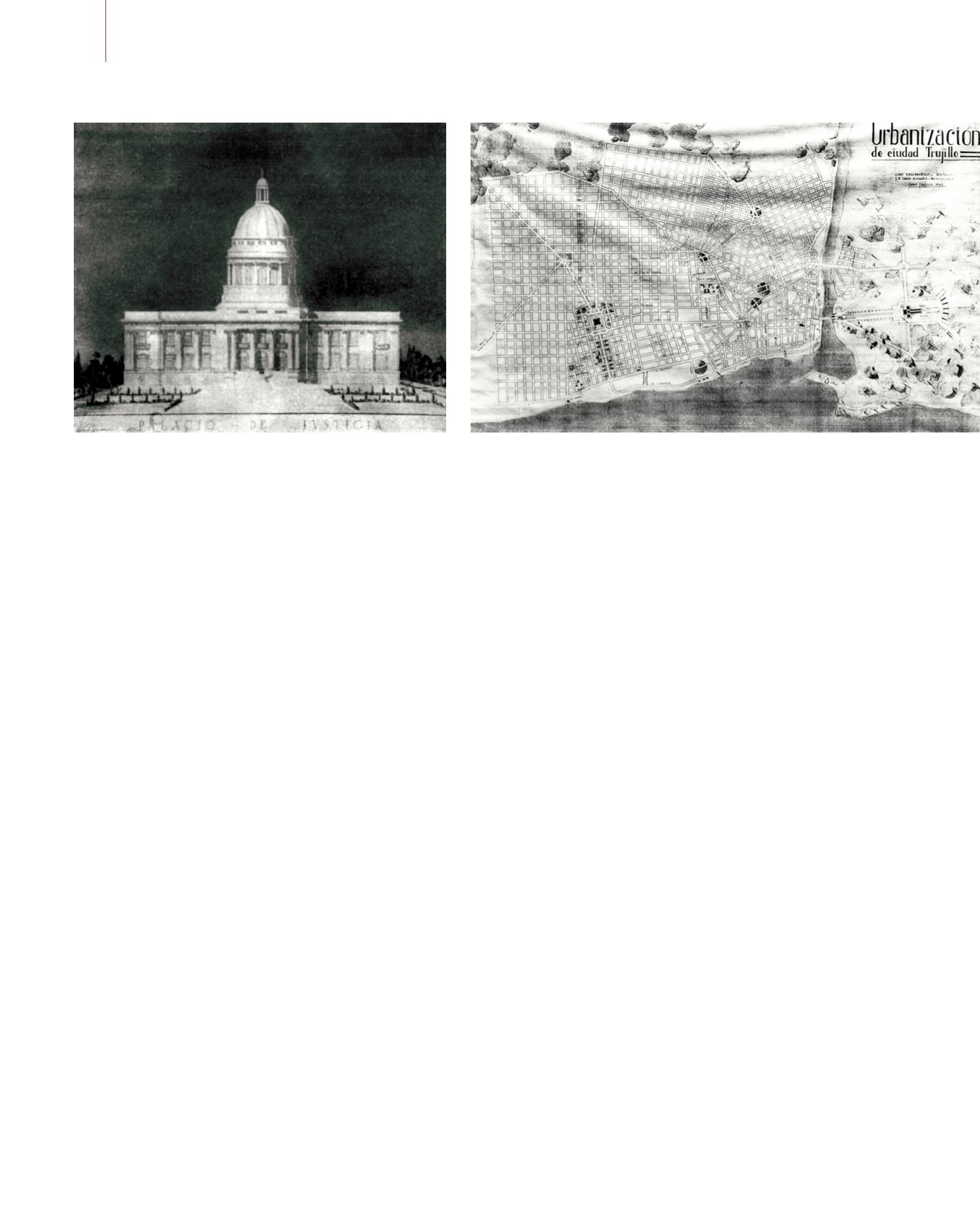
Courthouse. Project
presented by the
General Bureau of
Public Works.
© Collection of the
D’Alessandro Tavárez
family. Courtesy of José
Chez Checo
Following the proposal
of the engineer J.R.
Báez López-Penha,
this new vision of
the future City of
Santo Domingo was
conceived by Guido
D’Alessandro and J.A.
Caro Álvarez.
© Collection of the
D’Alessandro Tavárez
family. Courtesy of José
Chez Checo