


 277 / 540

THE ITALIAN LEGACY IN THE DOMINICAN REPUBLIC
276
old city was now rapidly expanding toward the sector beyond the defense walls, extending toward fields that
primarily sloped toward the east. This is due to the fact that the geological fault that divides the city’s bedrock
abruptly ascends at its northern side. This made it subject to unusual phenomena of different types, including
those arising within the country itself, as well as those from countries within the region. Thus, it assimilated
fundamental influences for the development of social, political, and economic life. Its architecture, an inherent
aspect of sociocultural development in an emerging nation, was the true reflection of the isolationism within
which the political events of recent years had forced it to exist.
24
The physical process of transformation in Santo Domingo was thus very slow, lacking a pace that would
enable it to establish an immediate goal for its horizon and future. From the moment that the independent
nation proclaimed itself to be a republic, in 1844, a long period elapsed in which virtually nothing with a per-
manent and transcendental character was built throughout the entire country or that would endure and be
recorded within the collective memory of the Dominican people. This only came about with the International
Competition for the design and construction of the Monumental Lighthouse dedicated to the memory of
Christopher Columbus, which took place in 1928.
25
This competition can be considered as the starting point
of a redemptive process of architectural activity that had been almost otherwise completely lacking.
26
It is perhaps in the fertile and consequently prosperous region of the Cibao where the most eloquent yet
modest examples can be found of a nascent architecture reflecting the economic progress of the emerging
business and social sectors. The regional capital of Santiago de los Caballeros and other provincial capital
cities, such as La Vega, San Francisco de Macorís, and Moca, with their civic centers (main squares, religious
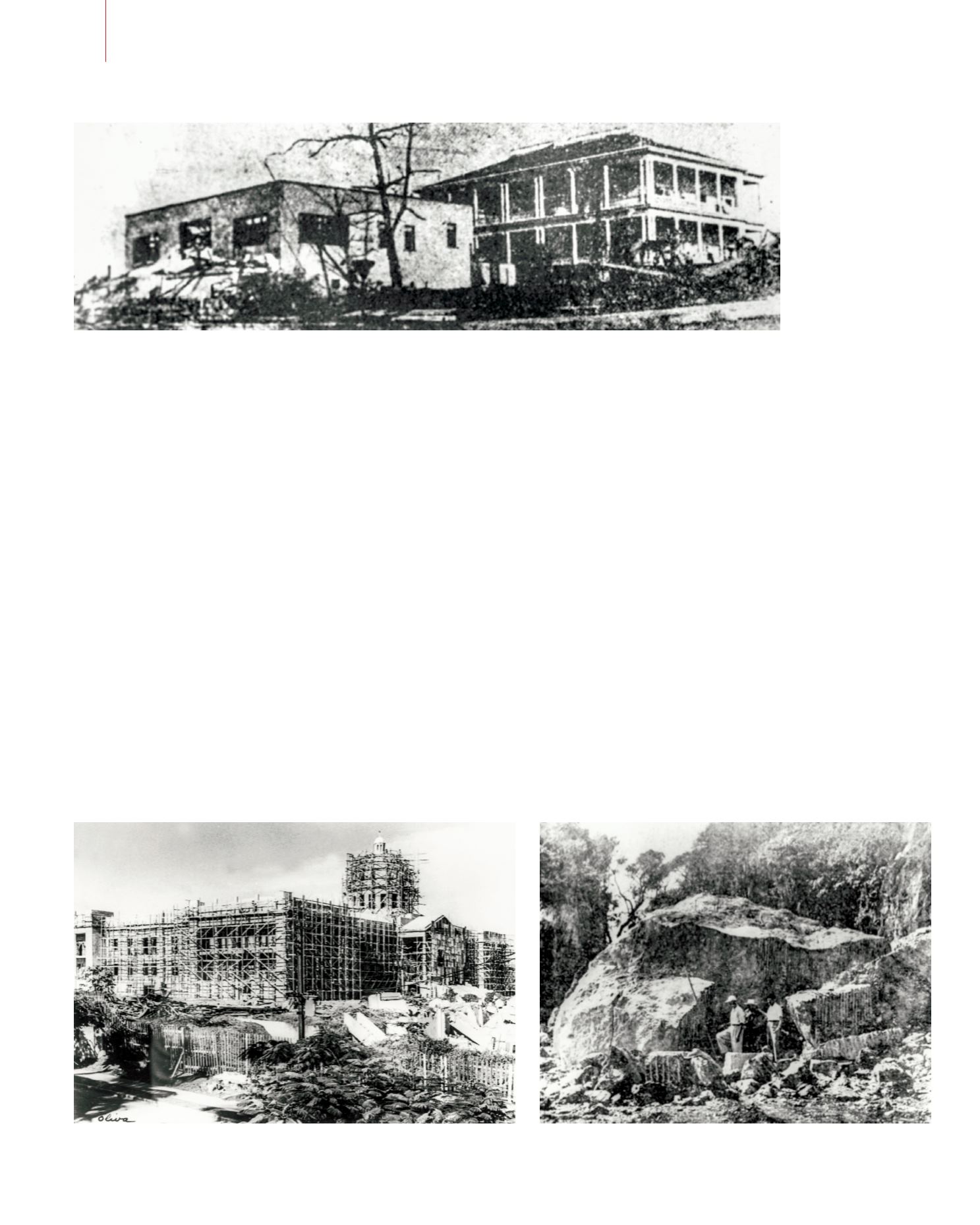
View of the Presidential
Residence, with its
roof severely damaged,
probably caused by
Hurricane San Zenón in
1930.
© Collection of the
D’Alessandro Tavárez
family. Courtesy of José
Chez Checo
View of the National
Palace’s construction.
© Collection of the
D’Alessandro Tavárez
family. Courtesy of José
Chez Checo
Marble quarry, Villa
Ramfis, Samaná.
© Collection of the
D’Alessandro Tavárez
family. Courtesy of José
Chez Checo