


 276 / 540

275
the “young and competent professionals Ramón and Carlos Trueba” [sic]. It is very likely that the ideologues
of the Trujillo regime would have preferred traditional and classic shapes and lines for the National Palace
over the bold and innovative shapes and lines characteristic of new modernity.
20
Similar considerations would
also prevail such that the models created from state funds that Trujillo bookmarked for architecture, as well as
those that he designated to make urban planning a political action, would follow this idea of creating a modern
(and model) building like that of the market that was opened in 1944, which would also represent a “modern”
nation.
It is worth noting that in the years in which D’Alessandro Lombardi was ordered to assume responsibility
for the works slated for the new seat of the government, the grand master of modern Dominican architecture,
Guillermo González Sánchez, had already produced three significant monuments within the urban architec-
tural dynamic of the city. These would launch the modern movement, formally linking him to the interna-
tional style of so-called rational architecture that arose during the peace imposed in the period between both
World Wars:
a. Ramfis Park (1937-1939)
21
b. Edificio Copello (1939)
22
c. The authentic and original Hotel Jaragua (1939-1942)
23
These three projects by González Sánchez are distinctly hallmarked by the modernist and revolutionary
trends of the era, and the rather unique circumstances that the country was experiencing at the time. González
Sánchez had received a Beaux Arts education, but his intellectual mastery was developed during his personal
search for codes that were representative or distinctive within architecture. Translating a contemporary build-
ing’s representation of power into a communicative language that would also afford it an artistic accent was a
task that could not be entrusted to the hands of an innovator. This was due to the risk of adopting a code that
was too audacious, especially for “communicating,” as was suggested above.
During its turbulent process of urbanization, Santo Domingo had managed to surpass the limits imposed
by its own walled defense system dating back to the time of the Spanish Conquest. This systemwas created on
just two of the corner posts from the original grid that was planned around 1502, maintaining the Ozama Riv-
er as the defense point to the east and the estuary and the Caribbean Sea as the defense point to the south. That
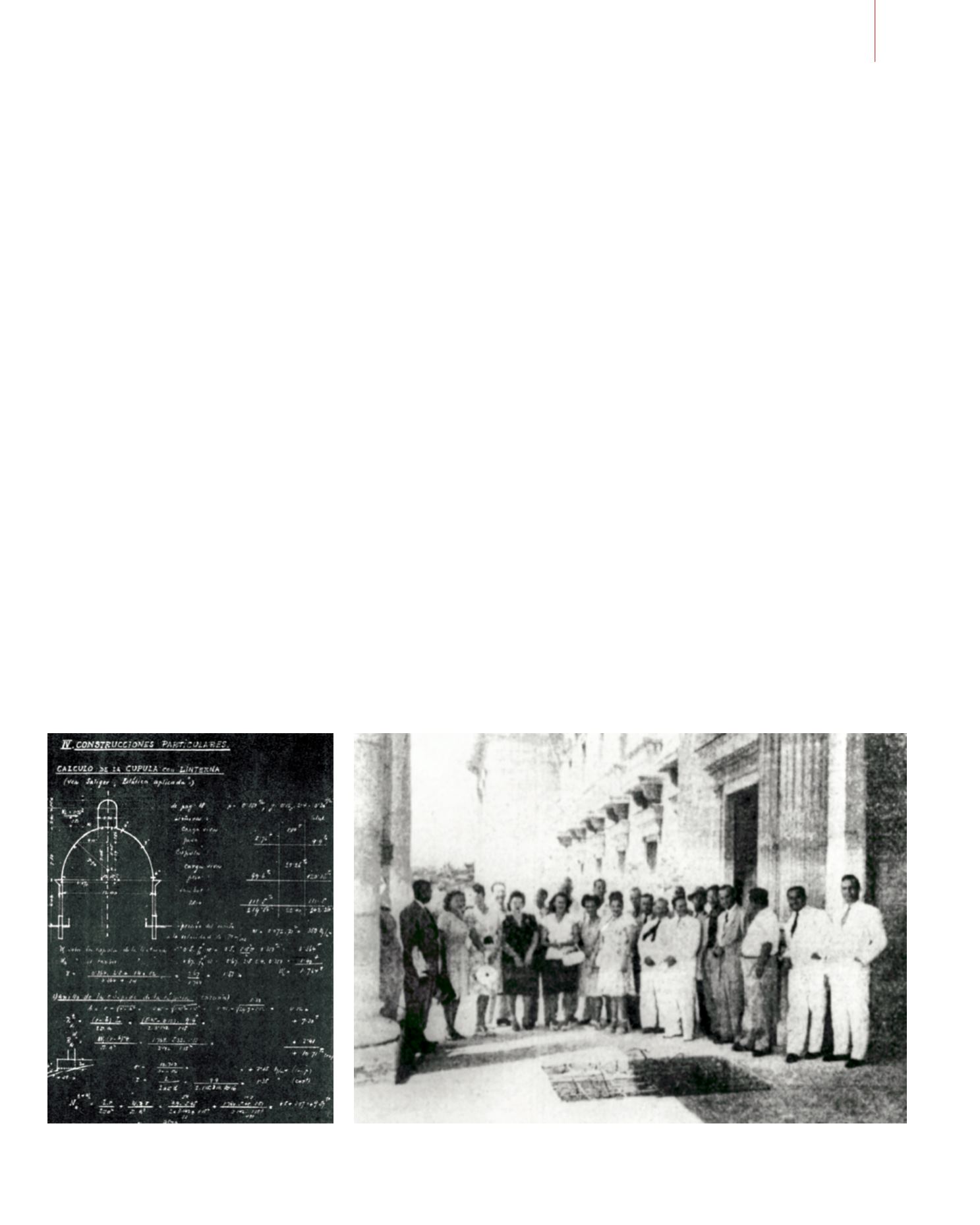
Diagram and partial
calculations of the
dome of the National
Palace.
© Collection of the
D’Alessandro Tavárez
family. Courtesy of José
Chez Checo
A group of engineers
from the ADIA
(Association
of Engineers
and Architects)
accompanied by
their spouses on a
visit to the Executive
Palace, while under
construction.
© Collection of the
D’Alessandro Tavárez
family. Courtesy of José
Chez Checo
THE ITALIAN ENGINEER GUIDO D’ALESSANDRO LOMBARDI