


 271 / 540

THE ITALIAN LEGACY IN THE DOMINICAN REPUBLIC
270
pleted by engineer José R. Báez López-Penha. The Edificio Copello building was unveiled,
and plans were drawn up for the authentic Hotel Jaragua, which was inaugurated in 1942
and demolished in 1985.
At Mercado Modelo (45 meters long and 72 meters deep), later known as “Modelo,”
11
bold sorts of canopies were used, which at the time was a complete technical innovation.
A central nave measuring 21.6 meters in height and 60 meters in width covered by a par-
abolic arch with two joints is the most significant feature of the complex. It also contains
two rectangular structures between two and three stories high flanked at its sides. Yet the
most important project in which D’Alessandro Lombardi would take part had not yet even
been drafted, though it was conceived in 1924. This was the National Palace, the seat of
the Government of the Dominican Republic, and the most important building erected in
the nation up until this time. Between 1939 and 1944, plans were created for the majestic
structure measuring 16,500 square meters. And in Brazil in 1943, the Brazilian architect
Oscar Niemeyer completed the impressive Church of Saint Francis of Assisi located in Belo
Horizonte.
12
It was clear that the advisers for the construction of the National Palace wanted to
unveil it in 1944, the year in which the plans were finally ready. That year would have pre-
sented the perfect occasion, because the centenary of the foundation of the Republic was
commemorated with incredible splendor. However, the global situation was worsening,
both economically and politically. Europe was experiencing the horrors of war, first with
the Spanish Civil War and then World War One. Meanwhile, in the Dominican Republic
and quite far from the warring parties, a building’s infrastructure was being created that adhered to the ide-
ological guidelines outlined by the apparatus of power controlling the destiny of the Dominican people. The
influence was drawn directly from Italian Fascism and German National Socialism, allies to the Spanish Fran-
coism of which the Trujillo regime was a fraternal and stringent adherent.
13
These formal, mass architectural plans employing a Monumentalist style proposed to dominate the urban
landscape, drawing on the excessive use of classical materials (for example, marble) and to create an imposing
presence. They were thus used politically for propagandistic purposes, while concurrently displaying social
and physical development and economic progress and enabling the Dominican Republic to produce a skyline
of diverse structures that were quite emblematic of its current state.
A considerable number of Spanish immigrants were arriving in the country, capitalizing on state protec-
tion measures that aimed to “elevate the culture” and “improve the nation” with a new type of ethnic miscege-
nation. This time the wave of immigrants included Jews, Lebanese, Spaniards, Italians and other nationalities
that were ethnically perceived as “white.” The immigrants arriving under these auspices were to remain in
the Dominican Republic and contribute through their work and ethnic diversity to the development of the
entire nation. Among them were Spaniards Tomás Auñón, who arrived in 1941 and created the design for the
monument commemorating the payment of the external debt or “Financial Independence” erected in 1942, as
well as Romualdo García Vera, who was born in Albacete in 1897 and created the Hotel Mercedes in the city
of Santiago de los Caballeros.
14
It was in this context that D’Alessandro Lombardi worked, drafting the plans
for the future National Palace that would eventually be erected on a plateau that was still bare at the beginning
of the twentieth century. It was located in the northwestern section of Santo Domingo, which was devoid of
growth. The wilderness at the beginning of the century came to visually dominate the entire landscape.
At that time, the promontory opened onto a bucolic horizon that was vaguely outlined by scarcely popu-
lated areas with makeshift homes covered in palm fronds and reddish-hued roofs topped for the most part with
gabled and hipped slopes. These were cut among the lush and thick wooded green area, which still remains
there today. By the end of the twentieth century, the outline of that ancestral Santo Domingo still blended
into the majestic clouds visible within the infinite depths of the sky where the eastern trade winds form. This
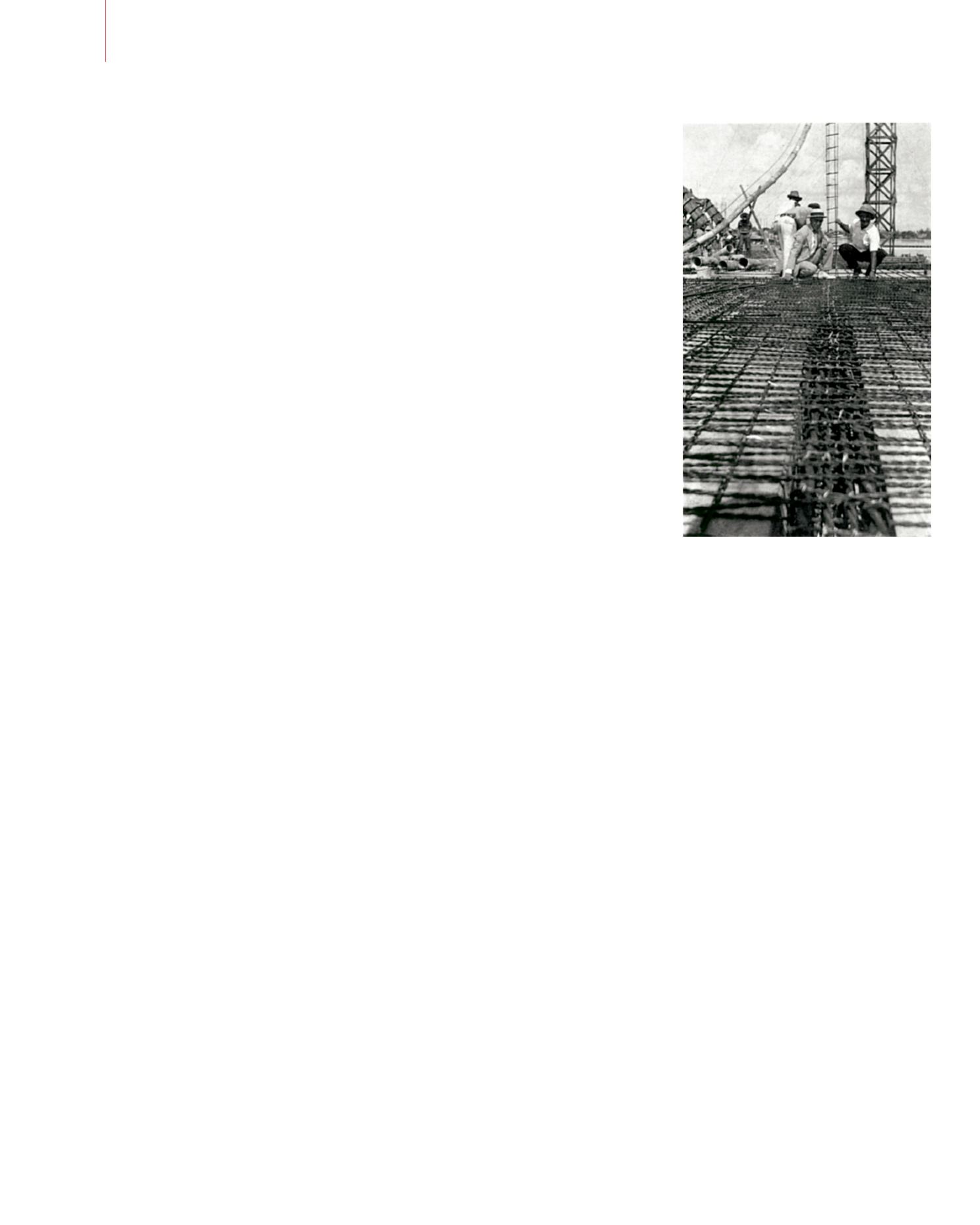
D’Alessandro (wearing
a jacket) and Gazón
Bona (wearing a white
shirt) on the market’s
flat roof.
© D’Alessandro Tavárez
family collection. Courtesy
of José Chez Checo
Opposite page:
Details on the National
Palace’s façade.
© Thiago da Cunha
View of the National
Palace’s dome and
external corridors.
© Thiago da Cunha