


 278 / 540

277
institutions, and government buildings) and the transportation infrastructure provided by the railroads, finally
afforded the luxury of formal and ideological representation of a framework symbolizing the end of the 19th
century. Yet these, too, continued to formally rely on models from European cities. Let us take as an example
the Consistorial Palace of Santiago de los Caballeros to understand the grandiloquence that was sought in the
symbolic representation of its architecture. Moreover, before Santo Domingo would even come to be seen
as a city on the rise, San Pedro de Macorís in the eastern region guided the nation’s progress and business
and commercial development along the paths of prosperity, which is evident in the construction and thus
architectural boom that took place there. It was only at the beginning of the 20th century that Santo Domin-
go assumed such leadership for the physical and urban development of the Dominican cities. Unlike these
interior cities mentioned above, the southern cities of Santo Domingo and San Pedro de Macorís were sup-
ported by maritime cabotage that allowed for a minimal level of exportation and importation. This, in turn,
unleashed an economic power that capitalized on the emergence of the sugar cane industry. As an exportable
good, it quickly became the fulcrum for the job development that drove progress for the next sixty years and
concentrated capital within these cities, polarizing economic growth
between the Cibao and the southeast.
In this context of environmental sustainability, the political appa-
ratus that fiercely governed the entire country strengthened its own
image through the use of formal architecture placed at the service of
the state. Supported by a demagogic effort that was consonant with
its nationalist spirit, yet contradictorily arose from his own military
training by the United States, Trujillo feigned humility. He also chose
to steer national destinies during the first years of his rule from an
outdated building inherited from the foundational center of the city.
It was a show of false modesty that capitalized on the stupor produced
by Hurricane San Zenon, which completely destroyed the city.
27
The
Presidential Mansion, the high point in the panoramic neighborhood
of Gazcue, must have experienced much of the fury from the weath-
er-related phenomena that pummeled the city only a few days after
brigadier Trujillo’s ascent to the presidency.
28
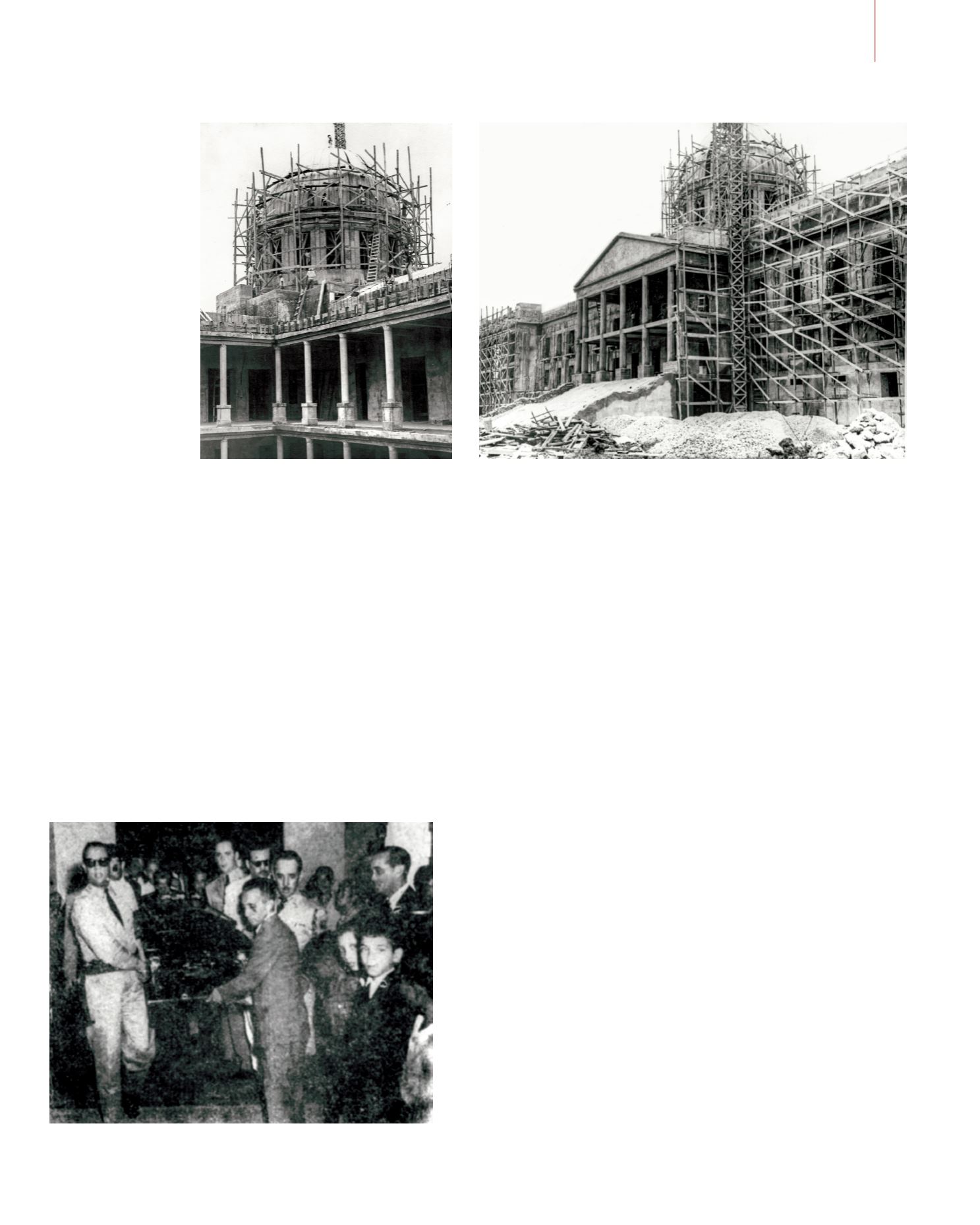
Details of the National
Palace’s dome during
construction.
© Collection of the
D’Alessandro Tavárez
family. Courtesy of José
Chez Checo
The burial of engineer
Guido D’Alessandro.
Shown is the point
at which the coffin is
being removed from
the church of San Juan
Bosco and is heading
toward the graveyard.
© Collection of the
D’Alessandro Tavárez
family. Courtesy of José
Chez Checo
THE ITALIAN ENGINEER GUIDO D’ALESSANDRO LOMBARDI