


 83 / 540

THE ITALIAN LEGACY IN THE DOMINICAN REPUBLIC
82
Bartolomé Bancalari, president of the city council of Samaná in 1893 and member of the literary and rec-
reational society Unión Samanés in 1887, was the owner of the first motor boat that sailed the bay of Samaná
at the beginning of the twentieth century, baptized the “Rosa Consuelo.”
Domingo Sangiovanni, established in Samaná in the last decade of the 19th century together with his
wife María Rosa Grisolía and their children Bonifacio, Paulino and Vicente, began as a traveling jeweler, an
occupation that he was already engaged in by 1896. In 1904, his sons founded the Hermanos Sangiovanni
establishment, an import-export enterprise. Of these, Paulino Sangiovanni was the owner of the first Samaná
ice factory and the Colón cinema.
The Caccavelli brothers held prominent positions at the local level: Marcos Aurelio was a parish priest;
Noel was deputy consul of France and Antonio served as a merchant. His nephew Francisco María (+1952),
a native of Ajaccio, Corsica, was the owner of the Vencedora lemonade, soda and liquor factory. He was the
father of Professor María Leticia Caccavelli Clark.
Finally, José Demorizi, also a Corsican, was founding councilor of the Sánchez community in 1886, while
his son General Evaristo Nicolás Demorizi Deloup (1850-1926) was president of the Samaná city council,
deputy, governor and Secretary of State for War and the Navy during the government of President Ulises
Heureaux. Our greatest historiographer, Emilio Rodríguez Demorizi,
98
is one of his descendants.
In the Santiago area, among the numerous social ties that intimately bind Italy and this city, we should
acknowledge the many contributions of industrious and enterprising Italian immigrants as one of the most
positive factors to influence Dominican history of foreign origin. Several cases merit particular attention: An-
gelo Rusterucci, pastor of the church of Nuestra Señora de la Altagracia,
99
was one of the principal overseers
in the construction of Parque Colón in 1892,
100
and in that same year served as a member of the Commission
for the celebration of the IV Centenary of the Discovery of America, together with Francisco Bloise.
101
The
resident Anselmo Copello, who is commemorated by a street in the La Joya sector, served as president of the
city council and director of the Recreation Center and the Compañía Anónima Tabacalera. He served as Do-
minican ambassador to Washington, D.C., and brought the first Cadillac “Super Six” model to the country in
1924.
102
Aquiles Zorda
103
was also a noteworthy figure, exceling as a poet, actor, and painter. Oreste Menicucci
Chiardini (1876-1950), a native of Fucecchio, Tuscany, contributed to Santiago’s architecture with his works in
granite and his prefabricated facades.
104
Aurelio and Salvador Cucurullo—the latter being the most visionary
foreigner to come to the country after Eugenio María de Hostos, according to Félix Evaristo Mejía
105
—natives
of Santa Domenica Talao, were esteemed educators. Their compatriot, Dr. Vicente Grisolía, was one of the
most outstanding surgeons to have practiced in this city. Another man from the same town, Vicente Anzelotti
Cosentino, was one of the founders of the Chamber of Commerce and Production in 1914.
106
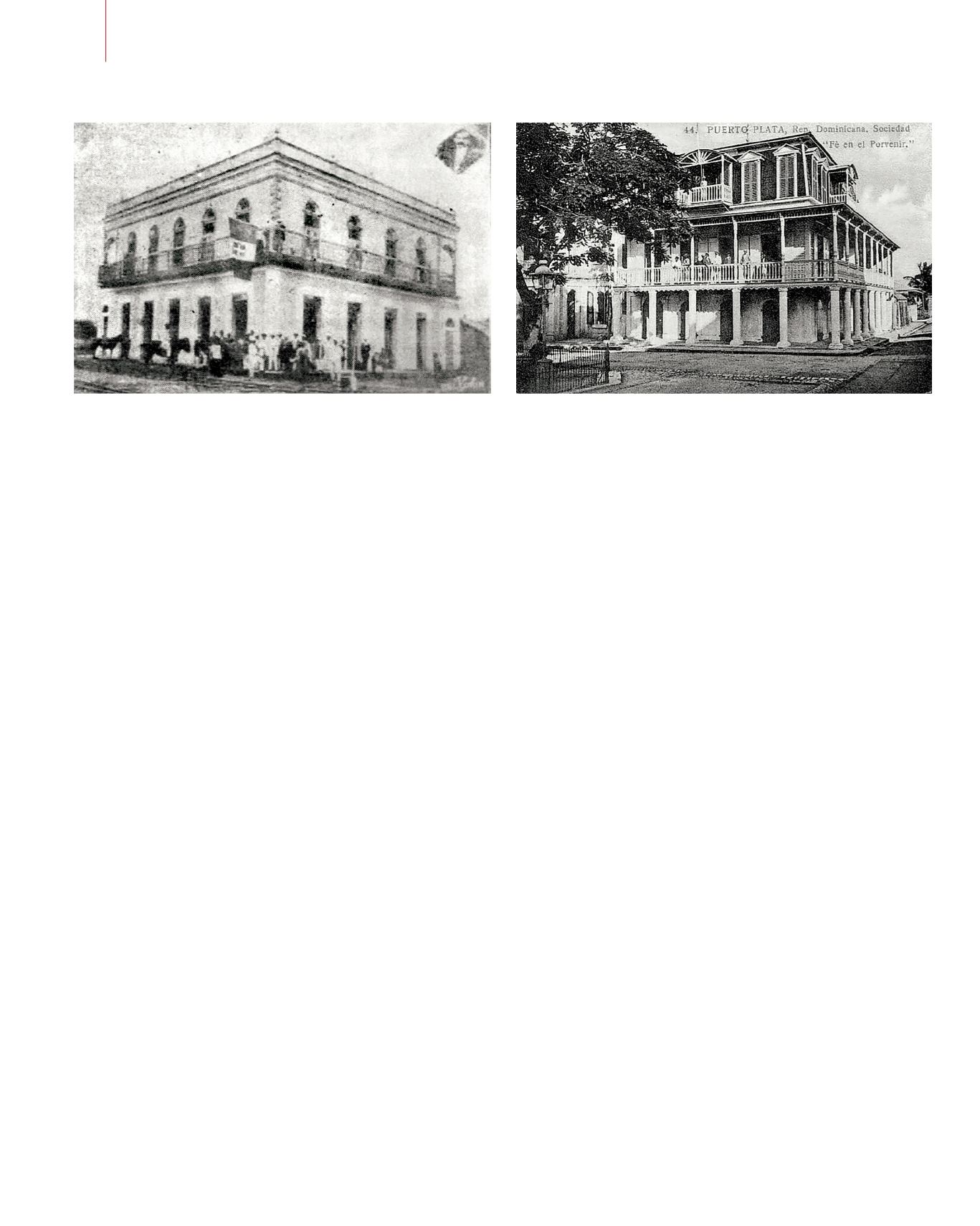
Enrique Sas-
Hotel Venecia, by
Gaetano Pellice.
© Edwin Espinal
The Faith in the
Future Society in
Puerto Plata, where
Isidoro Rainieri’s Hotel
del Comercio was
previously located.
© Edwin Espinal