


 79 / 540

THE ITALIAN LEGACY IN THE DOMINICAN REPUBLIC
78
There was also an Italian community in the province of Duarte. The city of San Francisco de Macorís was
home to various families, including the Negrettes, Simeolis,
72
Richettis, Finizolas and Sturlas. The Minervinos,
meanwhile, lived in Tenares.
73
In 1910 in San Francisco de Macorís, the Italian colony was formed by, among
others, Antonio Fabrasile, Vicente Malvarosa, Luis and Vicente Simeoli, Tomás Olivieri, Chichí Olivieri, José
Pugliese, Francisco Schiffino, Lázaro Finizola and Juan Canónico.
74
A grandson of Antonio Sturla, initially
based in Samaná and later in the city of Jaya, Amadeo Sturla Richetti (Mallín), went on to become a senator,
and his nephew Amadeo Conde Sturla died heroically in the Dominican Civil War (1965).
75
In Pimentel, we find Gaetano Pellice, owner of the Hotel Venecia, which he built in 1915,
76
whose build-
ing, known as “The Stone House,” was destroyed by the 1946 earthquake;
77
Luigi Bruno (1865-1917), born in
Santa Domenica Talao, who arrived in Puerto Plata in 1895 and husband of María Cino Senice (1874-1963),
whom he married in Italy;
78
and Alejandro Capobianco, husband of Angiolina Divanna Majolino, both natives
of Santa Domenica Talao, who settled there in 1914 with her son Silverio Capobianco Divanna (1902-1981),
the latter of whom later relocated to Puerto Plata.
79
Puerto Plata has the distinction of being the birthplace of the cinema in the Dominican Republic, due
to the Italian Francesco Grecco, who on August 27, 1900, projected eleven films from the Lumière broth-
ers, made between 1895 and 1899, at the Teatro Curiel. Grecco had acquired a projector and a camera
directly from the Lumières, and he traveled the Caribbean exhibiting his devices and his films over and
over again. The films were shown in Santiago, at the Teatro Palmer, in La Vega, and in Santo Domingo
at the Teatro La Republicana.
80
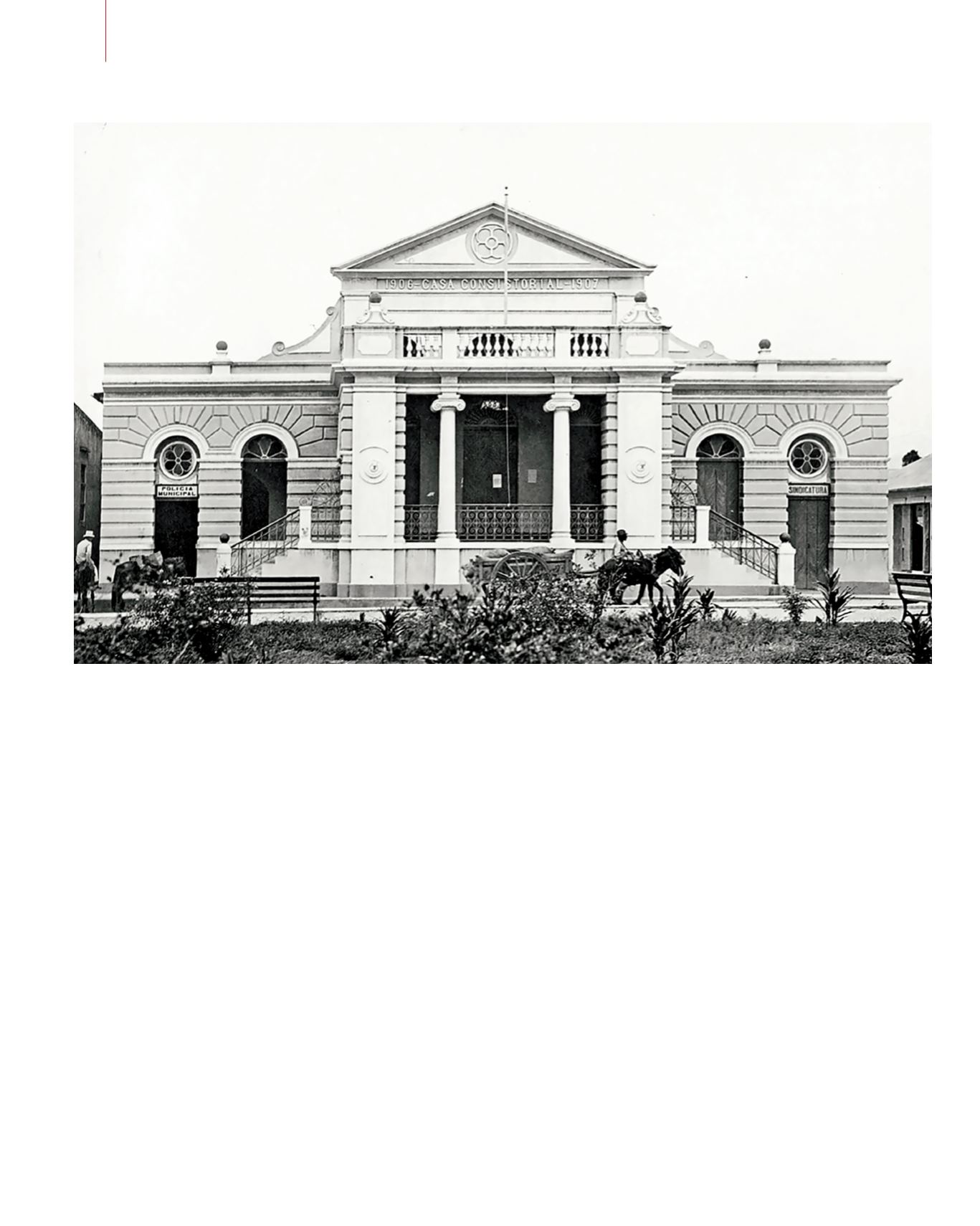
City Council of Moca,
built by the engineer
Alfredo Scaroina
Montuori.
© Edwin Espinal