


 82 / 540

81
from Santa Domenica Talao, Cosenza. He arrived together with his uncle Domingo Francisco Russo in 1908.
He first married Inmaculada Sangiovanni Russo in 1924, and in 1950, he married Zaida Carolina Bentz Castán
(1910-2000).
90
Nicolás Perrone León (1900-1986) settled in the Puerto Plata municipality of Altamira. Another native
from Santa Domenica Talao, Cosenza, he arrived in Puerto Plata in 1925 and married María Dolores Polanco,
with whom he had various children and grandchildren.
91
Finally, as regards Puerto Plata, it should be noted that the Puerto Rican grandchildren of the Milanese na-
tive Félix Spignolio Fasana
92
(1824 - 1888), Fernando Alberto and José Antonio Spignolio Mena,
93
participated
in the military defenses at Luperón in 1949 and Constanza, Maimón, and Estero Hondo in 1959,
94
respectively,
and that the painter Jaime Colson, a practitioner of pictorial modernism in the Dominican Republic, is “an heir
to the Italian Renaissance,” in the words of Marianne de Tolentino. The notable art critic recognizes the Italian
affinities of this master in his drawings and paintings, which evidence his admiration for Andrea del Castagno;
Benvenuto Cellini; Caravaggio; Filippo Lippi; Leonardo da Vinci, whose
Treatise on Painting
serves him as a
veritable bible; Michelangelo, his greatest inspiration in frescos; as well as Amadeo Modigliani, Giacometti and
Giorgio de Chirico.
95
Of course, we cannot ignore that in the Second Republic there was a place for Italy in the heart of a son
from Puerto Plata: Gregorio Luperón, the “First Sword of the Restoration,” rubbed shoulders in Europe with
the great Giuseppe Garibaldi.
96
At the dawn of the democratic opening after the death of Trujillo, a descendant of Italians, Carlos Juan
Grisolía Poloney (Grisco) (1914-2005), was elected senator of the province of Puerto Plata by the National
Civic Union in the elections held on December 20, 1962. Attorney General, deputy, municipal trustee and
provincial governor, he was the brother of the outstanding and brilliant Puerto Plata pianist Vicente Grisolía.
97
In Samaná, the Italian presence can be found in surnames such as Messina, Bancalari, Sangiovanni, Cac-
cavelli, and Demorizi. Pedro Messina Galleti, son of Angelo Messina and María Galleti, originally settled
in Sabana de la Mar, where he served as mayor. After moving to Samaná, he became the owner of the El
Limón plantation, the most important agricultural project on the peninsula, where he also specialized in the
production of cheese and butter. His son, Ángel María Messina Pimentel (1903-1967), was the founder in
1936, together with Dr. Edmon Sevez, of the Santa Bárbara clinic in Samaná. His sister Ana Messina Galleti
married the Lebanese immigrant Antonio José, who also settled initially in Sabana de la Mar and relocated
to Samaná in 1893.
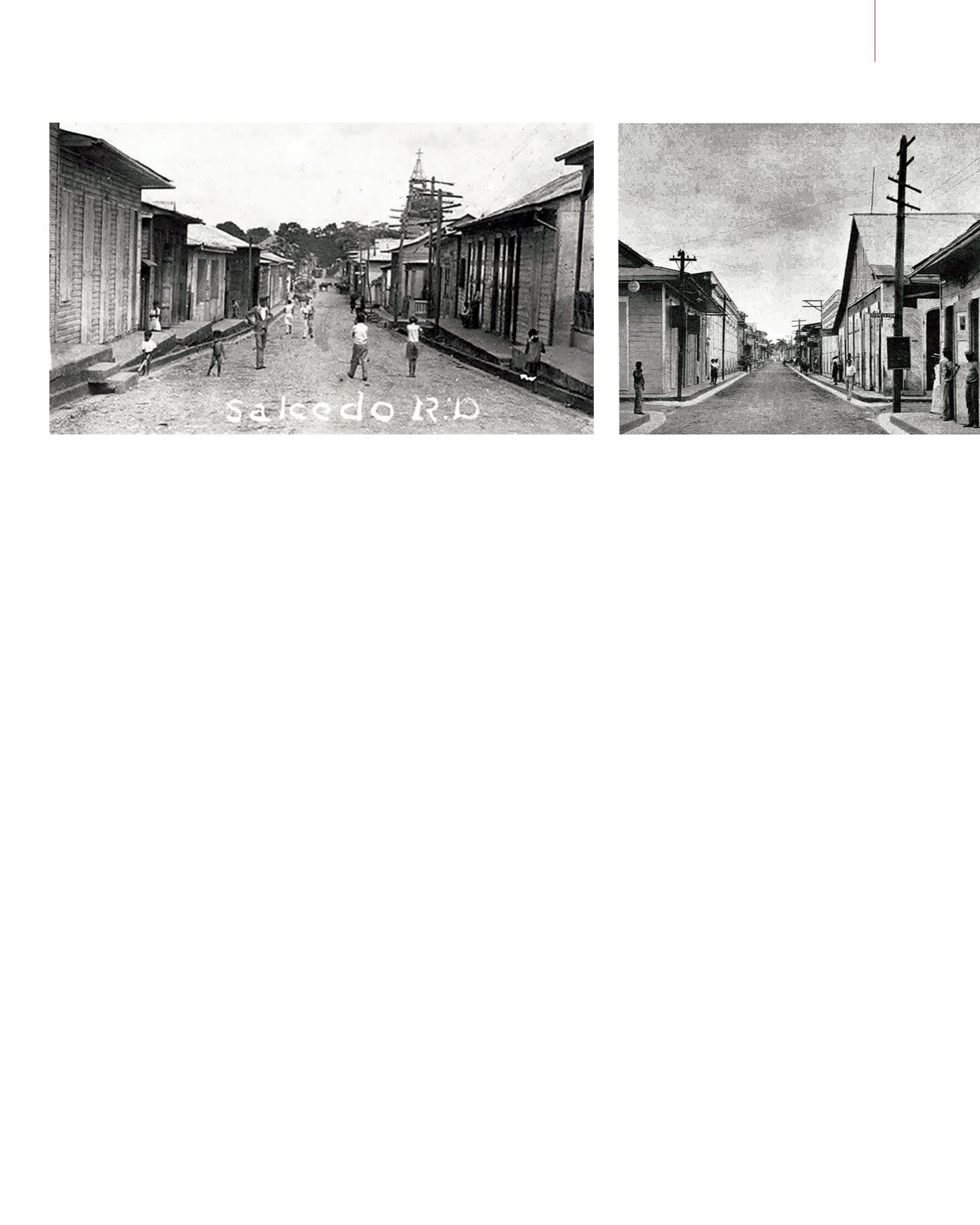
Doroteo Antonio Tapia
Street in Salcedo.
© Edwin Espinal
Corner of San
Francisco Street and
Santa Ana Street in
San Francisco de
Macorís.
© Edwin Espinal
THE ITALIAN PRESENCE IN THE CIBAO REGION AND IN SANTIAGO DE LOS CABALLEROS