


 81 / 540

THE ITALIAN LEGACY IN THE DOMINICAN REPUBLIC
80
Plata, in the three-story building belonging to the La Fe en el Porvenir Society. In the spring of 1908, after a
long sojourn in Europe with his wife and children, he went to Santiago to take over his new establishment,
the Hotel Rainieri, which he managed until his death in New York in 1912, where he had gone to deal with
health-related issues.
86
Several representatives of the Italian community contributed to the architecture of Puerto Plata, as was
the case with Juan Grisolía and Vicente Sarnelli, the former with the construction of a large residence and the
latter with a neoclassical building, works by the Spanish architect Martín Gallart y Canti.
87
Anselmo Copello,
a resident of Santiago of Ligurian ancestry, built a Prairie-style residence
88
in the second half of the 1930s. The
Teatro Curiel theater (later, the Teatro Municipal) showcased Italian theater companies that were touring the
country.
Two iconic Italian surnames in Puerto Plata are Sangiovanni, whose roots in the Dominican Republic
can be traced back to Juan Sangiovanni and Josefa Russo—natives of Santa Domenica Talao who settled in
Puerto Plata in 1919
89
—and Pappaterra, originally with the brothers Francisco, José Antonio and Fortunato
Pappaterra (1869 - 1957), natives of Santa Domenica Talao and sons of Blas Pappaterra and Angela Scaldaferri.
Francisco married Angela Domínguez; José Antonio entered into nuptials with Magdalena Sangiovanni; and
Fortunato married his countrywoman María Anunciata Bloise Depuglia (Santa Domenica Talao, November
12, 1882 - Puerto Plata, 1979), daughter of Ángel Bloise and Angiolina Depuglia. All three brothers had numer-
ous children and grandchildren.
Other Italian surnames in Puerto Plata include Russo, Divanna, Oliva, Conte, Villari, Ciriaco, Nardi, Nico-
demo, Vineli, Micheli, Saco, Dipino, and Capobianco. Another important Italian immigrant who settled in the
city, and who was considered the “dean” of the Italian community, was Blas Di Franco Russo (1896 - 2000),
Bust of Raffaele Ciferri
by sculptor Mario
Gatti. Inaugurated
on May 25, 1967,
it represents a
fundamental figure of
the Botanical Garden
of the University of
Pavia. A testament
to his ability to face
a difficult post-war
period and to set
in motion research
projects and the
current layout of the
structure. (Paolo
Cauzzi).
© Andrea Vierucci
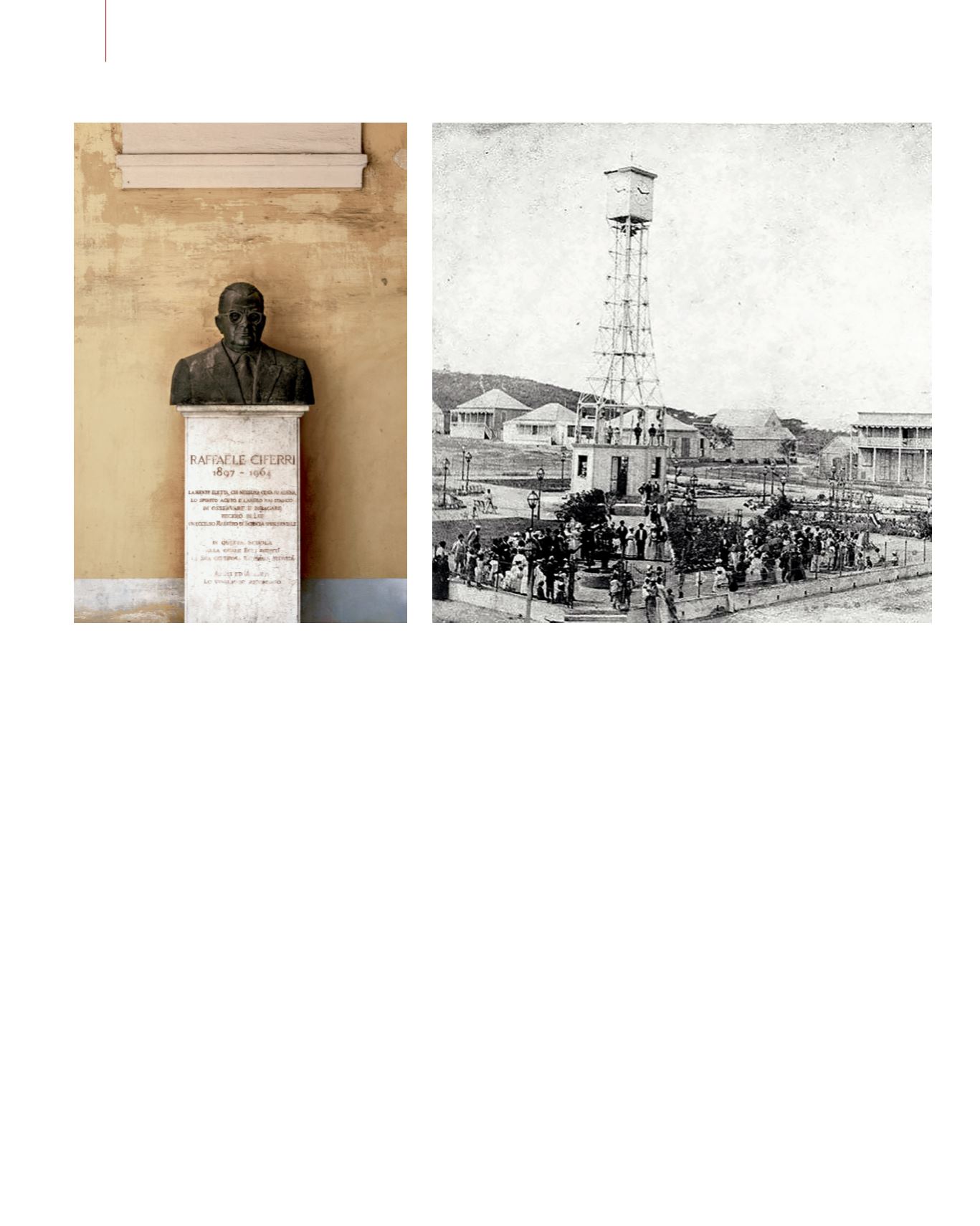
Duarte Park in
Montecristi, with its
emblematic clock.
© Edwin Espinal