


 86 / 540

85
years their number increased by only three.
121
As early as 1916, 49 Italians resided in Santiago of a total popu-
lation of 14,774 inhabitants.
122
The bulk of this immigration was predominantly composed of younger men
123
—of an average age below
30—from both inland towns and cities near the coast. Despite this elevated male percentage, we do find excep-
tions, as with the two immigrant siblings José Domingo and María Anunziata Bloise, children of Angel Bloise
and Angela Depuglia and natives of Santa Domenica Talao.
124
José Domingo married Lucía Margarita López
Fernández on October 14, 1906; María Anunziata married on August 17, 1905 with her native Fortunato Pap-
paterra Scaldaferri,
125
already mentioned.
Despite the immigrants’ largely rural origin, very few were engaged in agriculture. As far as we know,
only Rafael Biaggiotti (1857-1893), a native of Barga, settled and farmed in Gurabo,
126
where he married Rita
Adelaida Andreu. The main professional activity for these immigrants was commerce, although there were
several exceptions in the city: Sebastián Cestaro or Cestari,
127
musician; Pilade Stefani,
128
agricultural engineer
and surveyor; Salvador Cucurullo (1872-1926), professor at the normal schools for boys and girls, director of
the secondary school, professor at the Professional Institute, Provincial Mayor of Education, recipient of the
title of Adoptive Son of Santiago in 1917, and leading figure in the educational and cultural work of the city;
Ricardo Godeluppi, orchestra teacher, violinist, instrumentalist and music teacher;
129
and Angel Schiffino, a
native of Santa Domenica Talao, who although a merchant, also worked as a journalist and politician.
130
Other exceptions to the general professional profile of business were Garibaldi Campagna, a pharmacist at
the University of Naples and professor of pharmacy there, who filled prescriptions at Ulises Francisco Espaillat
Julia’s pharmacy in 1905;
131
Antonio Pagani, bookkeeper at the same establishment (d. 1905);
132
the physicians
Carlo Felipe (Félix) Cozza, from Santa Domenica Talao, authorized to practice medicine through a 1905 pres-
idential decree;
133
Vicente Grisolía, also from Santa Domenica Talao, a surgeon and graduate of the University
of Naples, who arrived in the country in 1911;
134
and Emmanuelle (Manuel) Senise, a Neapolitan, also a sur-
geon graduated from the University of Naples,
135
a former intern at the Maternidad de los Incurables clinic and
a specialist in obstetrics, gynecology and dermosyphilopathy.
136
Two of the more renowned figures in the field
of the visual arts were Oreste Menicucci and Hugo Pardi, natives of Livorno, Tuscany,
137
who used the Nardi
patronymic.
138
They were professional painters, portraitists, decorators, and gilders.
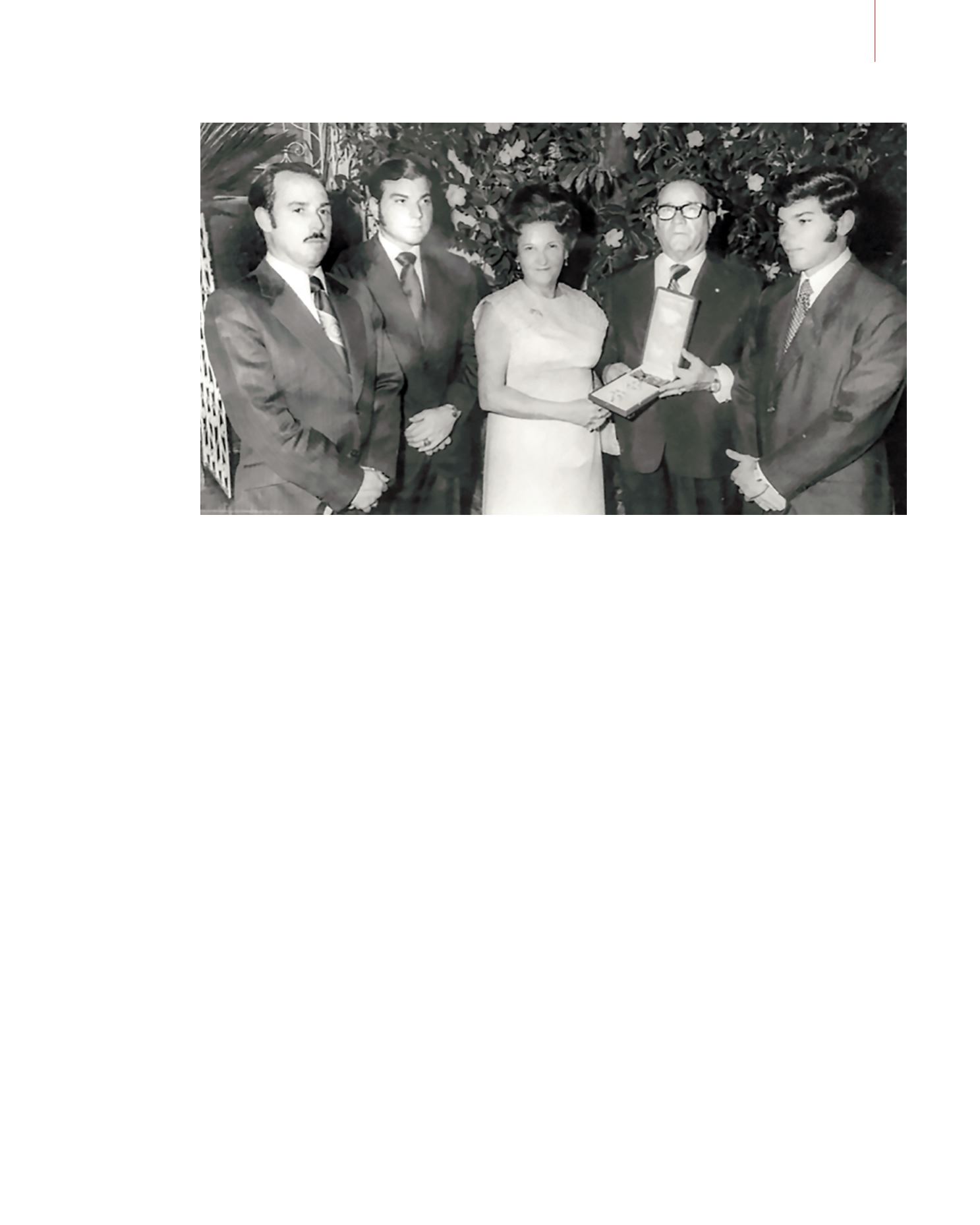
Queco Rainieri
Honorary Consul
of Italy in the
Dominican Republic
and his family when
he was conferred
the medal of
“Commendatore
dell’Ordine della
Stella d’Italia” at the
Italian Ambassador’s
Residence,
March 29, 1966.
© Rainieri Family
THE ITALIAN PRESENCE IN THE CIBAO REGION AND IN SANTIAGO DE LOS CABALLEROS