


 88 / 540

87
cessors continued the business under the name of “Pedro Russo Sucesores” until 1912, when it was absorbed
by “Miguel B. Perellada y Ca.,” with his widow, Gertrudis (Tula) Perellada, as a limited partner
170
but who left
for Banes, Cuba, with his children in 1913.
171
Grisolía, Cino & Cía., which appeared as a novelty establishment in 1904,
172
ceased operations in No-
vember 1905; its establishment was occupied by D.T. Russo y Ca.
173
The operations in Puerto Plata were
dissolved in 1908, due to the death of its partner Carlos Grisolía; the company “Cino Hermanos,”
174
owned
by Francisco y Angel Cino, took over the company’s assets and liabilities. In Santiago, the new house oper-
ated for some time in the Central Casino, until the Cino brothers decided to move to Puerto Plata,
175
closing
their operations in January 1909.
176
Another prominent establishment was Campagna Hermanos, owned
by the brothers Alberto, Luis and Aquiles Campagna Pezzotti, natives of Santa Domenica Talao; founded
around 1906, the company, which was located on the corner of Calle Comercio (today España) and Calle
Exconvento (General Cabrera),
177
supplied retailers in Tamboril, Moca, Salcedo, Mao, Jánico, and San José
de Las Matas.
178
The latter company sold—and possibly produced—Campagna rum, one of the best and
most popular rums in the city,
179
as well as Plá rum,
180
produced by Divanna, Grisolía and Plá, from Puerto
Plata.
181
Other noteworthy businesses include the shop of Domingo Francisco Russo Dipuglia, brother of
Pedro Russo, opened in 1905 on the corner of Calle Libertad and Calle Comercio
182
(today Máximo Gómez
and España), and which later moved to Calle Del Sol;
183
and the Hotel Garibaldi, established in 1907 by Luis
Schiffino
184
Perrone, also from Santa Domenica Talao, and which formed a regional hotel complex with the
Hotel Europa in Puerto Plata,
185
the Hotel Marconi in Moca (owned by the Schiffino brothers and which
opened its doors in 1909
186
), and the Hotel Italia in La Vega, across from the railway station and next to
the national post and telegraph office,
187
and owned by one of the brothers Peruccio,
188
who purchased the
Hotel Inglaterra in San Pedro de Macorís in 1913.
Also worth mentioning is a café-restaurant that would become iconic during an entire era in the city’s
history: El Edén, owned by Aquiles Campagna Pezzotti, who would also become the owner of the Hotel Gar-
ibaldi as a result of its acquisition from Luis Schiffino
189
before he left for Italy in mid-1915 to enroll in military
service with his brother Petruccio,
190
who lived in San Pedro de Macoris.
191
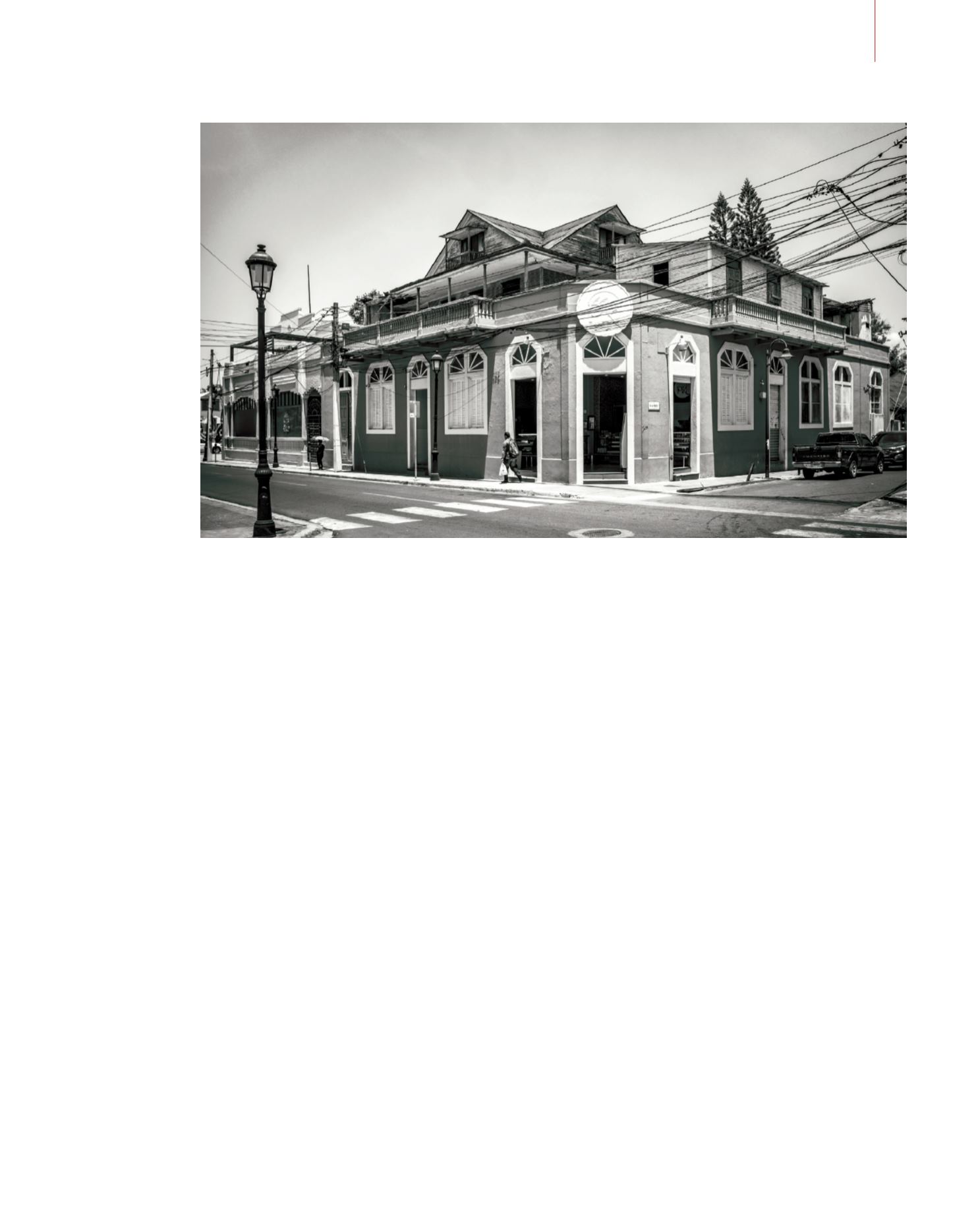
Campagna Pezzotti commissioned
Sarnelli Bakery of
Flor and Vicente
Sarnelli on the
corner of the Del Sol
Street and Benito
Monción Street in
Santiago.
© Edwin Espinal
THE ITALIAN PRESENCE IN THE CIBAO REGION AND IN SANTIAGO DE LOS CABALLEROS