


 89 / 540

THE ITALIAN LEGACY IN THE DOMINICAN REPUBLIC
88
the great architect José Casanova with the construction of this restaurant on the northern side of Calle Del
Sol
192
—across from the Hotel Garibaldi—in October 1916.
193
Classified as “the first of its kind in the entire re-
public,”
194
it was inaugurated on February 18, 1917, Carnival Sunday.
195
Because most of these immigrants did not have much capital, their finances and savings were tied directly
to the success of their businesses, which they began quite modestly, the evolution of which is evident from the
operating licenses under which they were classified. The cases of Vicente Anzelotti Cosentino (Santa Domen-
ica Talao, 1870 - Santiago, October 21, 1956
196
), Genaro Cantisano Limongi (Maratea, March 21, 1869 - Santia-
go, January 7, 1928), Anselmo Copello Ducassou (Saint Thomas, September 18, 1879 - Washington, December
9, 1944), and the brothers José (Vibonati, October 6, 1886 - Santiago, June 7, 1960) and Vicente (1898-1932)
Pugliese Giffone reveal their considerable rise from street-based marketing and small retail businesses to large,
consolidated operations.
197
Italian businesses focusing on import and export activities led to more European-oriented shifts in local
consumption habits with regard to food, beverages, and fashion among the urban population. The products
that they introduced included pasta, cheese, olives, olive oil, various sweets, canned fruits, wines, canned
goods, sausages, salchichón, and salami. Fashion accoutrements became more nuanced with contributions
such as Borsalino felt hats, sold by Vicente Anzelotti
198
at his establishment on the corner of Calle Comercio
and Calle General Cabrera.
199
The need to mitigate the difficulties of being uprooted and nostalgia for their homeland, combined with
other economic and social motivations, prompted many Italian immigrants to associate with their compatri-
ots. By 1900, an “Italia Unita” society was already in existence. In that year the society chose a new board of
directors composed of Salvador Cucurullo
200
as chairman; Enrique Ferroni, deputy chairman; José Antonio
Divanna, treasurer; Carlos Grisolía, auditor; and Francisco Schiffino, secretary.
201
As its name may indicate
(United Italy), it was principally devoted to the causes of mutual assistance and relief.
202
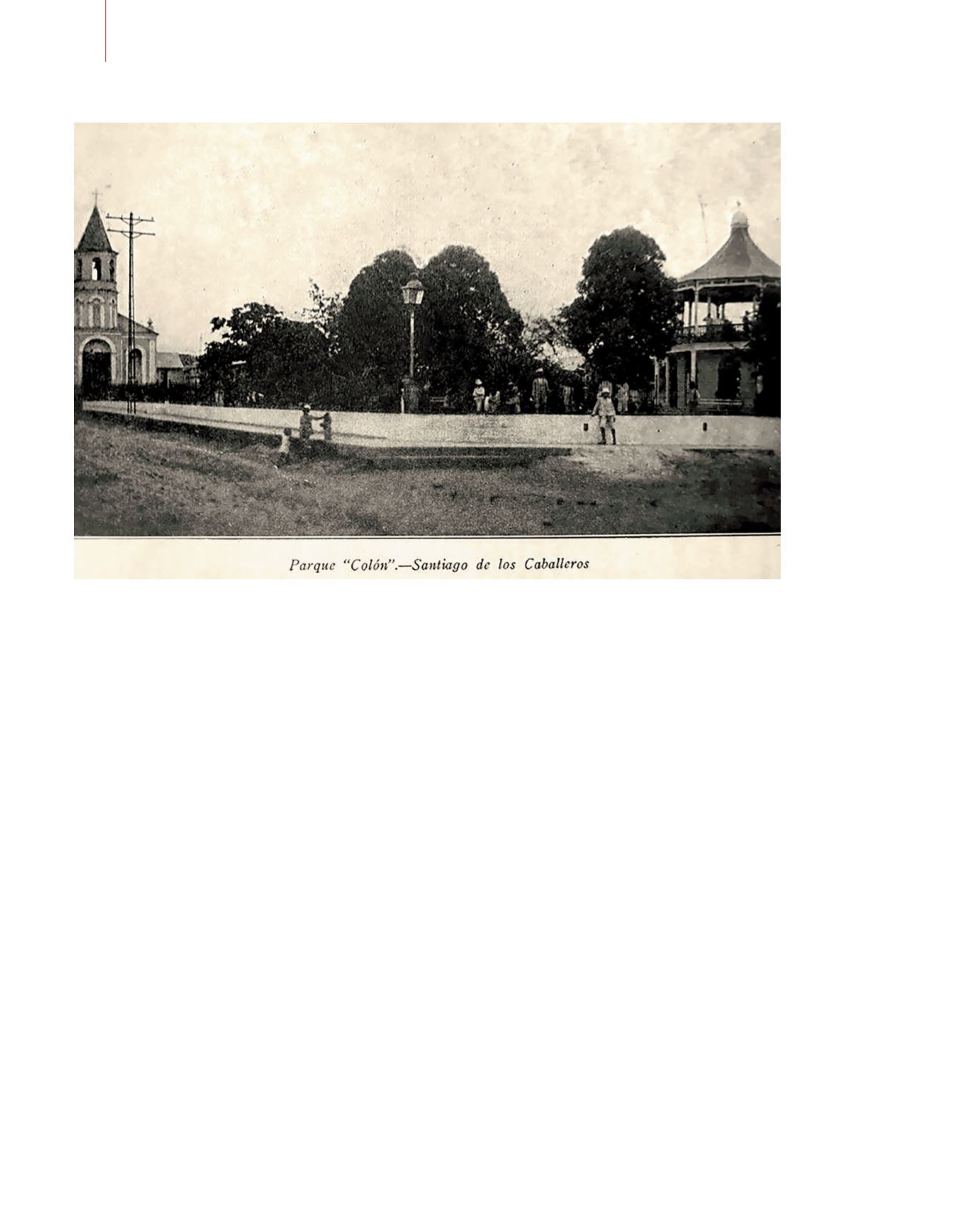
Parque Colón in
Santiago, created by
the efforts of Angelo
Rusterucci, the parish
priest of the church
of Nuestra Señora of
Altagracia.
© Edwin Espinal