


 78 / 540

77
followed by their first cousins Mariange-
la, Pedro Domingo, Francisco María Do-
mingo, María Josefa, and Anna Russo Di
Puglia, children of Pedro Carmelo Russo
and María Teresa Di Puglia, and Pedro
and Antonio Russo Latuffo, children of
Alejandro Russo and Filomena Latuffo.
Rafael Ciferri (1897 - 1964), born in
Fermo, Ascoli Piceno, taught at the Ag-
ricultural School in Moca, between 1925
and 1932. Considered one of the most
revolutionary mycologists in the world,
he was an esteemed professor of botani-
cal and forest centers in Alba, Pavia, Flor-
ence and Palermo. In the Dominican Re-
public, he focused on problems inherent
to plant pathology and the selection of
plants for use in agriculture.
59
He lived in
Quinigua and Santiago for a time, host-
ing the eminent Swedish botanist Erik Leonard Ekman from the time of his arrival in the country in 1929 until
his death in 1931.
60
In Montecristi, the business establishments of Lorenzo D’Aste, Orlando Pannocchia, and J.B. Richetti con-
tributed to the city’s economic development during the so-called Campeche Era.
61
Decades later, the engineer
Guido D’Alessandro Lombardi (Bovino, Foggia, 1895-Santo Domingo, 1954), who arrived in the country in
1927 motivated by the Italian consul to the Dominican Republic, Amadeo Barletta, designed the port facilities
for Ciudad del Morro. He also erected the Model Market on Avenida Mella in Santo Domingo (1944), and
designed the National Palace, seat of the Executive Branch, which was completed in 1947. He was married in
Montecristi in 1930 to Carmen Tavárez Mayer.
62
Also, in the Northwest Line, in Sabaneta, Father Pedro A. Acelli, native of Ajaccio, Corsica, who served his
parishioners for over 25 years, died in 1892.
63
The Bloise, Caputo, Forestieri, Pezzotti, Palamara, Trifilio, Schiffino, and Vigniero
64
families settled in
Salcedo, along with others of Italian descent, all of whom contributed to the economic development of that
municipality. Juan Rossi, the town’s first apothecary,
65
a resident of Santiago in 1863 as already mentioned, re-
located to Moca in 1871.
66
He was the great-grandfather of Porfirio Rubirosa Azira, a diplomat, race-car driver
and
bon vivant
. Meanwhile, Evaristo Pezzotti, who was employed as a pharmacist beginning in 1915,
67
became
the city’s alderman in 1919, as did Felice and Giuseppe Forestieri, who arrived via Puerto Plata from San
Nicola Arcella, Cosenza, for the first two decades of the twentieth century. The Forestieri brothers
68
and their
cousins Pietro and Vicenzo devoted themselves to the coffee and cacao trade.
69
Francisco Bloise, a merchant,
who initially settled in Santiago in 1879, moved to Salcedo in 1897, where he went on to serve as a council
member, vice president and president of the city council on several occasions; he also served as a member of
the construction board for the cemetery that was started in 1898.
70
Alejandro Vigniero established a power
company in 1927 along with Tobías Cabral and Porfirio Montes de Oca.
71
In Salcedo, the merchant Juan Bautista Bloise, son of Francisco and Filomena Bloise, was married at the
age of 20 on December 19, 1903 to Alejandrina del Carmen Guzmán from Moca, then 19 years old, daughter
of Ramón Guzmán and Felítica Veloz. They were the parents of twelve children: Francisco, Verónica Felcita,
Juan Bautista, María Filomena, Annia Francisca, Amada Concepción, Victorio Tomás, Yolanda Mercedes,
Juan Ramón, Giovanni, Dolores Ludovina, and Humberto Dante Bloise Guzmán.
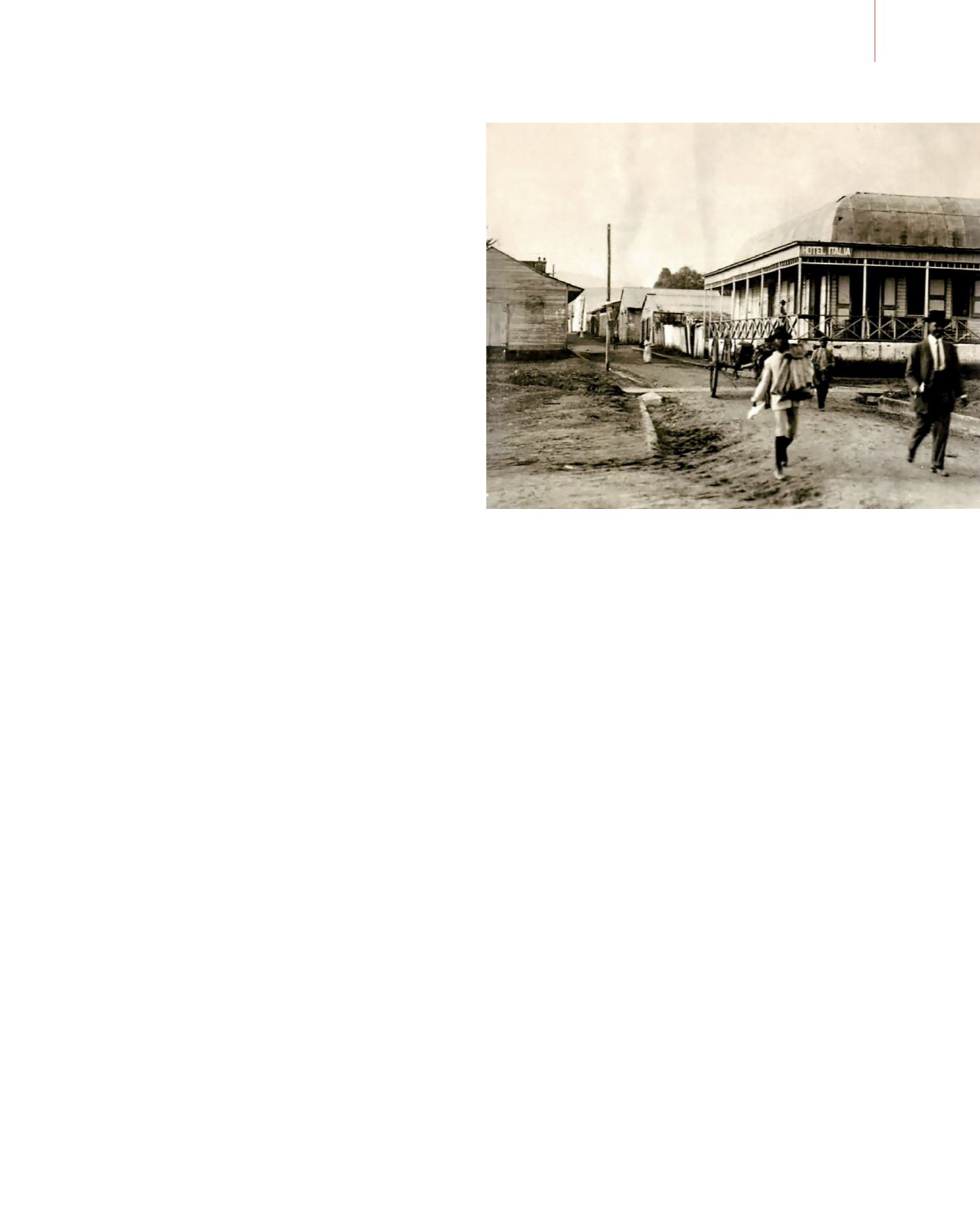
Hotel Italia, by
Petruccio Schiffino,
on the corner of
Núñez de Cáceres
and Duvergé Streets
in La Vega.
© Edwin Espinal
THE ITALIAN PRESENCE IN THE CIBAO REGION AND IN SANTIAGO DE LOS CABALLEROS