


 76 / 540

75
In the interior of the Dominican Republic, the Italian
presence was definitive at various points in history. In
the process of the development of various communities
and cities, we find a substantial contribution of various
Italians, who arrived mainly from the second half of the
nineteenth century onward. Regarding the Cibao re-
gion, however, most of the Italian migration began to
manifest itself from 1886 onward,
17
although there were
Italians beginning in the first half of the nineteenth cen-
tury. For example, on January 27, 1830, a wedding was
celebrated in the parish of Nuestra Señora del Rosario in
Moca, between Féliz Butin, son of Pablo Butin and María
Frirna, a native of Italy, and Manuela de la Cruz, daugh-
ter of Ignacio de la Cruz and Merchora Morel, and wid-
ower of Agustina Pérez.
18
This bit of information is very
interesting, because it leads us to the conclusion that the
Italian presence in the northern region is much older than previously thought.
In the case of Santiago, Juan Antonio Alix, in his tenth “El Niño de Atocha” (undated), refers to the impor-
tation by Italians of carvings of saints, a task in which they were already engaged “in the memory of Father
Solano,”
19
(in reference to the Fr. Domingo Antonio Solano, who died on May 20, 1862).
20
Juan Rossi
21
lived
in the city as early as 1863,
22
and by the 1870s and the first half of the 1880s, about twenty Italians had settled
there. Among the members of that group, we should mention Silvestre Pierri or Pieri (1870);
23
Víctor Merlano
(1877);
24
Esteban Piola (1878),
25
the founder of this important surname in the city; Cesare and Quilico Agostini
(1878);
26
Vittorio and Pilade Stefani (1878);
27
Sebastián Cestaro or Cestari (1881),
28
musician; Nicolás Francis-
co Buzzoni (1883);
29
Rafael Cardona (1883),
30
a peddler; José Farine (1883);
31
Leonardo Melfi (1883);
32
Ángel
Pellerano (1883);
33
Mateo Senise (1885);
34
Francisco Bacchiani (1885);
35
and Juan Fabiani, a priest from the city
of Naples who died in Guayubín on October 17, 1881.
36
Of these, Leonardo Melfi and Ángel Pellerano lived
in Altamira in 1883, before residing in Santiago. There they were donors for the construction of the Catholic
church that served this community.
37
The year 1879 marked the arrival of the person that could be referred to as the “patriarch” of the Italian
community, Francisco Bloise,
38
whose house was the deathbed of several compatriots
39
and refuge of oth-
er peasants who, working as traveling clothes salesmen, had arrived in Santiago for a few days.
40
Likewise,
Bloise’s business establishment served as a refuge for other compatriots.
41
Along with Santiago and Moca, La Vega, Monte Cristi, Salcedo, San Francisco de Macorís, Pimentel, Puer-
to Plata, and Samaná were noteworthy centers for Italian migrants. In La Vega and Santo Cerro, Fr. Giovanni
Francesco Fantino Falco (1867 - 1939), a Piedmontese from Borgo San Dalmazzo,
42
in the province of Cuneo,
is fondly remembered as a priest, and a monument to his memory was unveiled on January 11, 1998. He ini-
tially settled in San Pedro de Macorís at the end of 1899.
43
In La Vega he went on to found the San Sebastián
school (1903)
44
and the San Vicente de Paul children’s home and school, as well as the Padre Las Casas School
in Santo Cerro.
45
A descendant of Italians, and one of the earlier members of the Italian community in La Vega, Valentín
Piantini Blanchard (b. 1811) was the son of José Eugenio Piantini and Flora Blanchard. Piantini Blanchard mar-
ried Mariana de la Paz Núñez in that same city in 1841. At the end of the nineteenth century, the significant nu-
cleus of Italians in La Vega also included Alfredo Giuseppe Scaroina Montuori (1864 - 1950), who was born in
Avelino; Scaroina Montuori, a respected engineer and founding member of the La Vega and Santo Domingo
fire departments;
46
Luis Francisco Paonessa Cavalcanti (b. January 5, 1873), a native of Santa Domenica Talao;
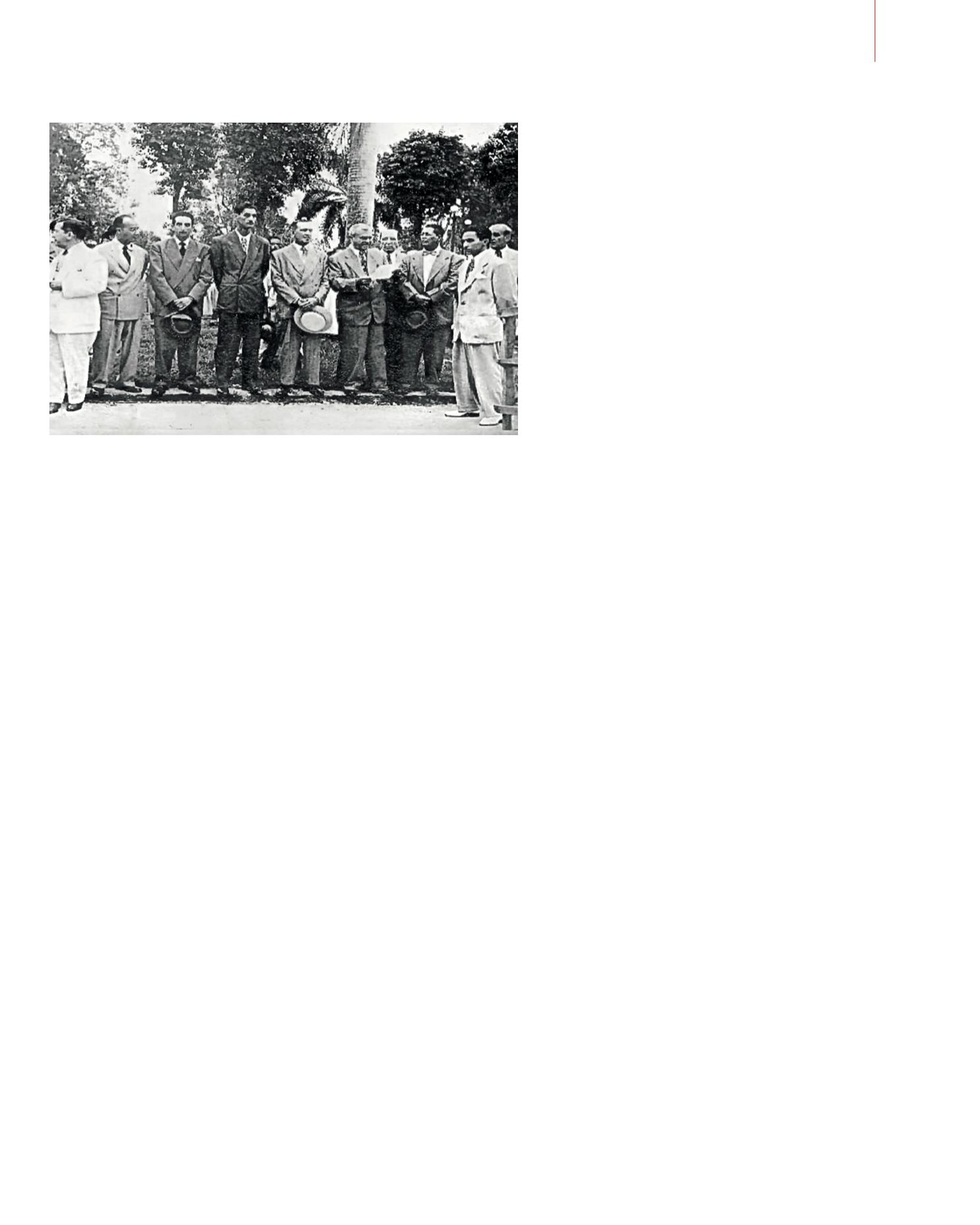
Giuseppe Russo
Cino delivers the
opening speech at
the inauguration of
the park dedicated
to Father Fantino
Falco in La Vega for
his philanthropic
endeavors in this city.
© Casa Mella Russo
THE ITALIAN PRESENCE IN THE CIBAO REGION AND IN SANTIAGO DE LOS CABALLEROS