


 420 / 540

419
Station. By 1927, some four hundred species of fungi found in the republic had been studied; and ten series
of bulletins had been published, prepared by Ciferri himself together with González Fragoso, covering some
three hundred species.
29
This self-imposed task was soon reflected in dozens of publications created in the
Republic and abroad; it culminated in one of his principal works,
Micoflora Domingensis
, published in 1929, and
on which he would continue to work until he published his integrated botany of the island’s fungi,
Mycoflora
domingensis integrata
, in 1961.
30
Report on Cacao
In 1928, Ciferri and his team completed their study of the cultivation and production of cacao in the Domin-
ican Republic. This fruit had a long history of cultivation and exportation beginning in colonial times, with
both highs and lows. In the early twentieth century cacao occupied a large number of cultivators, great and
small, as well as broad swaths of land in the main agricultural regions. Even apart from this, cacao was a crop
with high strategic importance to the country.
The report is representative of the type of research that was carried out by the staff at the Agronomic
Station and the College of Agriculture under Ciferri’s direction. The investigation took him to every region
that produced cacao, and comparisons demonstrated the poor quality of the cacao that was being produced, in
spite of the high potentiality of the Dominican product. As he sought the cause of the problem, Ciferri did not
limit his questioning to agricultural techniques, as others had commonly done, because the typical response
was to blame the low quality of the cacao and other produce on the ignorance of the
campesinos
. Ciferri went
deeper and found that the root cause was the commercial exploitation of the small farmer, who received no
incentive whatsoever and would thus end up responding to commercial demand by supplying cacao of infini-
tesimal quality, which was then more-or-less average for cacao of the Sánchez brand.
31
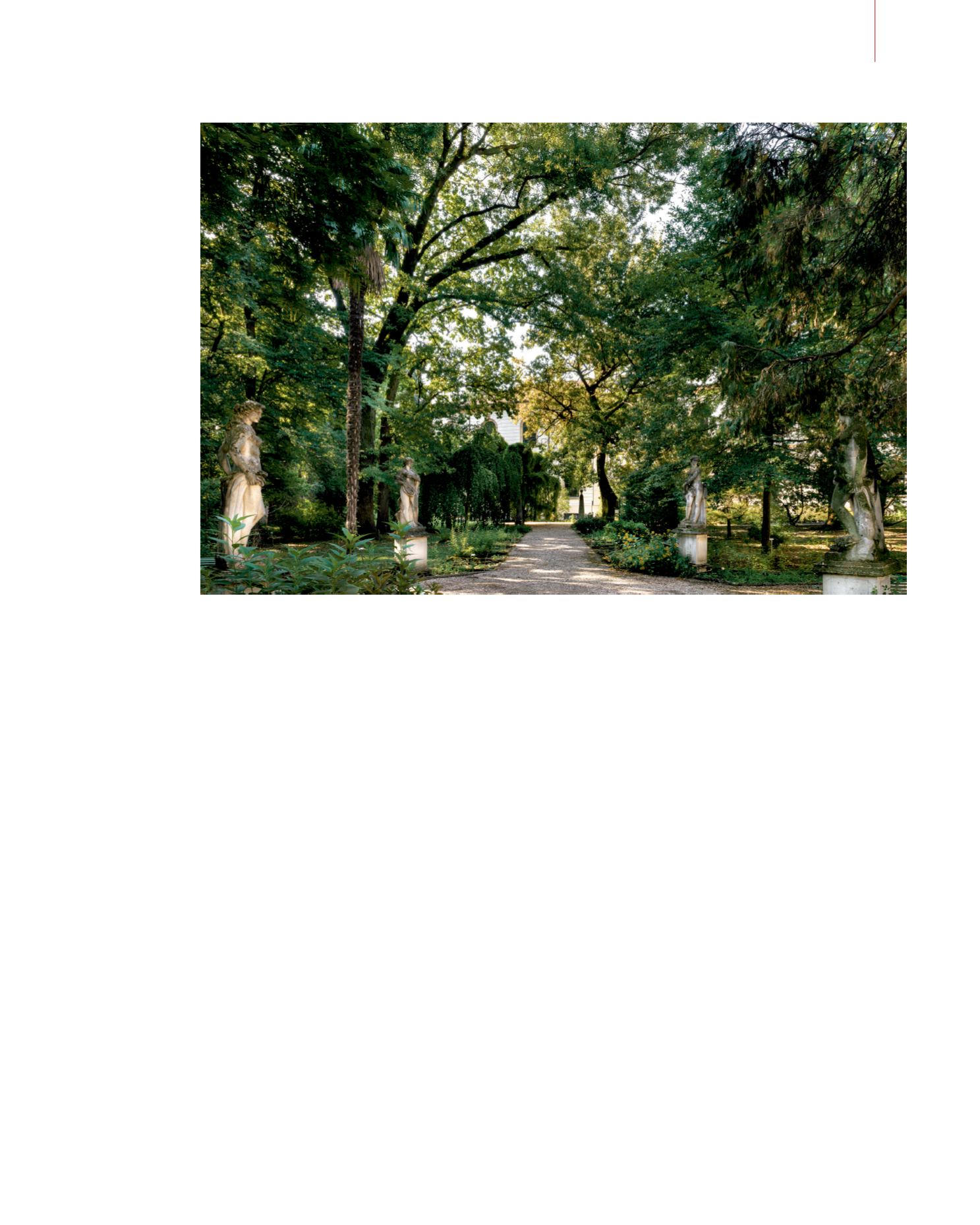
Quadrivio beneath
the arboretum
created by Raffaele
Ciferri: under his
direction, numerous
statues including
the four seasons
were introduced.
Underneath the
tall trees placed by
Ciferri, there are
flowerbeds and
botanical collections of
brushwood that flank
the main avenue which
leads to the Scopolian
greenhouses. The
arboretum established
by Ciferri extends
throughout the
area between the
departmental building
and the Scopoli
greenhouses. There
are several species,
and in this area one
can observe the great
diversity of shapes,
bearing, size, and
color of the main
trees. The current
setting was strongly
influenced by Ciferri
during the review of
the collections in the
post-war recovery
period, abandoning
a more formal
approach favored by
administration and
adopting a collection
of tree species more
favorable from a
scientific and popular
point of view and
suitable for a university
botanical garden.
(Paolo Cauzzi).
© Andrea Vierucci
DR. RAFFAELE CIFERRI’S CONTRIBUTIONS IN THE DOMINICAN REPUBLIC