


 422 / 540

421
graph; 5) Anemograph; 6) Mercury barometer for control. The establishment of this observatory would mark
the beginning of the work of measuring the cardinal data for “the principal arboreal and herbaceous plants
cultivated in the Cibao.”
Formation of Agricultural Professionals
The formation of these professionals was the main function of the College of Agriculture, which was also
directed by Dr. Raffaele Ciferri together with the National Agronomic Station. As has been shown, the body of
technicians at that Station also served as professors at the college; Ciferri, as director of the college, was mind-
ful of their continual education. The environment of investigation and of immersion in the problems related
to the nation’s crops as well as solutions, both proposed and experienced, was the context that was most con-
ducive to learning for these technicians in training. A library was created, as well as a document center with
dozens of issues of the principal professional journals specializing in the various branches of the agricultural
sciences, particularly tropical agriculture, which the college received in trade or by paid subscriptions. These
journals disseminated the most current and advanced knowledge available in the field.
33
Without a doubt, the
college provided the conditions that enabled its graduates to become acknowledged as technicians of the high-
est quality; to this must be added their training in personal ethics and in respect for nature.
Among other facilities, there was an agronomic experimentation field at the college, as well as an Acclima-
tization Garden for exotic plants, with a view to introducing into the country such new species of plants and
seeds as proved useful. These facilities were the scene of diverse tasks of importation, acclimatization, cultiva-
tion, and multiplication of the foreign plants, including ornamental plants and those that were to become part
of the Botanical Garden. These facilities were different from the nurseries at the station, where plants were
prepared to be distributed for planting. Some plants and cuttings were ornamental; others were forest species,
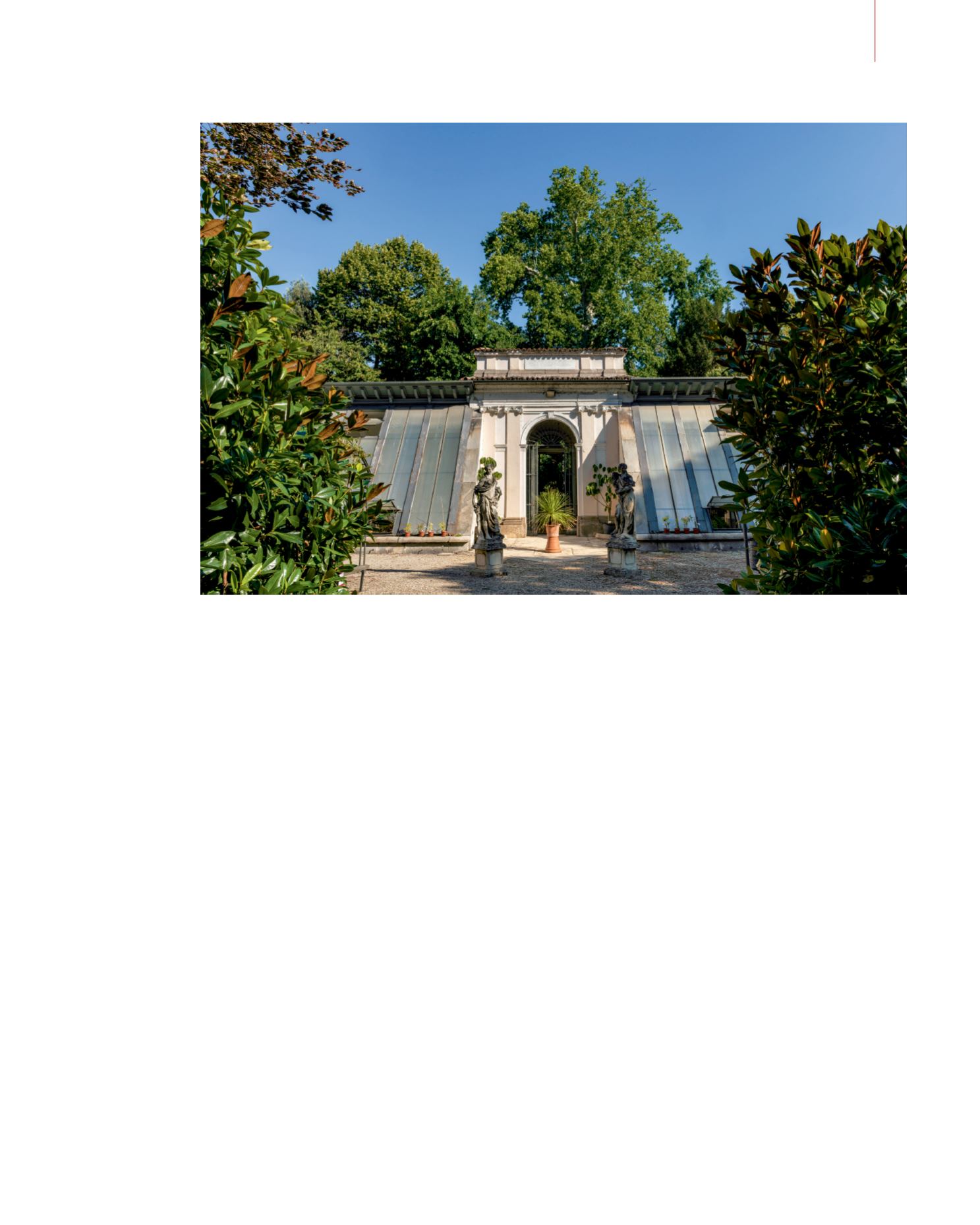
Scopoliane
Greenhouses: they
were designed by
Giuseppe Piermarini,
who was involved
at the time in
rehabilitation work at
the University of Pavia.
Construction began
in 1776 under the
direction of Valentino
Brusati. The building,
which was then only
in the planning stages,
was completed in
the following years
when Giovanni
Antonio Scopoli
became director of
the Botanical Garden.
It is a large straight
building with two
wings connected by a
central body. The two
wings (east and west)
were characterized
by large sloping glass
roofs facing south
and supported by
wooden frames.
The first building
was significantly
refurbished in the first
decades of the 19th
century: under the
direction of Domenico
Nocca, in fact, the
wooden structures
were completely
replaced by masonry,
stone, and iron. It was
Luigi Canonica who
was responsible for
the renovation, which
largely corresponds
to the current
greenhouse. (Paolo
Cauzzi)
© Andrea Vierucci
DR. RAFFAELE CIFERRI’S CONTRIBUTIONS IN THE DOMINICAN REPUBLIC