


 417 / 540

THE ITALIAN LEGACY IN THE DOMINICAN REPUBLIC
416
that this would be no easy task; it could not be resolved with a simple prohibition. The country needed the
forest and had enormous reserves that, it was argued, should be exploited for the sake of the development
of the republic (p.357).
The Forestry Section opened with a clear proposal to protect and a potent environmental consciousness.
Ciferri wrote in his report that “countries comprehend the value of their wooded lands only when they have
destroyed them; that is when, at great cost and sacrifice, they initiate a project of reconstruction of what they,
out of ignorance or greed, have destroyed” (p. 10).
The Dominican Republic has the good fortune, perhaps unique in the Caribbean, of possessing a
formidable forest reserve—formidable, but not infinite […]. This wealth has by no means been appre-
ciated, and much less cared for. Furthermore, it constitutes a mass that is almost completely unknown
economically.
Ciferri proposed the protection of “obligatory reserve” zones to be supervised by a specialist technician
from within the Secretariat of Agriculture and Immigration, a “chief of a Forestry Department, who would
be in charge of watching over the national wooded patrimony, in every sense, and particularly that of: 1) de-
limitation of the zones where clearing or leveling the land must be prohibited; 2) active repopulation where
necessary, supported expressly by government order; 3) recognition of the general forested zones and of the
potential for rational commercial exploitation, in reference to lumber and to subsidiary industries (extraction
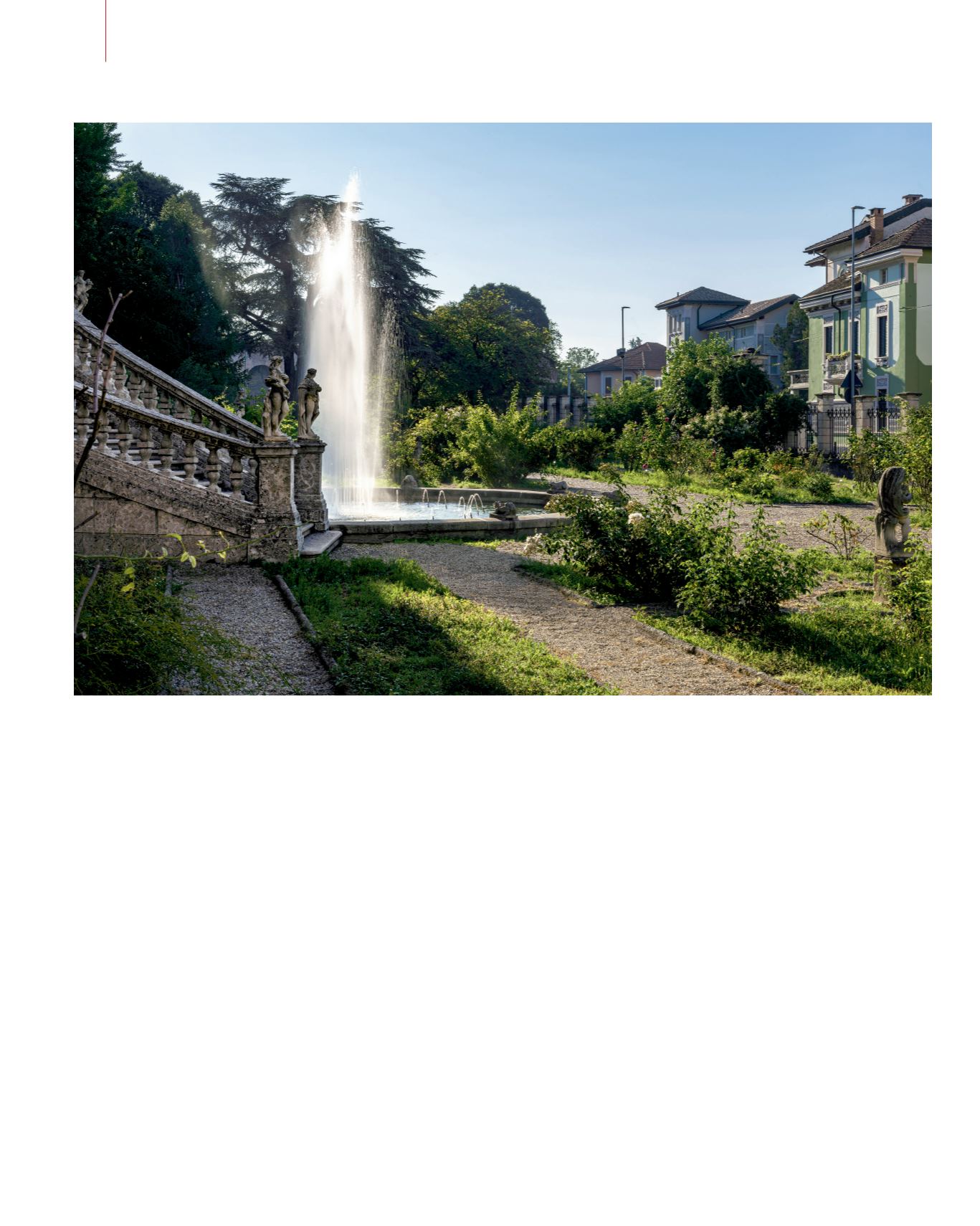
The great fountain
of the historic rose
garden. Under his
management (1942-
1964) Raffaele
Ciferri faced the
period of post-war
reconstruction, giving
the main façade of
the Botanical Garden
of the University
of Pavia (Sistema
Museale di Ateneo) its
current appearance:
he dismantled the
aquarium-house
built by Briosi and
built a monumental
semicircle staircase
that embraces the
large fountain. (Paolo
Cauzzi)
© Andrea Vierucci