


 413 / 540

THE ITALIAN LEGACY IN THE DOMINICAN REPUBLIC
412
It was a grand example of cooperation and teamwork
that also cast its light into national and international
scientific collaboration.
The members of the team that worked at the Na-
tional Agronomic Station and the College of Agricul-
ture in Moca include the following: Dr. A. E. Barthe,
agronomist, one of the veterans of the Department
of Agriculture, who replaced Dr. E. Razeto; Dr. E.
Balzarotti, chemist; Dr. M. Palacios, zootechnical
veterinarian; Dr. G. Russo, entomologist; Mrs. F. de
Cervantes, English professor; and many others. There
was also an expert staff working in the facilities and of-
fices, including F. O’Diot, teacher of crop cultivation;
J. Braun, manager of the Botanical Garden; J. Santos
M., Chemistry assistant; L. Quiñones, Entomology as-
sistant; E. Moltoni, ornithologist; R. Perdomo, agricul-
ture intern; J. Sochting, supervisor; G. Sanz, steward of
the College; P. A. Rojas and A. de Js. Brache, typists; J.
Caballero, mechanical electrician; and C. Rosis, driver.
A group of local and foreign collaborating scientists worked at continuing tasks; these include the presbyter
Miguel Fuertes y Lorens, Rafael Moscoso, Erik Ekman, Rafael A. Toro, and Romualdo González Fragoso.
Others collaborated in a variety of ways or on very specific projects: P. Radaelli, Rolando Martínez, the agron-
omist J. P. Duarte M., Andrés González, César A. Campos, Thomas Erickson, Mario E. Espaillat, Horacio A.
Read, Pedro A. Rojas, and Fabio A. Rojas, all of whom Ciferri mentions in the notes of acknowledgment that
he customarily included in his reports.
Publications
The
Revista de Agricultura
, published by the Secretary of State for Agriculture and Immigration, was the
most important organ of popularization and dissemination in the country. Publicized through its pages
were plans, projects, advertisements, and important notifications, such as the availability of farm imple-
ments, seeds, nursery plants, etc. There were also recommendations for dealing with plagues or diseases
affecting crops or livestock throughout the national territory. Articles from other latitudes, as well, were
reproduced in
Revista
’s pages, and farmers could read about a variety of subjects that might prove of inter-
est to them. These articles, however, formed a sort of mosaic or potpourri of agricultural information from
regions that might be very different from the tropics; the news could very well be copied from agricultural
services in Argentina or in the USA.
One of the earliest repercussions of the work of Ciferri and his scientific team of collaborators was the
change in agricultural publications. They were now refocused to support the Republic’s national plan for
agricultural development and to discuss the immediate problems that must be faced. When the Agronomic
Station and the College of Agriculture were established in Haina in 1925, the Secretariat of Agriculture and
Immigration announced the suspension until further notice of the
Revista de Agricultura
and the introduction
of the
Boletines Técnicos
(Technical Bulletins) of the school and station in Haina, now ready to function “in
every aspect.” Once the move to Moca was made, the station’s publication service included not only the bul-
letins but also educational fliers and posters to popularize the message. There were also logs, reports, studies,
and papers that appeared in publications—perhaps in the
Boletín
, perhaps in the form of books or pamphlets.
The
Revista de Agricultura
, in its editorial dated June 1925, stated:
Previous pages:
Agricultural landscape
of the Dominican
Republic. A rice field
during the rainy
weather.
© Photograph by Giovanni
Savino, donated by the
author
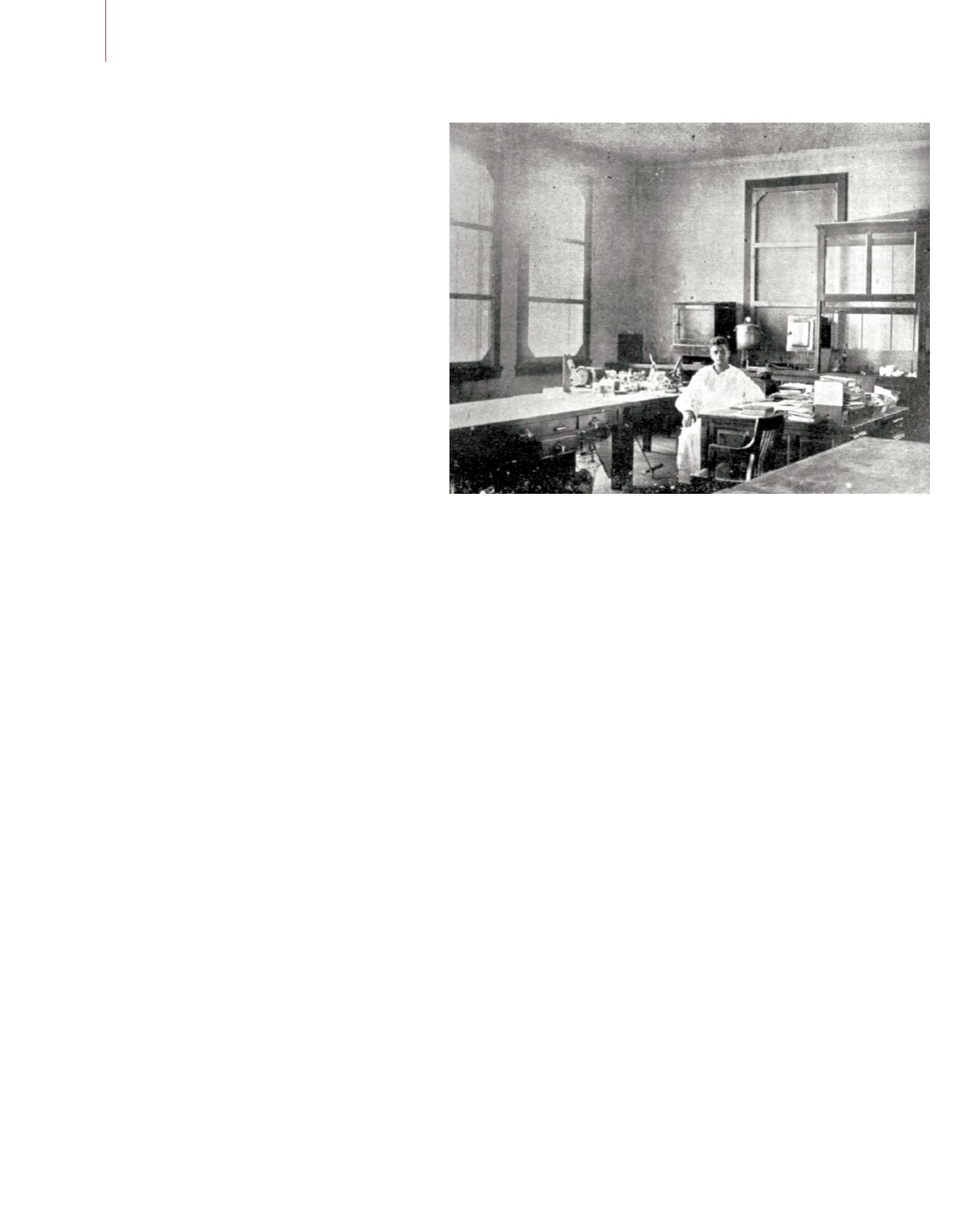
Dr. Raffaele Ciferri in
his laboratory at the
National Agronomical
Station. Moca,
Espaillat province,
around 1927.
© Archivo General de la
Nación