


 408 / 540

407
Republic of Arbor Day, with the objective of
promoting, in the schools and in the society,
love for and conservation of our flora.”
12
4. Creation and demarcation of the Yaque Re-
serve, in conformity with “the initiative that
Dr. Juan Bautista Pérez Rancier had set in mo-
tion in 1919 for the delimitation of the Yaque
Reserve,” which initiative “was later joined by
Dr. Miguel Canela y Lázaro, in his capacity as
surveyor.” In 1926, the Vásquez administration
allocated funds with which land surrounding
the headwaters of the Yaque River was to be
acquired.
5. A government program of agricultural col-
onization, which “collided in some cases with
regulatory provisions of the forestry law” and
caused one of the so-called state ambivalences
in the program, since “the Forests and Waters
Act of 1928 eliminated the forest reserves in the
country’s principal mountain ranges envisaged
in the rescinded Executive Order 586 of 1919.”
13
Rafael Armando Espaillat, who served as Secre-
tary of Agriculture in the Vásquez administration,
was the one responsible for inviting Dr. Ciferri to the Dominican Republic and for outlining, with Ciferri, a
new rural development plan for the nation. An overview of this plan appears in the
Memoria
(the government’s
official log or annals) for 1927 of the Secretary of Agriculture and Immigration. Some relevant aspects of
the Ciferri plan are: a) Popularization of modern scientific principles; b) School of Agriculture, Experiences,
Demonstrations; c) Rigorous inspection of fruits for export to guarantee the quality of our produce and raise
its prestige in the exterior; d) Measures to promote cleanliness of the produce; e) Precautionary measures for
growing healthy plants; f ) Creation of the Agricultural Statistics agency; g) Body of technical consultants; h)
Office of Information and Dissemination; i) Campaign for seed selection; j) Improvement of our livestock; k)
Enrichment of our fauna and flora; l) Creation of the Botanical Garden; m) Creation of parks for the conser-
vation of our autochthonous flora; n) Reforestation and defense of forests; o) Extension of the Meteorological
Service; p) Conservation of forests in hydrographic basins; q) Creation of the Jarabacoa National Park; and r)
Botanical, geological, and mineralogical studies. Even the lesser points of the program—such as agricultural
colonization, the formation of scattered
campesino
villages, an increase in national production, the opening
of secondary roads, irrigation of populated arid regions, the introduction of new crops, the creation of agri-
cultural cooperatives, rural property guarantees—received a positive impact from the scientific development
program, defined and applied by means of the national Agronomic Station and the College of Agriculture.
Only 28 years old, Ciferri came to the Dominican Republic by way of Cuba, where he had arrived to
work at the Agricultural Experimental Station in Santiago de las Vegas.
14
The Cuban institution was under
the direction of U.S. agronomist Dr. Josiah T. Crawley, a sugar expert, who had worked at the Louisiana
Experiment Station and the Audubon Sugar Institute affiliated with Louisiana State University, where many
young Cubans interested in sugarcane agriculture went to study. Crawley had a pragmatic view of educa-
tion in agronomic sciences, for which cause he had recommended since 1907 the creation in Cuba of “a
College of Higher Learning in Agriculture and the Mechanical Arts, situated in a rural area, with sufficient
DR. RAFFAELE CIFERRI’S CONTRIBUTIONS IN THE DOMINICAN REPUBLIC
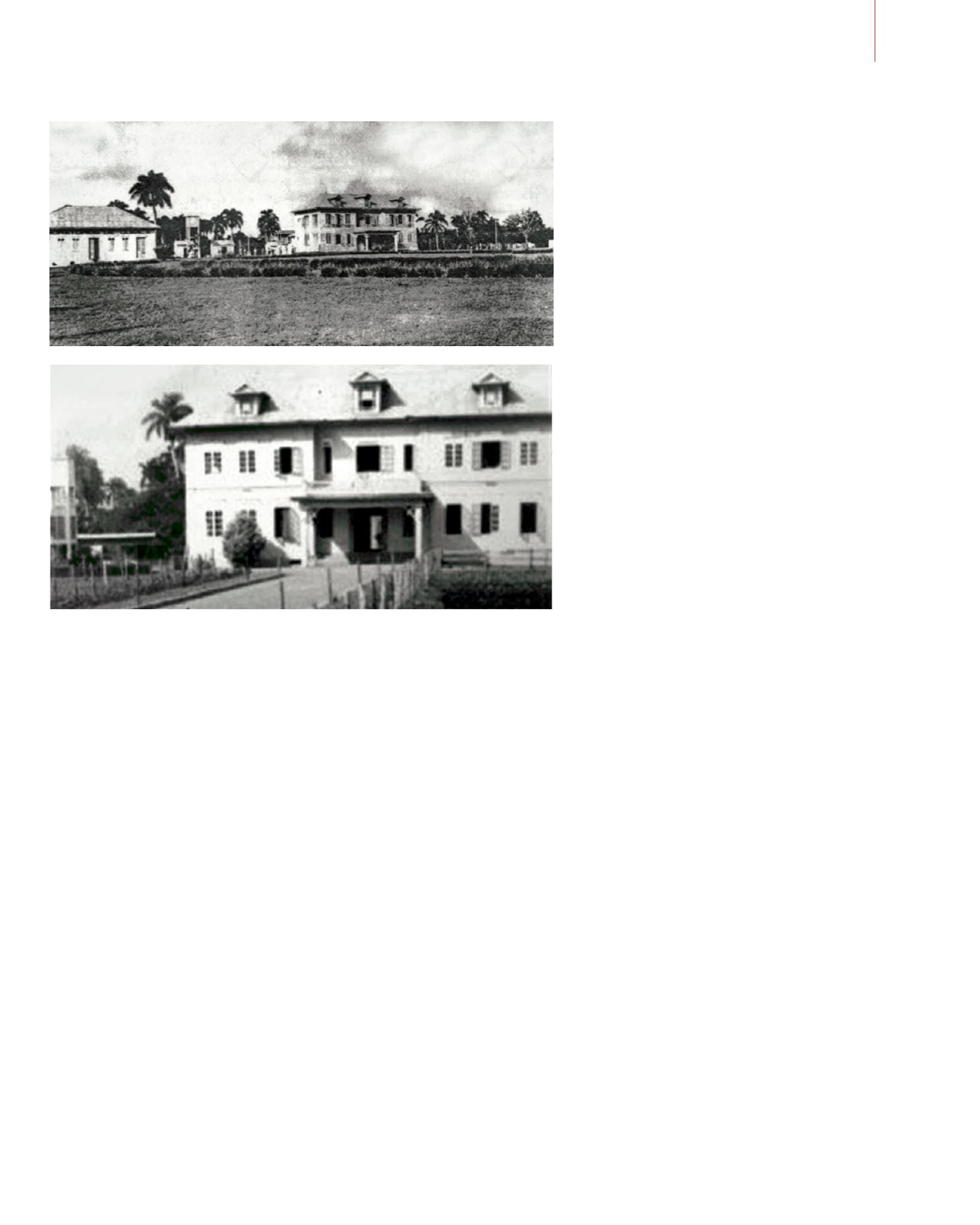
The Agricultural
School of Moca,
where Dr. Raffaele
Ciferri worked.
© Archivo General
de la Nación. Courtesy
of Edwin Espinal