


 409 / 540

THE ITALIAN LEGACY IN THE DOMINICAN REPUBLIC
408
land for the purpose of demonstration, with its own buildings, laboratories, and workshops,”
15
like the one
in his native country.
In accordance with common practice among scientists, Ciferri kept in touch with members of this corre-
sponding center in Cuba and strengthened ties of communication and collaboration among these and other
institutes in the region, as well as in North America and Europe. Ciferri’s work in the Dominican Republic
began in 1925 and concluded in 1932. He was hired by the Dominican government to activate and direct the
first station for agronomic studies. This center would teach and train experts in the subject who would further
the country’s agricultural development. Ciferri arrived in Santo Domingo
16
accompanied by a work team con-
sisting of three other young scientists: Dr. Osvaldo Arrocha, a Cuban veterinarian; Dr. Enrico Balzarotti, an
Italian chemist; and Dr. Enea Razeto, an Italian agronomist.
Ciferri’s work, however, fulfilled and transcended these objectives. Under his direction, the agronomic sta-
tion and college in Haina (San Cristóbal province) was transferred to Moca (Espaillat province), a much more
suitable location in the Cibao, the agricultural region par excellence of the Dominican Republic. With the
approval of Agriculture Secretary Espaillat, Ciferri established in Moca a scientific and technical complex, un-
precedented at that time, for research and the formation of professionals in agricultural development. Within
a short time, the intense labor of the two institutes produced incomparable advancement in the development
of natural sciences in the Republic.
As discussed above, the first establishment in Haina was the tardy product of the U.S. military intervention
that took up the plan outlined in 1910 by Cáceres to establish agricultural farm schools. Years later, the new
director needed just a few months to revive the Station in Haina as well as the College, in addition to acquiring
all the equipment that was necessary for the purpose at hand. The following year the operation was moved
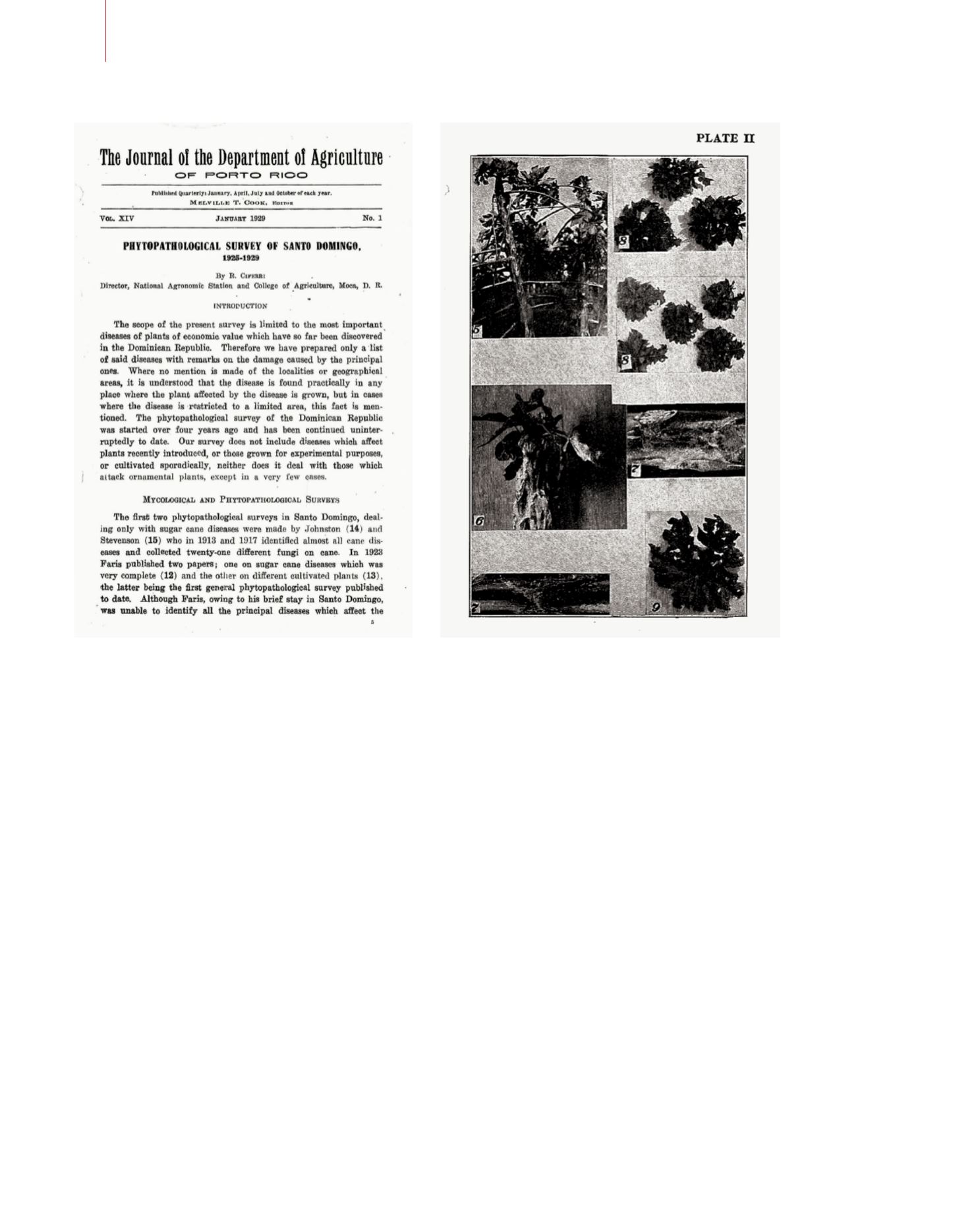
First page of the article
“Phytopathological
Survey of Santo
Domingo, 1925-
1929” by Dr. Raffaele
Ciferri published
in the
Journal of
the Agriculture
Department of Puerto
Rico,
January 1959.
© Archivo General de la
Nación
Samples of papaya
leaves as published
in the article by
Dr. Raffaele Ciferri
“Phytopathological
Survey of Santo
Domingo, 1925-
1929,” featured
in the
Journal of
the Agriculture
Department of Puerto
Rico
, January 1959.
© Archivo General de la
Nación