



 415 / 540

THE ITALIAN LEGACY IN THE DOMINICAN REPUBLIC
414
Collection of dried plants
, consisting of samples brought from all
parts of the country.
Entomological Collection
, consisting of insects collected in all
parts of the country and displayed in 50 boxes and 40 jars.
All of the collections required special care to prevent mildew and
other damage caused by tropical humidity. Each collection had specific
functions that were often interrelated. For example, a beetle from the
entomological collection might be associated with a plant part where
the beetle had produced a certain type of damage in the phytopatho-
logic collection; something similar might occur with the ornithologi-
cal and ichthyologic collection, since both plants and waters may be
affected by birds and fish. It is therefore understandable that these col-
lections grow day by day, changing with the rhythm of contributions,
consultations, research tasks, and interchanges at the Station.
One example of early and important collaboration and scientific exchange occurred in the year under dis-
cussion, 1926. The mycological collection received in trade (for another collection of fungi of the same group
that was sent out from here) a collection of Torulopsis (Candida), a reddish pigment sent from the American
Type Culture Collection, adjunct to the John McCormick Institute for Infectious Diseases in Chicago. The
samples were placed under study at the Station in Moca with the collaboration of Professor P. Redaelli.
The Botanical Garden was part of the scientific complex of the National Station and the College as a com-
ponent for teaching and research. It was designed to have five sections in which the principal native flora as
well as exotic plants could be grouped according to species.
Phytopathologic Laboratory
It can be said unequivocally that the activation of this laboratory and the others at the National Agronomic
Station represented a milestone in Dominican agriculture, with the inception of systematic knowledge of crop
diseases as well as the population of plants and trees in the country. If empirical practices were not immedi-
ately eradicated, at least a principle of scientific collaboration was established to determine the most effective
and efficient means to cure such diseases. That in itself signifies a radical change from the previous approach.
This task was ardently assumed by Ciferri himself, who related that in 1927 he had observed and placed un-
der investigation diseases of Orange blossom (leaf spots), Sweet potato (white blight), Cacao (mold, mildew),
Cinnamon (defoliation associated with yeast infections), Onion (leaf spots, rotting of the bulb, etc.), Plum
tree (blight), Coconut palm (“
anillo cojo
,” etc.), Downy myrtle (leaves attacked by fungi), Beans (mosaic virus
and anthracnose), Tonka beans (defoliation due to fungi), Fig tree (blight), Lychee (attacks by fungi), Papaya
(attacks by fungi and “
mal de la piña
”), Corn (bacterial infection), Peanuts (blight and others), Mangosteen (api-
cal desiccation of the leaves), Yams (leaf spots), Potatoes (“
roña blanca”
and mildew), Peppers (anthracnose),
Pineapple (rotting at the heart), Licorice (leaf spots), Tobacco (stem rot, brown spot, and others), Tomato
(mildew, rotting fruit), Cassava (leaf spots), Rice (damage in varying degrees), Pomegranate (attacked by fun-
gi), Hyacinth (rotting of bulbs).
26
Also subject to study were different diseases found in plantains and other
popular consumer items.
Entomology Laboratory
This laboratory was designed to carry out scientific agricultural studies of insects that are harmful to agri-
culture. In 1927 the lab had still not been completely installed, despite offering “Entomological Service to
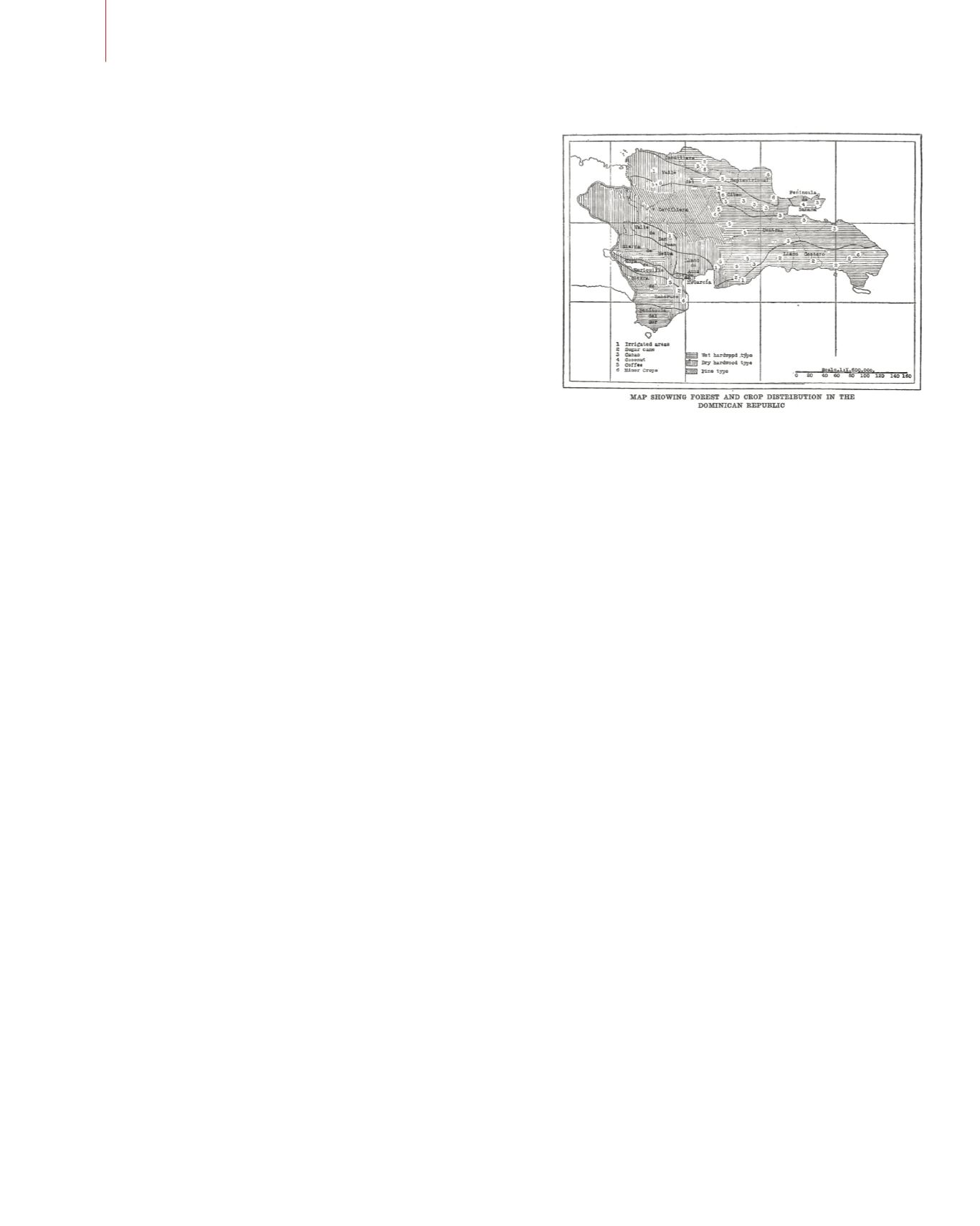
Map of the distribution
of forests and crops
of the Dominican
Republic, as published
in the article by
Dr. Raffaele Ciferri
“Phytopathological
Survey of Santo
Domingo, 1925-
1929”, featured
in the
Journal of
the Agriculture
Department of Puerto
Rico
, January 1959.
© Archivo General de la
Nación