



 416 / 540

415
DR. RAFFAELE CIFERRI’S CONTRIBUTIONS IN THE DOMINICAN REPUBLIC
the entire Republic.” Insects were collected systematically
during field investigations and crop inspection visits. Their
place was the Entomological Collection mentioned above,
where they were classified according to the plants that they
attacked, and also in combination with their entomopha-
gous enemies, predators, and parasites. This collection had
a mission to grow into a broad sampler of “Arthropods,
Insects, Myriapods, Spiders, Crustaceans, and other groups
of animals, for the purpose of forming an Agricultural Zoo-
logical Museum, which is greatly needed in this country.”
27
The
modus operandi
was the preparation of biolog-
ical boxes of the insects, which were observed system-
atically, to enable the observers to “summarize the life
of the insect and of its parasites,” as well as its relations
(with plants, other insects, and other sorts of animals),
and study its morphology and its scientific classification: a) Linnaean and b) Anderlich-Silvestri. This study
procedure was applied to all of the insects, regardless of whether they were noxious or beneficial to Domin-
ican agriculture.
Chemistry Laboratory
The primary labors of this component of the National Agronomic Station have to do with soil studies, includ-
ing the composition of minerals (coal, copper, etc.), the presence or absence of mineral waters, and fertilizers,
as well as the plants that produce edible products for consumption or export. The soil study made it possible
to judge the potential for adaptation of plants that could be brought in and cultivated in the Republic and to
determine which new crops might be the most advantageous. The laboratory also responded to requests from
farmers, who would send samples with their common names; the Station provided analyses and, in addition,
supplied the scientific names of the plants.
Regarding mineral waters, by 1927 the results were available from the “Analysis of thermal water from
the Province of Azua,” determining its levels of hydrogen sulphide and minerals, although the bacteriological
analysis was still pending. Comparisons were also made with other thermal springs in Europe, the Americas,
and Oceania. Analysis was made of water from the Laguna Salada (Salt Lagoon), whose “high chlorine content
makes it unpleasant,” also “almost indigestible and not potable.” Water from Villa Vásquez was also analyzed
and found to be “hard water and very difficult to digest.”
28
Meanwhile, many agricultural products were also analyzed. These included sugarcane, cacao, coffee, and
popular foods such as tubers (sweet potatoes, yams, cassava, plantains) and rice, as well as many different
grasses for fodder. From these analyses arose numerous suggestions for the industrial exploitation of many of
these products. In 1927, the initiation of “the classification of the soils in the Republic” was envisioned as a ma-
jor long-term task for the National Agronomic Station. For this project a complex method would be utilized
for tropical soils; it was described as “modern classification based on its
profiles
,
that tell us not only what a soil
is and what it is worth today, but also its layered strata, its development, its history and its future, that is, its
aptitude for improving, conserving, or losing its current characteristics” (p. 360).
Forestry Section
One of the most significant challenges was the question of pine forests, because the indiscriminate felling
of pine trees was destroying any possibility of a streamlined exploitation of the forest. It was suggested
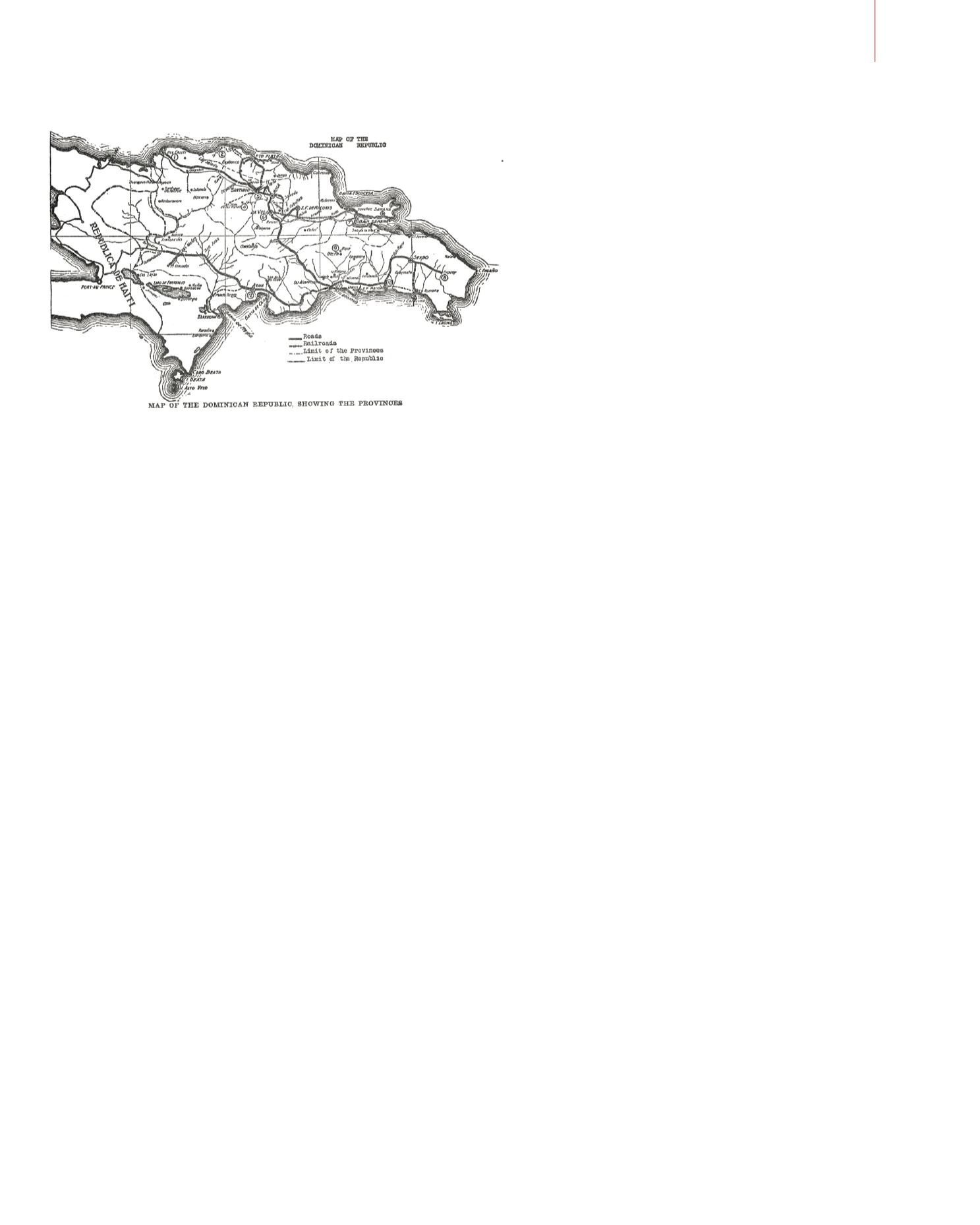
A map of the provinces
of Santo Domingo, as
published in the article
by Dr. Raffaele Ciferri
“Phytopathological
Survey of Santo
Domingo, 1925-
1929,” featured
in the
Journal of
the Agriculture
Department of Puerto
Rico,
January 1959.
© Archivo General de la
Nación