


 405 / 540

THE ITALIAN LEGACY IN THE DOMINICAN REPUBLIC
404
Background: Modern Schools and Agricultural Education
Until the last third of the nineteenth century, in the industries related to agricultural production for domestic
consumption as well as those involved in exportation (tobacco, cacao, sugarcane), the specialists who provided
practical expertise had little more than affinity and interest to guide them, rather than any sort of education or
formal knowledge of agriculture. In general, it was another cultural element, rooted in rural society, that filled
that space. From the mid-nineteenth century until well into the twentieth, most of the
campesinos
turned for
planting advice to the
Almanaque de Bristol
(Spanish edition of
Bristol’s Illustrated Almanac
) which, “in the days
when communication was minimal and information was scarce, was considered fundamental in countries
without a weather service and with limited medical and healthcare services, when other types of calendars
were hard to find”; therefore, “The
Bristol Almanac
informed fishermen about the coastline, while also provid-
ing advice about agriculture.”
2
The situation varied little with the passing of years, and the
Almanac
was still
available in the late twentieth century.
Eugenio María de Hostos, who was responsible for founding Dominican schools in accordance with mod-
ern pedagogical methods, had called for the creation of agricultural farms in association with the normal
schools, as a way to establish a scientific basis for growing crops for local consumption and for export. As phy-
sician and historian Guido Despradel Batista has written:
The vast plan of reforms that Mr. Hostos decided to implement in our country was not limited exclu-
sively to the rational organization of education at both the primary and normal-school levels but aimed
further at the establishment of a number of agricultural farms to create a generation of young agricul-
turists with a consciousness of the cultivation of the earth—a condition that is indisputably the basis for
the existence and the progress of the nationality. As he expressed it to his privileged disciple, Professor
Joaquín Arismendy Robiou: ‘Let us begin with the normal schools, but we need that for each normal
school established in the city there should be a corresponding agricultural farm in the country.’
3
Hostos
had also advocated setting up agricultural colonies as a means of expanding modern agriculture.
4
There were likewise specific proposals referring to the still novel experience of several countries in Europe
and the Americas; such was the case of journalist José Ramón Abad, who was born in Santo Domingo but
emigrated to Puerto Rico at an early age. Abad was hired by the Dominican government to create a manual
about the Dominican Republic that would be taken to the Paris World’s Fair in 1889. He took advantage of
this opportunity to include many suggestions and opinions regarding the direction in which the Dominican
Republic’s economic and social development ought to move. Among various agricultural initiatives, he gave
his support and detailed analysis to the proposal for systems of agricultural colonies, already the object of
tentative efforts in the country. Abad proposed limiting the system of military colonies and added a call to cre-
ate “agricultural communities for correction and beneficence,” following the guidelines set by Pestalozzi and
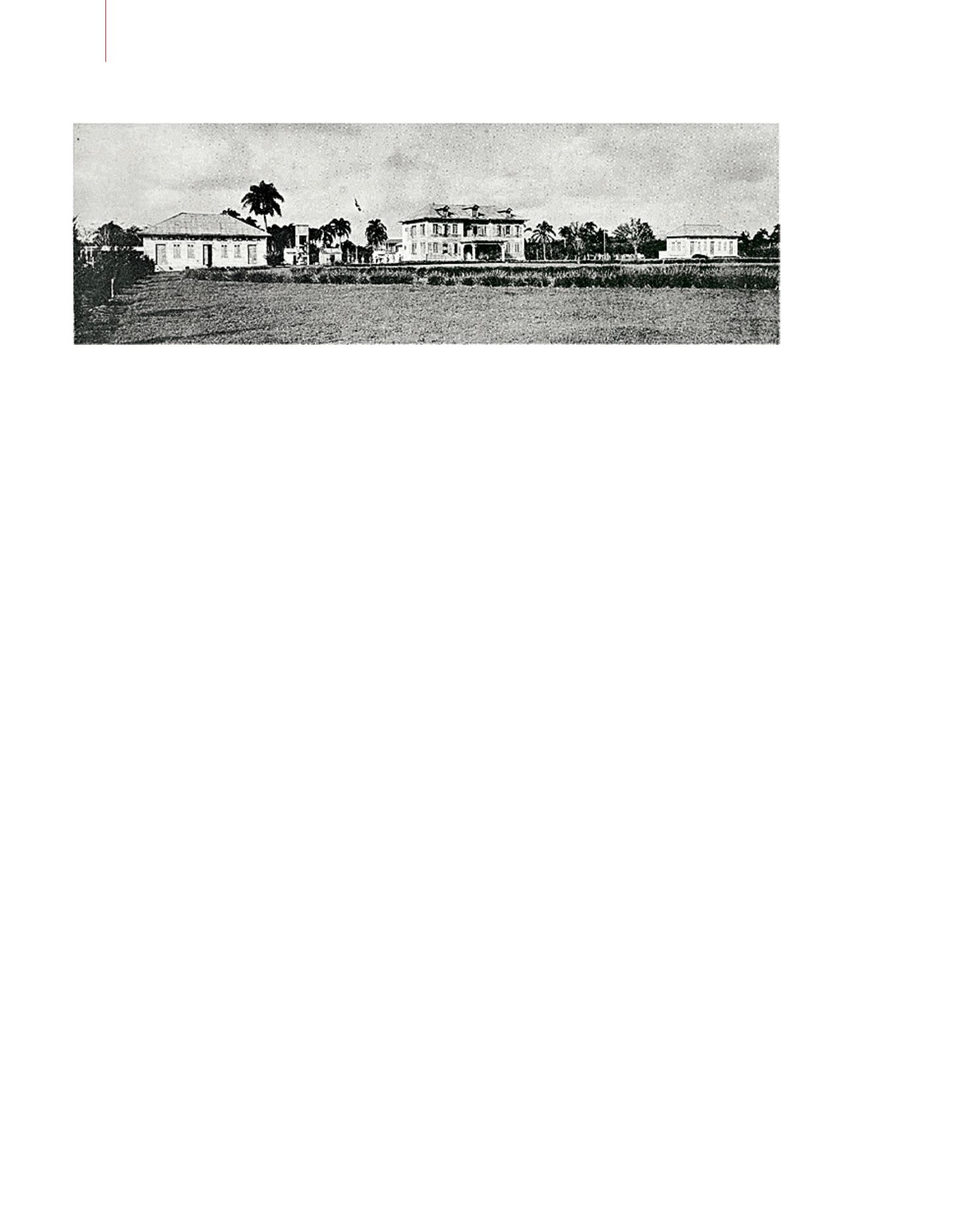
The Agricultural School
of Moca (1936), where
Dr. Raffaele Ciferri
worked.
© Archivo General de la
Nación. Courtesy of Edwin
Espinal