


 424 / 540

423
mainly mahogany. There were plants for industrial or medicinal uses, like eucalyptus; fruit trees, primarily
mangos; textiles, like sisal and hemp. Some were foreign plants and cuttings, like elephant grass and Japanese
sugarcane. There were also seeds for the same types of plants, except mahogany. Small quantities were also
sent to Colombia, the United States, Italy, Germany, and other countries.
Around the middle of 1927, the college graduated its first cohort of new technicians. Minister Espaillat
expressed his satisfaction in the corresponding
Memoria
: “In the month of July the investiture took place for the
presentation of the degrees of Bachelors in Agricultural Sciences to the young graduates following two years
of continuous studies.”
34
These graduates would then become agricultural instructors and fruit inspectors for
the Secretariat of Agriculture and Immigration in different points of the country. Espaillat also mentioned that
some of those who were not yet sufficiently prepared to study for the bachelor’s degree had received “a cor-
responding certificate of Study to show for having completed an Elementary practical course for one year.”
35
Given the excellent results of the College of Agriculture, Secretary Espaillat set out his vision to the Do-
minican president in the
Memoria
of the branch that he directed in 1927: “From the founding of this school,
I have thought that, after five years of operations, when we have been able to draw from it the number of
bachelors in Agricultural Sciences that the country might need in order to disseminate scientific principles
among the farmers, it should be converted into a Polytechnic Institute where pupils—now in much greater
numbers—will receive preparation that will qualify them for conscientious work in the field and in other in-
dustries that may arise in the republic.”
36
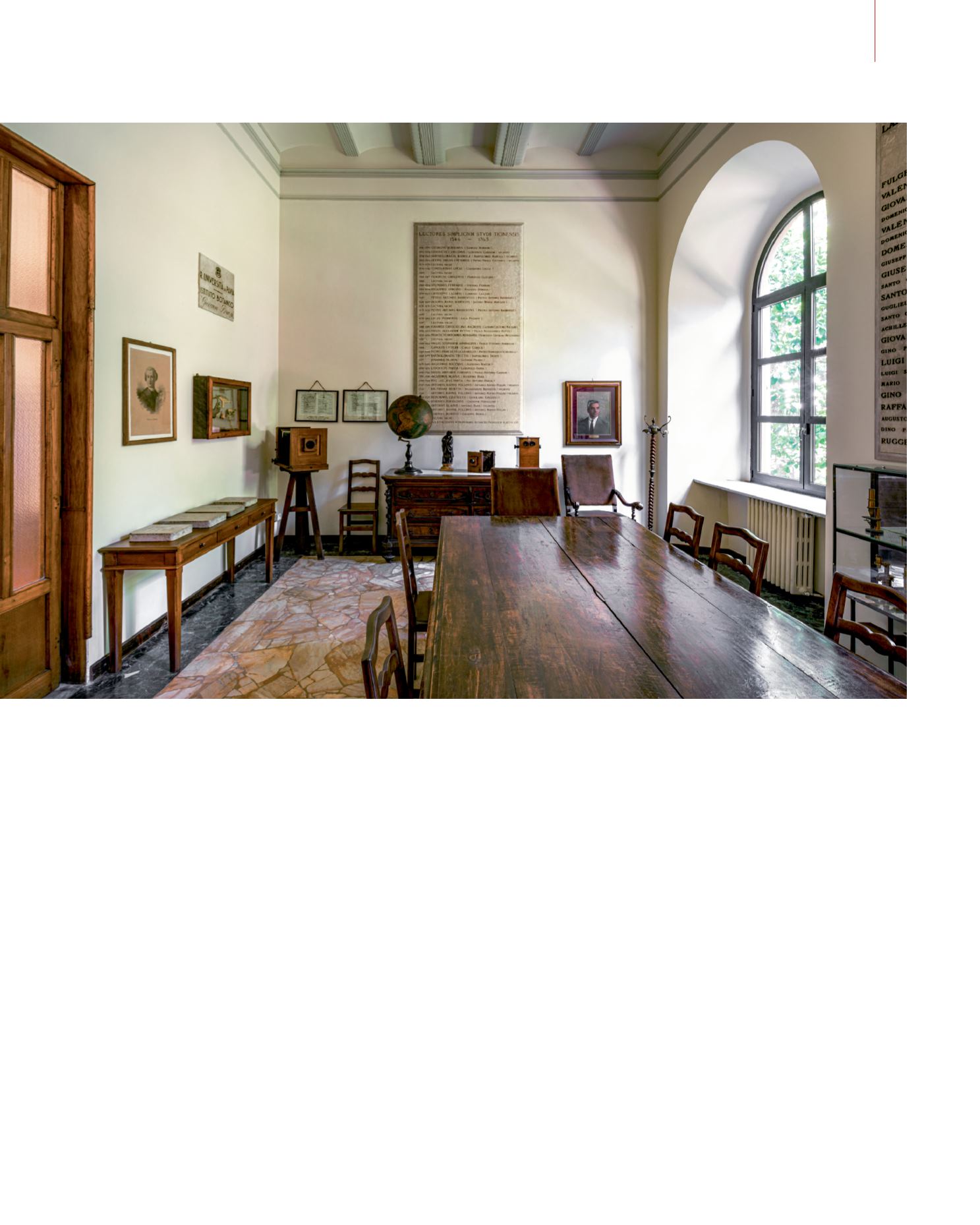
Historical Hall of the
Botanical Garden: this
hall is a testament
to the past and the
illustrious individuals
who contributed
greatly to the
development of the
Botanical Garden and
to scientific research
of the University
of Pavia. It houses
numerous artifacts and
paraphernalia, from
ancient microscopes
to botanical prints
and models as well as
portraits and a plaque
commemorating the
past directors of the
Botanical Garden.
(Paolo Cauzzi)
© Andrea Vierucci
DR. RAFFAELE CIFERRI’S CONTRIBUTIONS IN THE DOMINICAN REPUBLIC