


 430 / 540

CHAPTER 39
The Italian Contribution to Mining
Development in the Dominican Republic
By Renzo Seravalle
Engineer and President of Casa de Italia
•
he history of mining in the Dominican Republic began
with the arrival of the first colonizers in the Americas.
Although Genoese sailor Christopher Columbus’s pri-
marymotive was to find a shorter and safer route to the
east, from where spices and other exotic products of great value
came to Europe, he achieved a different outcome. He stumbled
upon a world that was completely different from the one he had
been seeking, and consequently, there was a shift in objectives
and strategies. The search for spices segued into a search for gold
and silver, and the mining industry was thus born in the Ameri-
cas. To honor Spain, the Admiral baptized the island Hispaniola
and began to search for the location where the indigenous peo-
ple were extracting gold they used to make jewelry. The Spanish
soon realized that the gold was coming from rivers, streams, and
sands in an area they called Cibao in the interior of the island.
According to accounts discovered in the Real Archivo de Indias,
gold mining in the Cibao region likely began in 1505, between the
contemporary town of Hatillo and the Zambrana valley near the
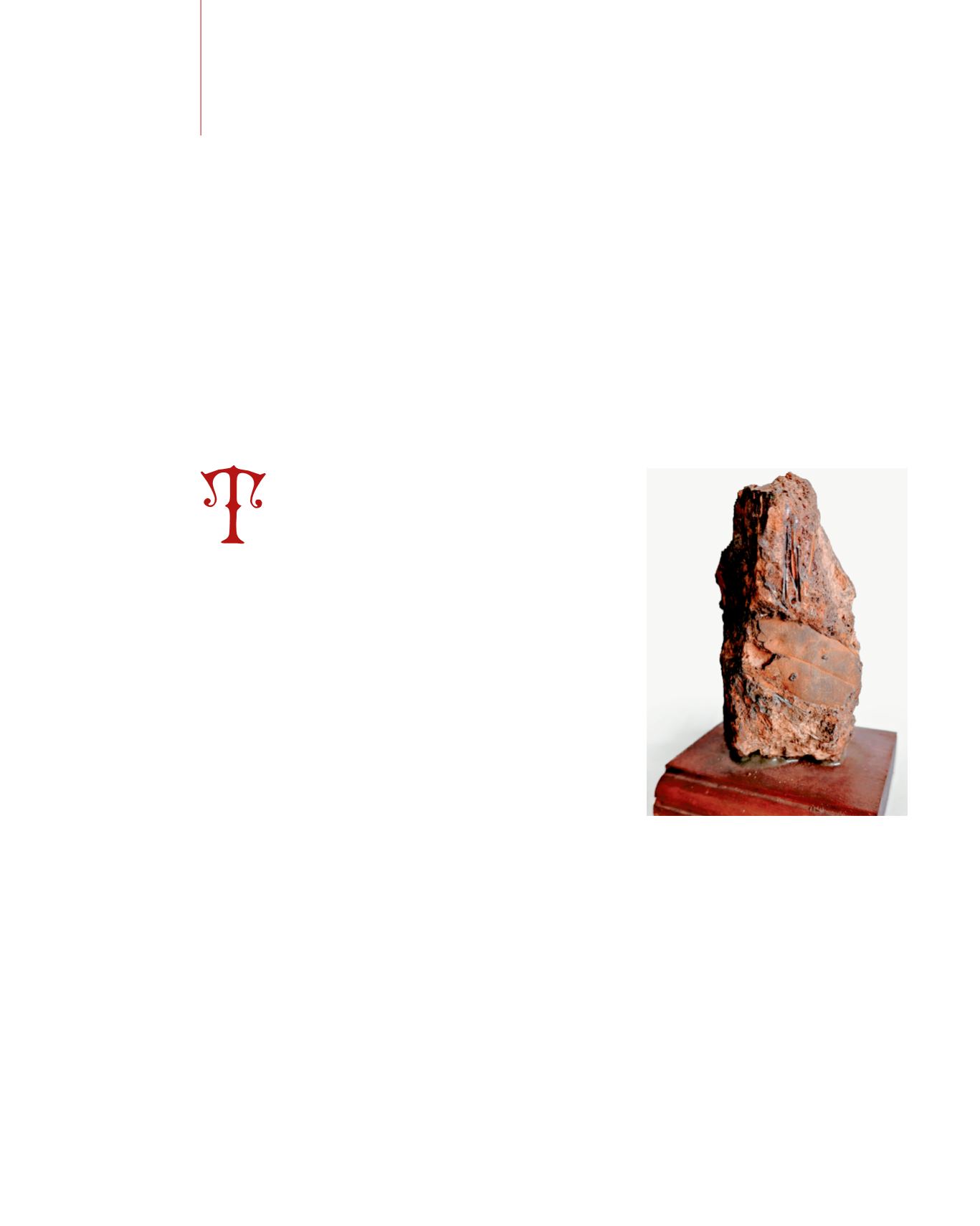
city of Cotuí. Until recently, there were still residues—rust from iron pyrite—lingering from the excavations
carried out by the first indigenous miners.
In that area, there was a small population of indigenous people who lived naturally, farming yams and
yucca and uncontaminated by Europeans. The colonizers turned them into enslaved mine workers with picks,
shovels, working hours, caves on the hillside, etc. Mining would ultimately prove a death sentence for those
first farmers-turned-miners. The mine was closed fifteen years later in 1520.
Juan Nieto de Valcárcel was later sent to Hispaniola by the Spanish Crown to reexamine the gold deposits.
He recommended that the ruler restore operations, arguing that, annually, the mines had produced more than
a million crowns for the throne.
After those first assignments, there was no other known mining activity. Several mining enthusiasts and
experts explored the area with no positive or practical results. A few concessions were allocated, but simply
for speculative purposes.
In 1946, Italian geologist and mineralogist Dr. Renato Zoppis de Sena arrived in the Dominican Republic.
Sample of the oxidized
residues from the
archaeological
excavations of the
Tainos, who were
searching for gold
for the Spaniards in
the 16
th
century of
the colony, in Pueblo
Viejo.
© Renzo Seravalle