


 431 / 540

THE ITALIAN LEGACY IN THE DOMINICAN REPUBLIC
430
He had vast experience exploring mines all over the world and was able to gather a plethora of information
on the mining history of the Dominican Republic. He conducted the first
in situ
explorations and presented
the Dominican government with a geological study of the country that included an analysis and explanation
of its mineral resource potential. The government accepted Dr. Zoppis’s proposal and ordered the Minister
of Industry and Commerce to open a mining department. Thus, the Mining Service—the first official office in
the Dominican Republic dedicated exclusively to the study and development of mining—was established, and
Dr. Zoppis was its first general director. Its first headquarters was located at Avenida Simón Bolívar No. 90,
between Avenida Dr. Delgado and Avenida Pasteur, next to Colegio del Apostolado.
Dr. Zoppis traveled to Italy on behalf of the Dominican government to recruit the technicians he needed
for his research work. He personally directed the selection of this group of technicians, who were hired for a
period of two years with the possibility of renewal and who immediately departed for the Dominican Repub-
lic, arriving in the country around the end of 1948 and the beginning of 1949.
The Italians hired by Dr. Zoppis to study in the Dominican Republic were engineer Leonardo Cioni from
the Directorate of Mines in Sardinia; engineer Tullio Seguiti, head mining inspector of the Italian Ministry of
Industry; industrial mining technician and engineer Alejandro Meani; engineer Adolfo Squillero, former direc-
tor of the Montecatini chemicals company; German geophysicist Dr. Hans Troyer; geologist Michele Lagana;
mineralogist and geologist Terenzio Seravalle, who had previous experience in African gold mines; technician
and mechanic Giuseppe Borrione; engineer Antonio Bodo; technician and engineer Adriano Cecchini, chief
surveyor; technician Priamo Caprini; surveyor Luigi Reboa; and cartographer Bruno Elías. The most notable
Dominicans assigned to this project were Maricusa Catrain, soul of the office and link between the govern-
ment and the Mining Service; unparalleled surveyor Federico Jerez; Juan Gil, University of Santo Domingo
engineering student gaining his first experience in the art of geology and surveying; mechanic Rafael Pacheco;
and drivers Flores and Peña.
According to the program that Dr. Zoppis had outlined, research work began immediately. The areas
explored were:
Opening page:
Pyrite; Copper ore
San Francisco, Mata
Grande; Native copper,
Loma La Mina Pueblo
Viejo; Hatillo iron ore;
Alabaster, Barahona;
Auriferous Quartz.
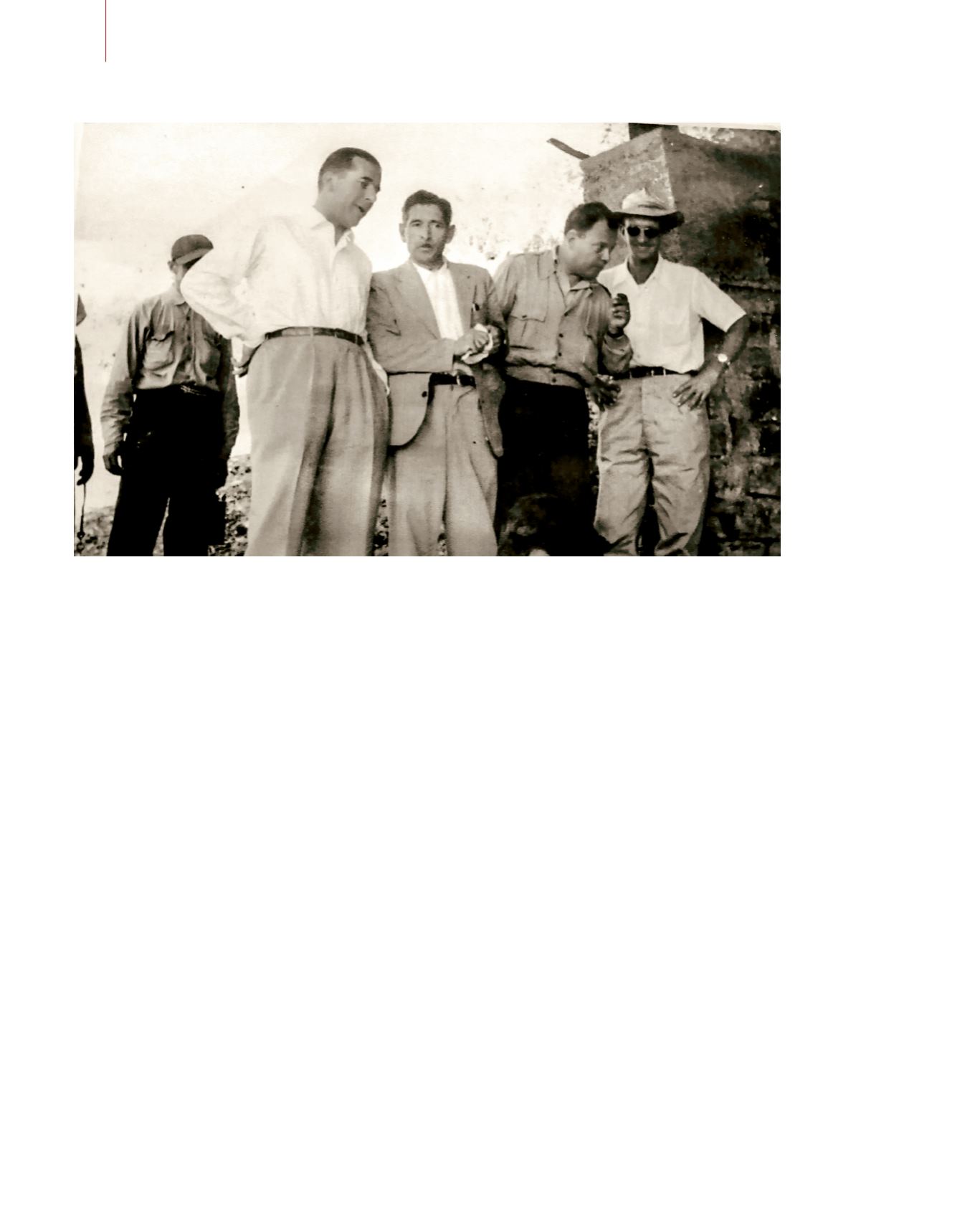
© Renzo Seravale
Pueblo Viejo, in
front of Tunnel No.
6 Terenzio Seravalle
(partially obscured),
Manuel de Moya
Alonso, Dr. Renato
Zoppis, Italo Sartori,
and Giuseppe Borrione
(1952).
© Renzo Seravalle