


 243 / 540

THE ITALIAN LEGACY IN THE DOMINICAN REPUBLIC
242
necessary to determine which natural defenses could be used and as such best capitalize on the various offen-
sive strategies that the defense system needed to resist.
During the many trips that Battista Antonelli made to the Americas, he more than once had to forego visit-
ing the island, in spite of the Royal Warrant from King Philip II, issued in 1586. In said decree, the King ordered
Battista to explore the coasts to build new fortresses or to plan improvement of those already existing. Santo
Domingo was included among the places indicated by the King, but Antonelli only reached the island on April
25, 1589, along with the engineer Tejada, three years after the siege by Sir Francis Drake.
The capital already had the Ozama Fortress, and there was a plan to construct some walls to fortify the
city’s perimeter in a modern fashion. However, the capital had already lost a great deal of its political impor-
tance and its commercial prosperity, and the enclosure planned for the new walls in addition to being weak
and ineffective was also rather far from the urban center. Whoever had created it certainly believed that the
city would continue its growth at the same pace as during the early sixteenth century. It was, however, a
prediction that would not materialize. Antonelli created a new plan for the walls, bringing them closer to the
city and adding alternative bulwarks along their entire length, with the addition of fortresses to improve the
precision and distribution of the bulwarks and the cannons.
The new and lower defensive wall included a small external trench, associated with ground motion that
minimized the presence of the batteries which amplified the scenic effect of the bulwarks. The outer system
was adorned with watchtowers and included a series of bulwarks that were equipped for shooting and fortified
doors. Only some features of these structures remain today, visible within the urban layout of Santo Domin-
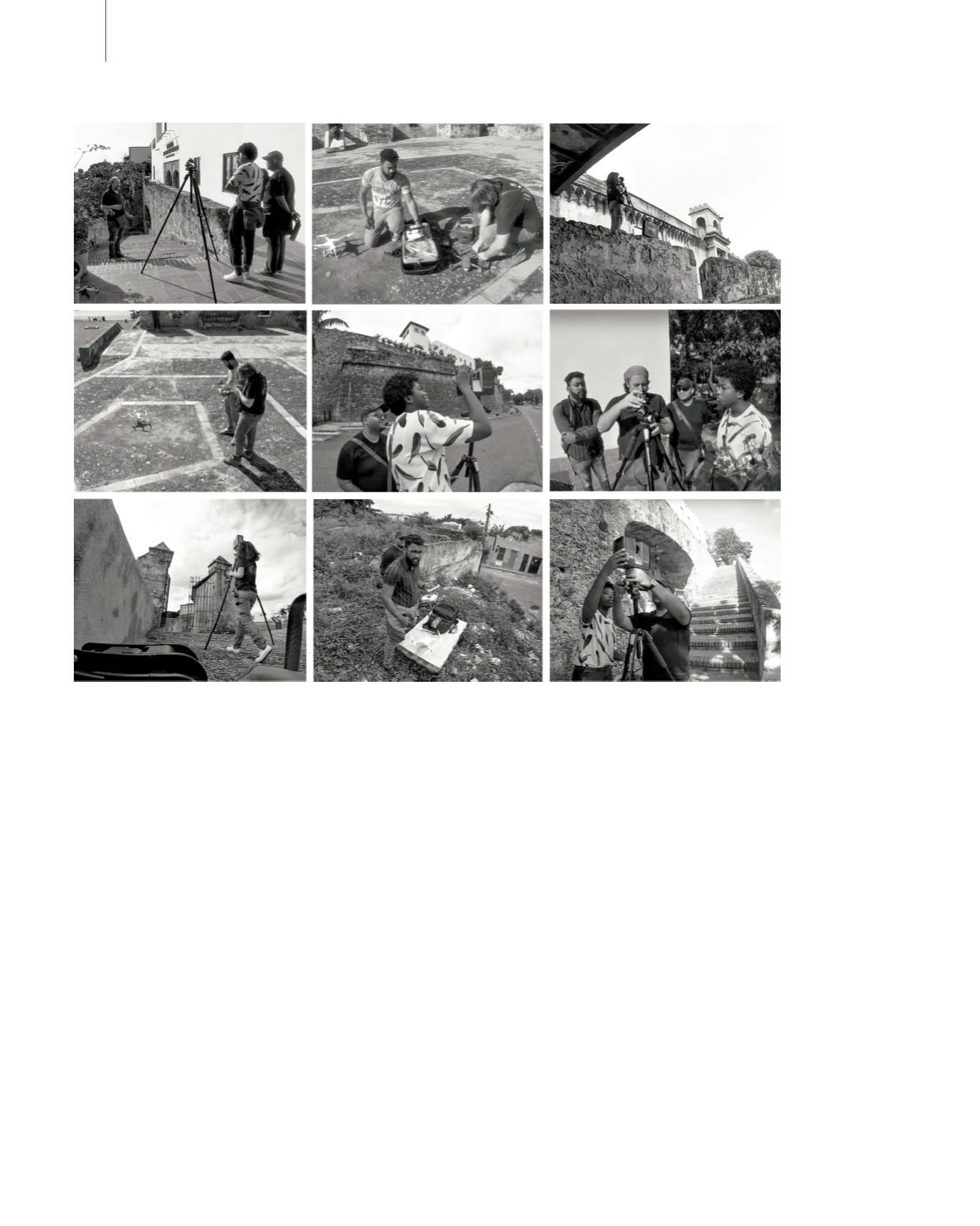
Activities related to
the assessment and
documentation by
the research group
from the University of
Pavia and UNPHU -
Universidad Nacional
Pedro Henríquez
Ureña, the objective of
which is the study of
the colonial defense
system of Santo
Domingo. In particular,
images are shown of
the workshop created
on the northeast
outline of the city.
© Sandro Parrinello