


 249 / 540

THE ITALIAN LEGACY IN THE DOMINICAN REPUBLIC
248
figured as real extensions of human intelligence, seem to come into existence in an intensification of those that
are the characteristics and values of architectural patrimony in order to establish existing systems for reading
and implementing information, capable of showing activities directly related to the patrimony which conse-
quently assumes a real and digital double identity.
The research project that the University of Pavia has initiated in Santo Domingo
specifically deals with the determination, by means of the complex of existing fortified structures, of the
constructive features of the Dominican defensive system in order to understand the contribution of Antonel-
li’s work from a technological standpoint. It is a form of applied research that also takes into account practical
aspects, related to methodologies and operating procedures applied directly at the site, in order to produce
new representations of the cultural patrimony.
In this regard, the DAda Lab of the Department of Civil Engineering and Architecture of Pavia has carried
out initial research with the objective of studying the fortified systems, their design and state of the art and to
obtain a digital database of the patrimony through the use of scientifically verified methods and tools.
The interests in Antonelli’s works, present for many years in the investigation activities inherent to the
documentation of patrimony carried out in Central America by the group of academics from the University
of Pavia has encouraged the establishment of specific surveying procedures to appreciate in the best way
possible each bulwark and the features of the urban walls, which are different with regard to the morphol-
ogy of each one.
This research, which is inherent to the development of technologies for architectural and landscape sur-
veying and representation, to analysis activity for the determination of development strategies related to
knowledge, and to conservation and enhancement of patrimony, have involved some parts of the fortified
system of the Colonial City, chosen based on their historical significance and distribution in order to obtain
the effective measurement of the remaining walled girdle and to be able to compare it with Antonelli’s project.
The DAda Lab research laboratory has made available systems for digital surveying (Laser Scanner and
SFM Structure from Motion) for the creation of 3D databases and the development of functional informa-
tion systems for knowledge of the dimensional and construction characteristics of historical architecture. The
precise surveying, the documentation, and the successive processing phases carried out in the area of the
Ozama Fortress, with particular attention to the main building and the lower battery, enable the reading of
the geometries of the defensive architecture of the production of systems for representation and promotion
of the monumental complex. Different operations have been carried out for the analysis of the bulwarks and
portions of the wall at the northwest area of the girdle (ruins of La Caridad Fort, Church San Miguel, and the
Hermitage of San Antón), with the objective of producing integrated systems for the protection of artistic and
cultural heritage, capable of connecting the urban space with digital representation.
Unlike what occurs with the
Ozama Fortress, the sites of the ru-
ins of La Caridad Fort and the Her-
mitage of San Antón are not consid-
ered monuments by the population,
which due to being unaware of their
historical and architectural value
make inappropriate use of them that
is detrimental to their preservation.
San Antón, along with the stretch
of walls that reaches the Santa Bár-
bara Cathedral, may represent an ex-
treme instance of this situation: the
bulwark is covered with weeds on its
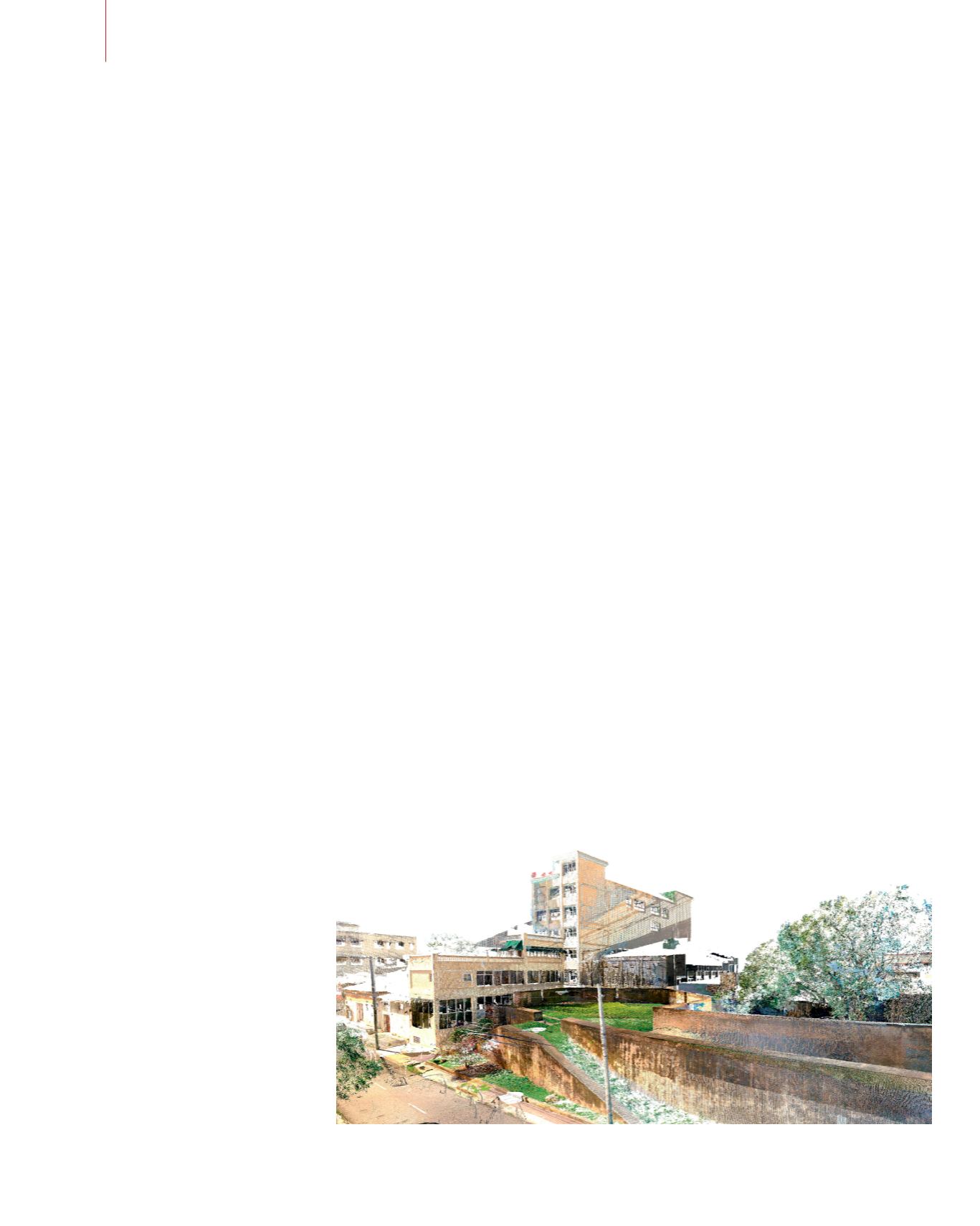
Image of the point
clouds of the La
Caridad fort ruins.
Along the northern
outline of the Colonial
City, they are the first
defensive structures
visible after the
Fuerte
de la Concepción
fort. The curtain of
walls between the
two bulwarks is
incorporated into the
building.
© Sandro Parrinello