


 250 / 540

249
upper section, which do not allow for assessing their true state of preservation, and where it does present
openings on different levels, it is used as a depository for waste materials of different types and sizes. At a
certain point in its history, the bulwark was used as cement for a building that was built on top of it, then de-
molished, the features of which continue to be visible at the present time.
If the Santa Bárbara bulwark is now subject to restorations that are partially altering its character, the
stretch of walls to the north of the city is, in turn, abandoned and has become a site for waste and neglect. At
La Concepción Fort on the opposite side of the city, a low fence, the presence of night lights, and effective
regular maintenance of the surrounding green areas are able, if only partially, to prevent encampments and
their consequences in terms of hygiene and decorum. The
San Miguel
bulwark, currently used as a sports field,
is a positive example of the integration of the fortresses into the city. However, if on the street side the wall
is kept in order and frequented, it is not possible to say the same for the rear segment of the bulwark, which
faces interior courtyards and is more neglected. The density of the courtyards and public and private buildings
existing in the area of La Caridad on the one hand encloses the structure such that it does not have high visi-
bility. Yet, in spite of the superficial renovations over time, it ensures that its original geometry is maintained.
The scope of the research in addition to the scientific and cultural aspects also had an educational and di-
dactic nature due to the participation by students from the Pedro Henríquez Ureña National University in the
measurement activities. The interest in the pursuit of these and new activities related to the representation,
study, and conservation of the architectural patrimony as manifested at meetings with Dominican universi-
ties, research centers, and public institutions shows a clear desire to develop future products and the bilateral
creation of research channels that connect Santo Domingo with Italy through architecture.
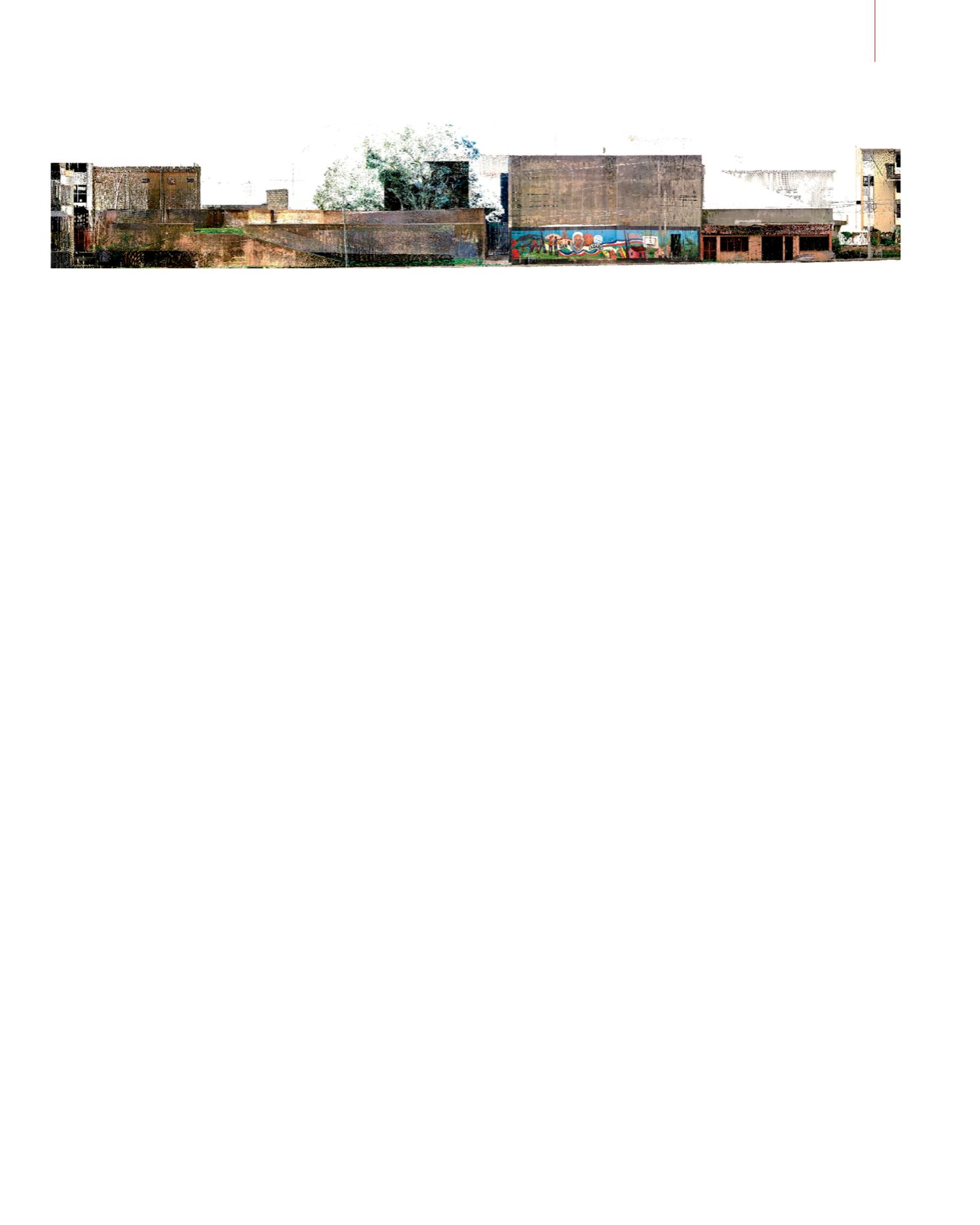
Elevated view of the
point clouds of the La
Caridad fort ruins. The
section of the girdle
remaining visible on
the street, connecting
the ruins with the San
Miguel bulwark.
© Sandro Parrinello
BIBLIOGRAPHY
Bertocci, Stefano, and Sandro Parrinello.
Digital Survey and Docu-
mentation of the Archaeological and Architectural Sites. Unesco World
Heritage List.
Florence: Edifir-Edizioni Firenze, 2015.
Parrinello, Sandro, Francesca Picchio, Raffaella De Marco, and
Anna Dell’Amico. “On the Edge of Mediterranean: Antonelli and
Gibraltar Fortification.” In
Fortmed 2018
_Torino:
BOOK OF AB-
STRACTS,
edited by Anna Marotta and Roberta Spallone
.
Turin:
Politecnico di Torino, 2018.
Parrinello, Sandro. “La documentazione delle opere antonelliane
nel nuovo mondo.” In
Programmi multidisciplinari per l’internazio-
nalizzazione della ricerca. Patrimonio culturale, Architettura e Paesag-
gio,
56-59. Florence: DidaPRESS, 2018.
Parrinello, Sandro, and Pietro Becherini. “La documentazione
delle mura di Verona. Rilievo, analisi e schedatura delle fortifica-
zioni veronesi. In
Defensive Architecture of the Mediterranean,
vol. 9,
edited by Anna Marotta and Roberta Spallone, 1075-1082. Turin:
Politecnico di Torino, 2018.
Parrinello, Sandro, and Silvia Bertacchi. “Geometric proportio-
ning in the sixteenth century fortifications: the design proposal
of Italian military engineer Giovanni Battista Antonelli.”
Nexus
Network Journal
17 (2015): 399-423, http://doi: 10.1007/s00004-
015-0255-7.
Parrinello, Sandro, and Silvia Bertacchi. “The Fort of Bernia by
Giovanni Battista Antonelli.”
Nexus Network Journal
16 (2014):
699-722, http://doi: 10.1007/s00004-014-0214-8.
Parrinello, Sandro, and Francesca Picchio. “Sistemi di documen-
tazione per l’analisi ed il progetto di recupero del Forte San Lo-
renzo el Real del Chagre, Colón, Panama.”
Restauro Archeologico
25, no. 1 (2017): 54-73.
Parrinello, Sandro, and Francesca Picchio.
Le fortezze di Portobello
e del Rio Chagres a Panama.
Florence: Edifir, 2019.
THE WALLS OF SANTO DOMINGO AND DOCUMENTATION OF THE CONSTRUCTION PROJECTS BY THE ANTONELLI FAMILY