


 256 / 540

255
The chapel and the funerary monument were ordered to be built by Geraldini’s servant, the clergyman Die-
go del Rio; Del Rio together with Onofre Geraldini took possession of the bishopric of Santo Domingo at the end
of 1517 on behalf of Bishop Geraldini, as mentioned earlier.
Diego del Rio held the position of treasurer of the cathedral at the time of its construction, but for several
years prior, he was responsible for the collection of tithes. According to an interrogation in 1532, Diego del Rio
“is responsible for the tithes and he collects them and he gives them out and distributes them however he wish-
es without any involvement in their division or collection by a public notary or the
cabildo
as is required by the
building committee so that they can be provided with a full account whenever the individual or individuals so
request it.”
17
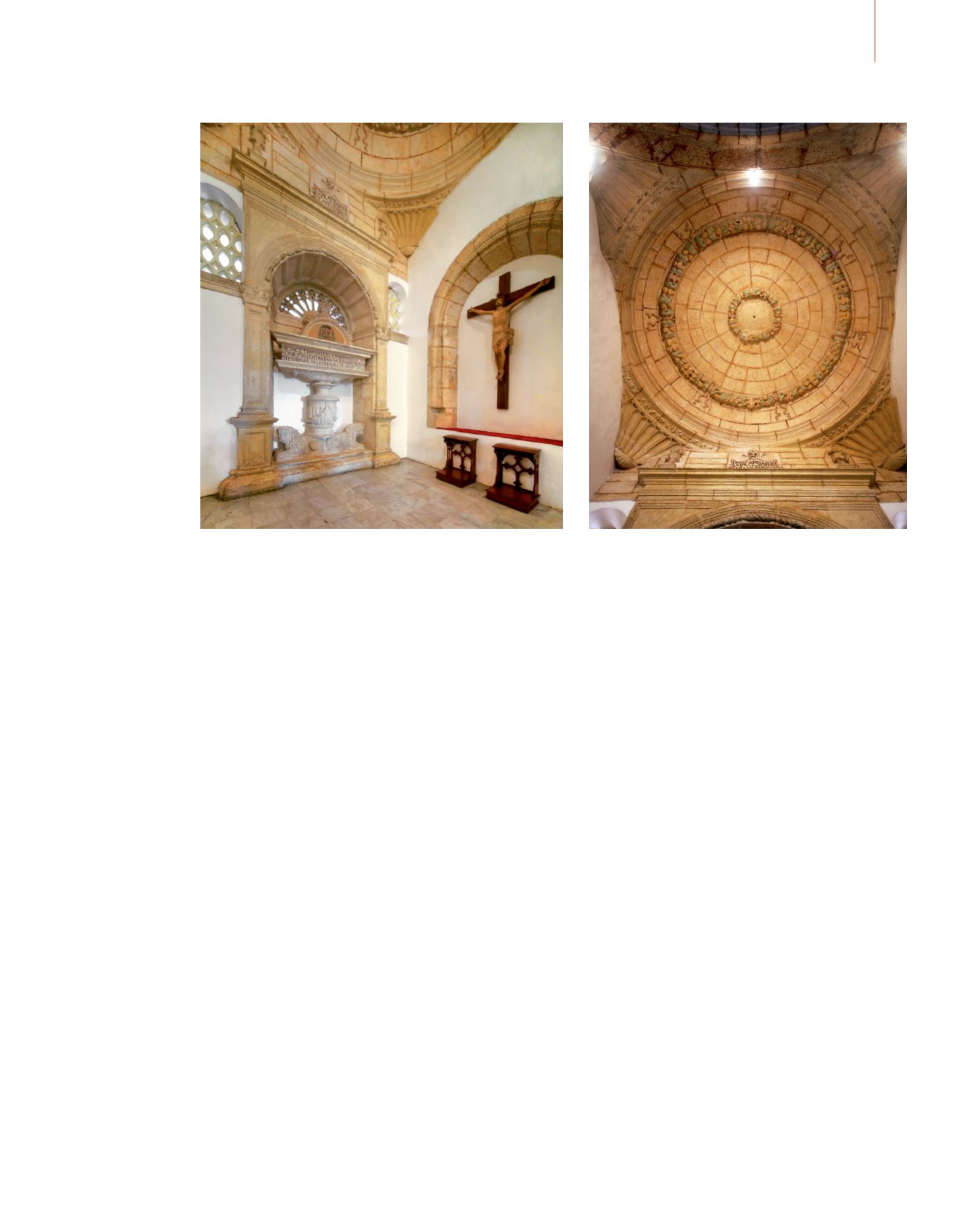
The chapel has a rectangular ground plan that is almost a square, measuring approximately 17.5 Spanish feet
(4.88 meters) by 16 Spanish feet (4.48 meters). It is covered by a circular stone dome, a type of spherical vault that
rests on pendentives in the shape of shells, which were quite common in Renaissance masonry. Two carved rings
stem from its center, decorated in the shape of a garland of flowers and fruit and delicately painted with pastel
colors. This painting was discovered in 1988 during restoration work, which immediately revealed the original
colors that once existed.
18
The square or almost square floor and the circular dome are expressions with a clear meaning within the
context of Humanism: squares were images of the earth and humankind, whereas the circle was considered a
perfect figure, as Plato states in his Timaeus and Philebus—an expression of the heavens.
19
Consequently, by
placing these two images in the chapel, the human and the divine, the permanence of virtues, and the nobility of
the deceased beyond death were represented. Further indicated was that the deceased person would continue in
eternity due to having been a faithful follower of Christian virtues.
Initially, the entrance of the niche chapel was defined by a pointed arch, like all the others, but during its con-
struction, this pointed arch was altered into a semicircular arch flanked by two fluted columns with a Corinthian
capital and square base, very much in keeping with the Renaissance style of the time. Its walls are made of stone
masonry, with the exception of the west wall. That wall was built from a rammed-earth wall that it shares with
the next chapel. On the eastern wall, there is a large but shallow niche that may have been an altarpiece at some
Christ in Agony
Chapel also known as
Geraldini’s Chapel.
© Courtesy of Virginia
Flores Sasso
Vault of the Chapel
of Christ in Agony or
of Geraldini. Stone
vault, spherical
that rests on shell-
shaped pendentives,
very common
in Renaissance
stonework.
© Courtesy of Virginia
Flores Sasso
THE FUNERARY MONUMENT TO ALESSANDRO GERALDINI AT THE CATHEDRAL OF SANTO DOMINGO