


 254 / 540

253
THE FUNERARY MONUMENT TO ALESSANDRO GERALDINI AT THE CATHEDRAL OF SANTO DOMINGO
Meanwhile, in Italy humanist and anthropocentric ideas were taking root, considering humanity as the center
of all things. In the mid-fifteenth century, with the invention of the printing press by Johannes Gutenberg, and
the cultural and scientific exchanges that were taking place, humanist ideas spread across Europe. These currents
arrived in Spain as a result of political and military ties with Italy.
Humanist ideals led to the Renaissance, which reevaluated humanity’s worth and revived the culture of
classical antiquity. God did not lose a predominant role but was instead relegated to a different plane of influence
and no longer the answer to all problems. Once again, fame was appreciated as a virtue and a legitimate right of
human beings. Glory, prestige, and power were emphasized—values considered formerly as pagan. The Church
was also influenced by these ideas and began to incorporate Renaissance components into its buildings, struc-
tures, and ornamentation. The style employed was inspired by the new architectural and artistic trends of the
Cinquecento,
or Italian Renaissance.
Leon Battista Alberti, considered the first theoretical artist of the Renaissance, blended both the ancient and
the modern in his perspective, thus espousing the ancient and modern praxis that had been initiated by Filippo
Brunelleschi but with a humanist slant. In Spain, the treatise
Medidas del Romano
by Diego de Sagredo, who had
trained in Italy during the 16
th
century, was widely read; the work was published for the first time in 1526, with
numerous reprints afterward. In his treatise, Sagredo describes how a tomb should look, emphasizing the need
for ornateness, and proposes the use of both biblical and pagan elements from antiquity, showing in one illustra-
tion an “arcosolium” in a classical style.
During the Renaissance, funerary monuments were designed to show the states of grandeur, triumph, and
immortality, emphasizing the virtues and qualities of the deceased individual. In theory, only clerics as well as
those affiliated with the Church and with a high economic status were buried in tombs or in the church—and
even according to a hierarchy as well. For the rest of the population, individuals may or may not have had any
marker or placard attached to their graves, and they were buried either inside the church or outside in the church
cemetery. Those with greater economic means and close personal relationships with the church were buried
closer to the main altar. The further from the altar, the poorer the person. Some enjoyed the privilege of having
their own chapel, where they were buried alongside relatives.
The trend of placing funerary sculptures together with funerary monuments began as an attempt to achieve
historical permanence. In Spain, Renaissance funerary sculpture was developed during the mid-fifteenth century.
During that period, the funerary monument may or may not have included a funerary sculpture. Initially, there
were no Spanish Renaissance sculptors; sculptures and works were imported from Italian workshops, and it was
even necessary to contract Italian sculptors to create works in Spain. These masters of Italian sculpture subse-
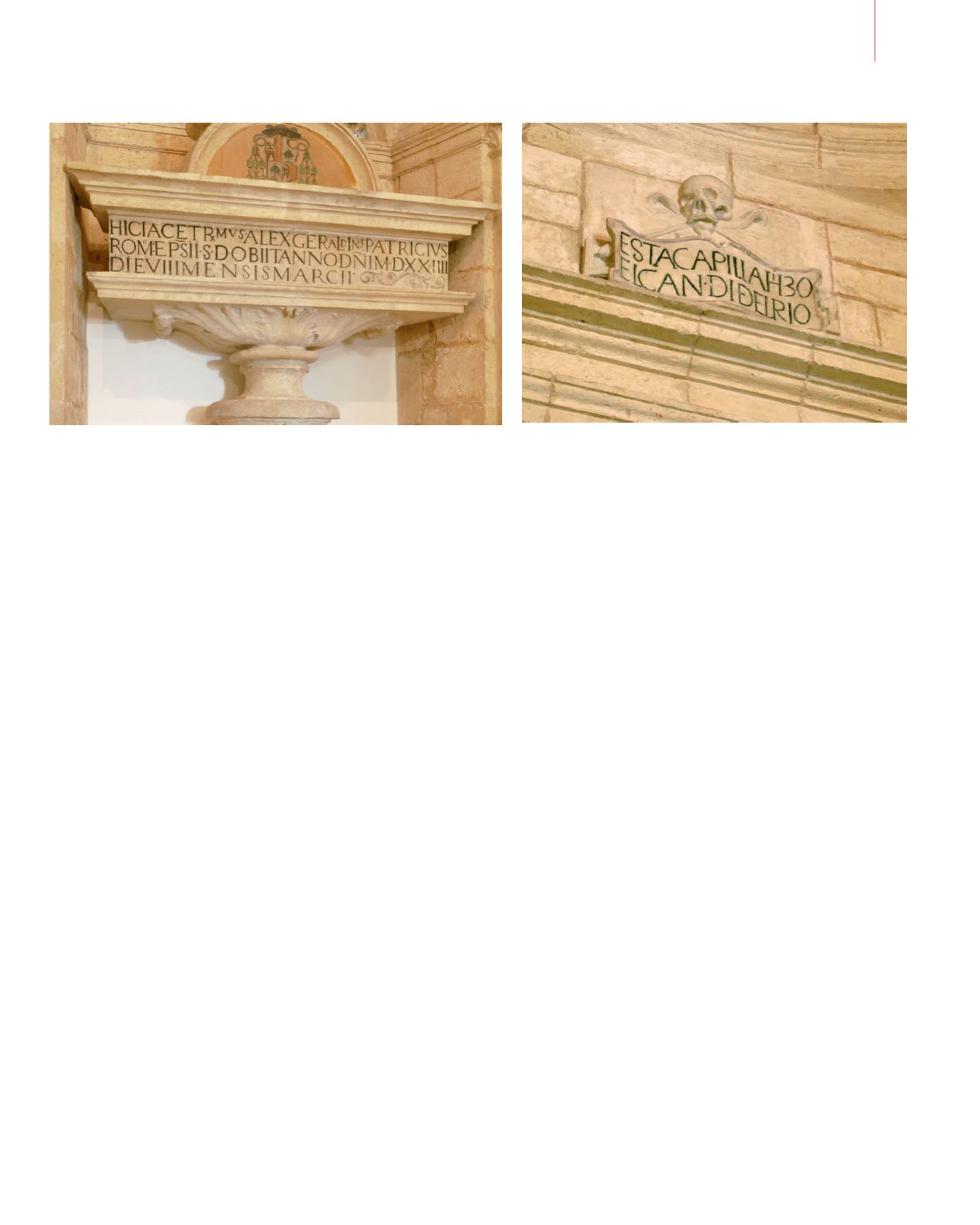
Epitaph in the Geraldini
Memorial:
HIC IACET
Rmas
ALEXANDER
GERALDINUS PATRICIUS
ROME EPISCOPUS
IL SANCTI DOMINICI OBIIT
ANNO DOMINI
M.D. XX IIII DIE VIII
MENCIS MARTIS. 244
.
© Courtesy of
Virginia Flores Sasso
Banner placed on
top of the north
wall of Geraldini’s
funeral monument,
describing that the
chapel was ordered to
be built by the priest,
then treasurer of the
Cathedral, Diego del
Rio, servant of Bishop
Alessandro Geraldini.
© Courtesy of
Virginia Flores Sasso