


 241 / 540

THE ITALIAN LEGACY IN THE DOMINICAN REPUBLIC
240
cannons, and these were the main threats for other transport ships and for the ports that contained the as-
tounding riches of the Americas that needed to be kept secure.
During the periods immediately following, and through a process that would continue throughout the
entire sixteenth century, the evolution of military strategies saw changes in ballistics and offensive models in
general due to attack practices that favored a quicker system of movement, as such reducing the size of the
weapons, the range, and most importantly for our considerations the trajectory of the cannon projectiles.
The trajectory of the cannonball depended on the range. Therefore, the slope of the curtains of walls was
calculated from the point where fire was opened. Based on the modern styles, the footprint of the walls had to
be as perpendicular as possible to the firing of the cannon, which when perforating the surface of the curtain
penetrated the masonry to then wane in force and be absorbed by the density of the walls full of inert material.
The transformations under which the Antonelli family operated nevertheless involved a first phase, in
which it was necessary to adapt the medieval style defensive systems to the new features associated with mod-
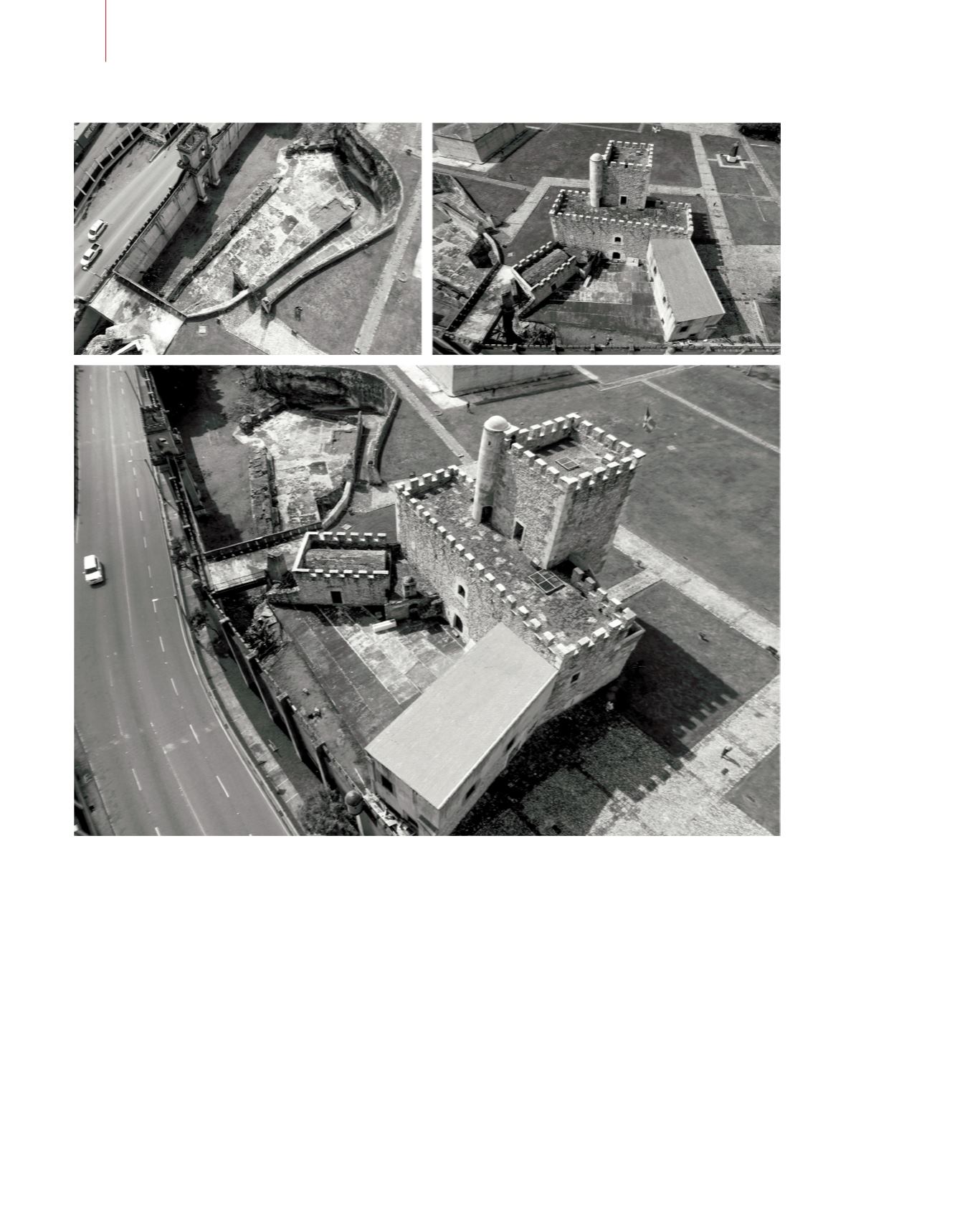
Images of the Ozama
Fortress, the principal
fortified monument
of Santo Domingo
and the only medieval
style fortress in the
Americas, taken
together with the
adjacent lower battery.
Collectively, the tower
and the battery trace
the evolution of the
defensive system
along the course of
the Ozama River,
displaying the main
features of the two
moments in history
that represent the
process of colonization
and fortification of
the city.
© Sandro Parrinello
Opening page:
View of the Torre del
Homenaje
,
or The
Tower of Homage,
from the lower battery.
In particular, the space
in front of the battery
is now separated
from the city and the
river by a more recent
curtain of walls, built
at the beginning of the
last century to afford
greater monumentality
to the capital’s
military system.
The concrete wall,
rather deteriorated
and ruined in spite
of its historization,
today seems to be
both an obstacle for
the utilization of the
colonial walls as well
as an opportunity to
define the residual
spaces that could be
used as exhibition
or tourist areas,
completing the
museum experience
of the Ozama Fortress
complex.
© Sandro Parrinello