


 237 / 540

THE ITALIAN LEGACY IN THE DOMINICAN REPUBLIC
236
Ultimately abandoned two centuries after its construction by the Columbus family—who devoted their
energies to fighting for their lost rights in Spain—it suffered from the physical damage brought on by aban-
donment. Consequently, its ceilings began to give way, so its most articulated parts, such as the arches and
balustrades, beams, tiles, and floors, became easy prey for extraction in the form of an open-pit quarry that
was available for other construction sites. The palace ended up being vandalized in this way, and its compo-
nents were reused in other works until it was expropriated and declared a National Monument on February
3, 1870. Its ceilings, floors, arches, and balustrades were rebuilt by the Spanish architect Javier Barroso in 1956
-1957 using the criteria of the period (“as it was supposed to be”). In Spain, Barroso set about purchasing a
large quantity of antique furnishings, tapestries, domestic items, and utensils in order to recreate the colonial
atmosphere of the palace and open it to the public as a museum.
Today, the Viceregal Palace and its invaluable collections are in need of proper conservation in keeping
with its role as the most visited museum in the Caribbean.
These brief notes precede a soon-to-be published monograph on the Viceregal Palace.
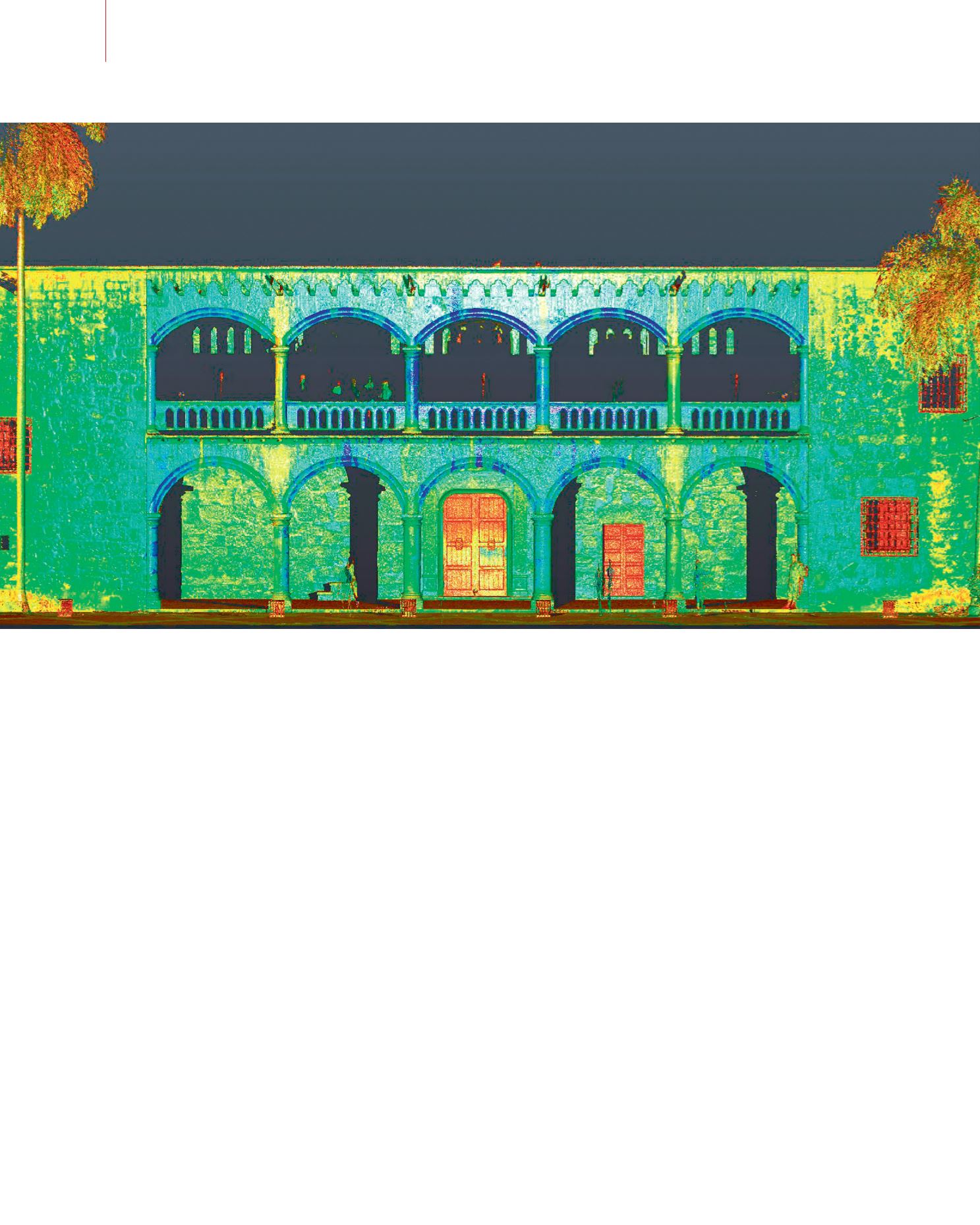
Santo Domingo,
Viceregal Palace of
Diego Colón. West
façade. Orthogonal
projection of the point
cloud in false colors,
preparatory to the
digital models. Laser
scanner technology by
Margherita and Luigi
Caputo (2018).
© Julia Vicioso
Page 235:
Santo Domingo, Viceregal Palace of
Diego Colón. East façade on the Ozama
River and west and south façades
before the restoration in 1957.
© Archivo General de la Nación
Opening page:
Santo Domingo,
Viceregal Palace of
Diego Colón. West and
south façades (2020).
© Giovanni Cavallaro