


 364 / 540

363
THE ITALIAN LEGACY IN DOMINICAN MUSIC AND CULTURE
violinist Emil Friedman, who had arrived in Santo
Domingo in October 1940, and would be in charge
of preparing his debut and putting in his student’s
hands the indispensable tools needed to achieve fu-
ture success.
On August 5, 1941, when the National Sym-
phony Orchestra was founded, and directed by the
Spanish Enrique Casal Chapí, the young Carlos Pi-
antini, barely 14 years old, was designated for the
second violin section of the brand-new institution,
in which he would debut as a soloist on May 15,
1944, under the direction of Casal Chapí.
After completing advanced studies in violin in
Mexico (1944-1946) under Joseph Smilovits and
Henryk Szeryng, and harmony courses under Man-
uel M. Ponce, Carlos Piantini on his return to the
country was promoted to the first violin section of
the Orchestra, ultimately achieving the position of
conductor.
During his sojourn in Mexico, Piantini per-
formed on Mexican radio with the famous Mexican maestro Julián Carrillo. At the helm of the Sinfónica H.
Steele, he played concerts and recitals, belonged to some of the major orchestras of Mexico as the first violin,
and frequented the circles of musicians and intellectuals who had flocked to Mexico City due to the war raging
in Europe.
With the passage of time, Piantini would be accompanied on the piano by Ninón Lapeiretta, Julio Alberto
Hernández, Vicente Grisolía, and Manuel Rueda, in a historic recital.
In the 1970s, Manuel Simó (director of the Symphony Orchestra), with his proverbial generosity, gave the
then violinist Carlos Piantini the privilege of using the foremost Dominican musical institution as a venue on
22 occasions, so that he could further practice as guest conductor. His knowledge of conducting was solidified
during his long years as a violinist with the New York Philharmonic Orchestra. That experience, which was
invaluable for Piantini, would result in a series of spectacular concerts that soon brought another dimension
to his artistic career, positioning him years later as the most successful Dominican conductor.
The intense period of apprenticeship with the National Symphony Orchestra may have served as a stimu-
lus for his decision in the 1970s to abandon his position among the first violins of the New York Philharmonic,
and to travel to Vienna to begin formal orchestral conducting studies with Hans Swarowsky, before finally
embarking on his career.
Between 1973 and 1978 as artistic director for the Piantini National Theater, he worked tirelessly to devel-
op a historic opening festival, in addition to ambitious programs that always aroused a tremendous response
from the Dominican public. The tangible achievements of his management have not been surpassed in the 46
years of existence of that cultural center.
Beginning on March 28, 1984, Piantini became musical director of the National Symphony Orchestra and
remained in that position until December 29, 1994, when the category of “Laureate Director” was created,
with Piantini in mind.
In the 1990s, his professional importance abroad was solidly established in parallel with his responsibilities
as director of the National Symphony Orchestra. He continued to conduct operas and concerts in Italy, while
establishing himself more permanently in the United States, as a professor at the Florida International Univer-
sity School of Music, where for several years he was in charge of orchestral studies and the string instrument
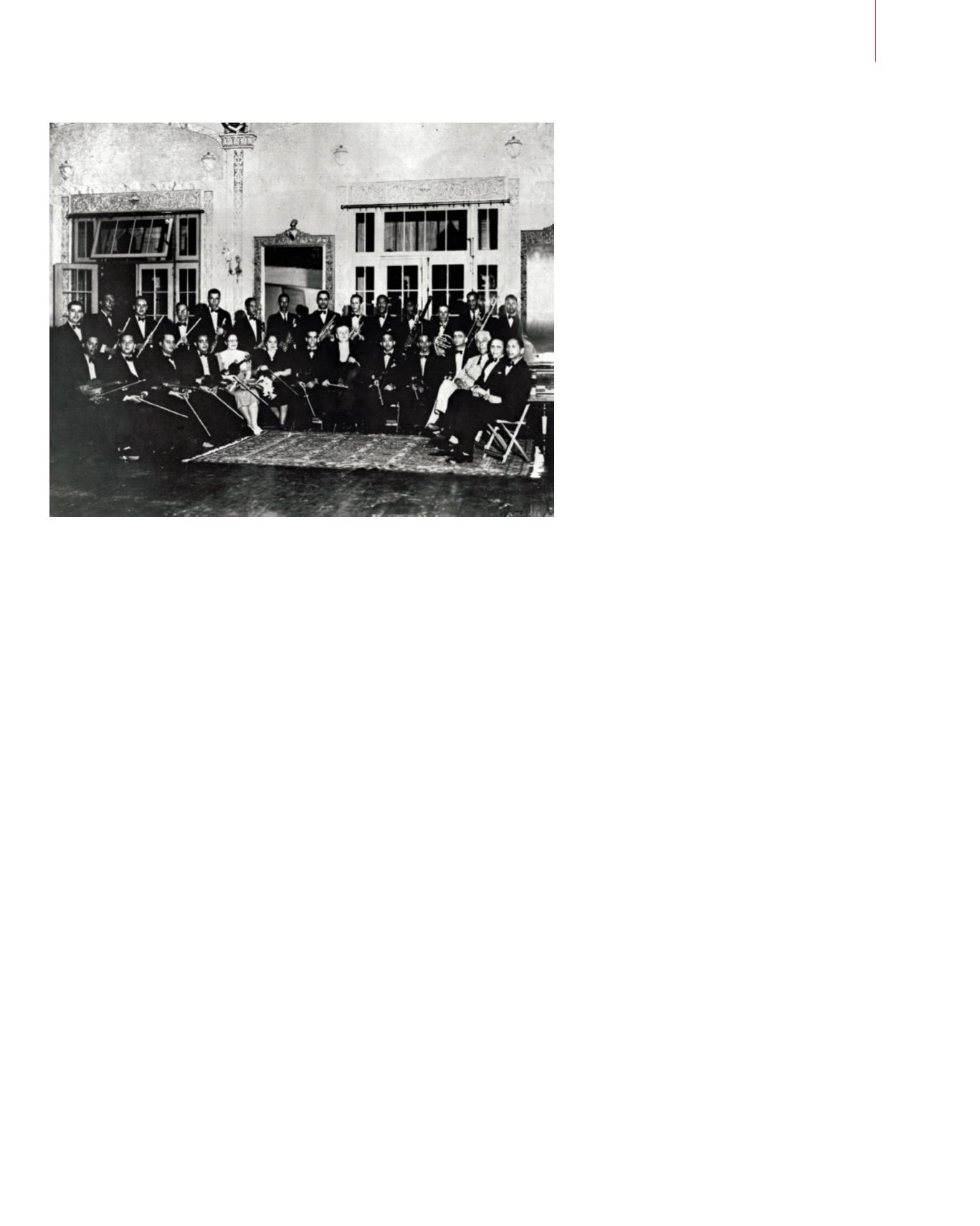
Santiago de
Compostela
Philharmonic
Orchestra conducted
by Julio Alberto
Hernández. The
orchestra is
composed of Juan
Francisco García,
Pepé Echavarría, Luis
Alberti, Max Guzmán,
Morito Sánchez,
Juan Sánchez, Pablo
Bornia, César Pacheco,
Antonio Pereyra, Oscar
García, Arcadio Aybar,
Bruno García, Apolinar
Bueno, and Piro
Valerio, among others.
© Blanca Delgado