


 370 / 540

369
THE ITALIAN LEGACY IN DOMINICAN MUSIC AND CULTURE
tional Anthem, creating a version that remained
popular for many years.
He frequently performed at other venues
around the country, as well as directed the choir of
the Luis Muñoz Rivera School in Santo Domingo.
Enrico Cagna Cabiati
arrived in Santo Domin-
go on July 9, 1947, on a contract with La Voz
del Yuna, as part of the Carta-Cabiati piano duo,
which, as indicated above, included Mario Carta.
His active participation in the radio programs
of that station very soon made various facets of
his talent broadly known. In addition to being
a member of the Carta-Cabiati duo, he served
as conductor, arranger, and solo pianist, as well
as conductor of the ensemble that accompanied
various artists associated with the broadcasting
company.
Among the various events organized by La
Voz del Yuna, Cagna Cabiati was responsible for evaluating a young man named Rafael Solano, barely 20
years old—a recent graduate with outstanding grades from the National Conservatory of Music—to deter-
mine whether he had sufficient skills to be a pianist for the Orquesta Angelita Orchestra, one of the main
musical groups featured by the station.
Having passed the test, and after receiving the corresponding guidance, the young pianist went on to even-
tually direct Orquesta Angelita Orchestra not long afterward. Rafael Solano—now a legendary artist in the
contemporary musical history of the Dominican Republic—owed a great debt to Enrico Cagna Cabiati, who
served as a key figure at that early stage of his professional life, guiding him on the path to success.
Maria Luisa Faini
was born in Rome. She graduated at the age of 15 from the Accademia Nazionale di Santa
Cecilia in Rome, where she studied under Carlo Angelelli. She then pursued advanced courses under Alfredo
Casello, in Siena and in Rome.
She won first performance prizes in 1937, 1940, and 1941, and went on to become a teacher of advanced
courses at the Siena Conservatory. With a passionate temperament, she is especially remembered in the coun-
try for her piano skills and her infallible musical interpretation. She came to La Voz del Yuna in 1947 and
returned to Italy in 1949.
The maestro
Adriano La Rosa
was born in Genoa on August 12, 1896. He came to the Dominican Republic
for ten days as guest conductor of the National Symphony Orchestra and ended up staying for many years,
leaving a mark most notably as arranger and conductor at La Voz Dominicana.
While in the Dominican Republic, he composed the opera
Anacaona
, with a libretto by the Dominican
Franklin Domínguez. This work, which remains unpublished, was being rehearsed; however, completion of
the project was postponed indefinitely.
Italian harpist
Laura Girardi Cacciapuoti
was part of the second wave of Italian musicians to arrive in the
Dominican Republic under contract by La Voz del Yuna in 1947.
Girardi Cacciapuoti was born in Venice on September 9, 1919. She studied at the Conservatorio di Musica
Benedetto Marcello in Venice with the harpist Margarita Cicognari. She studied advanced courses under Ada
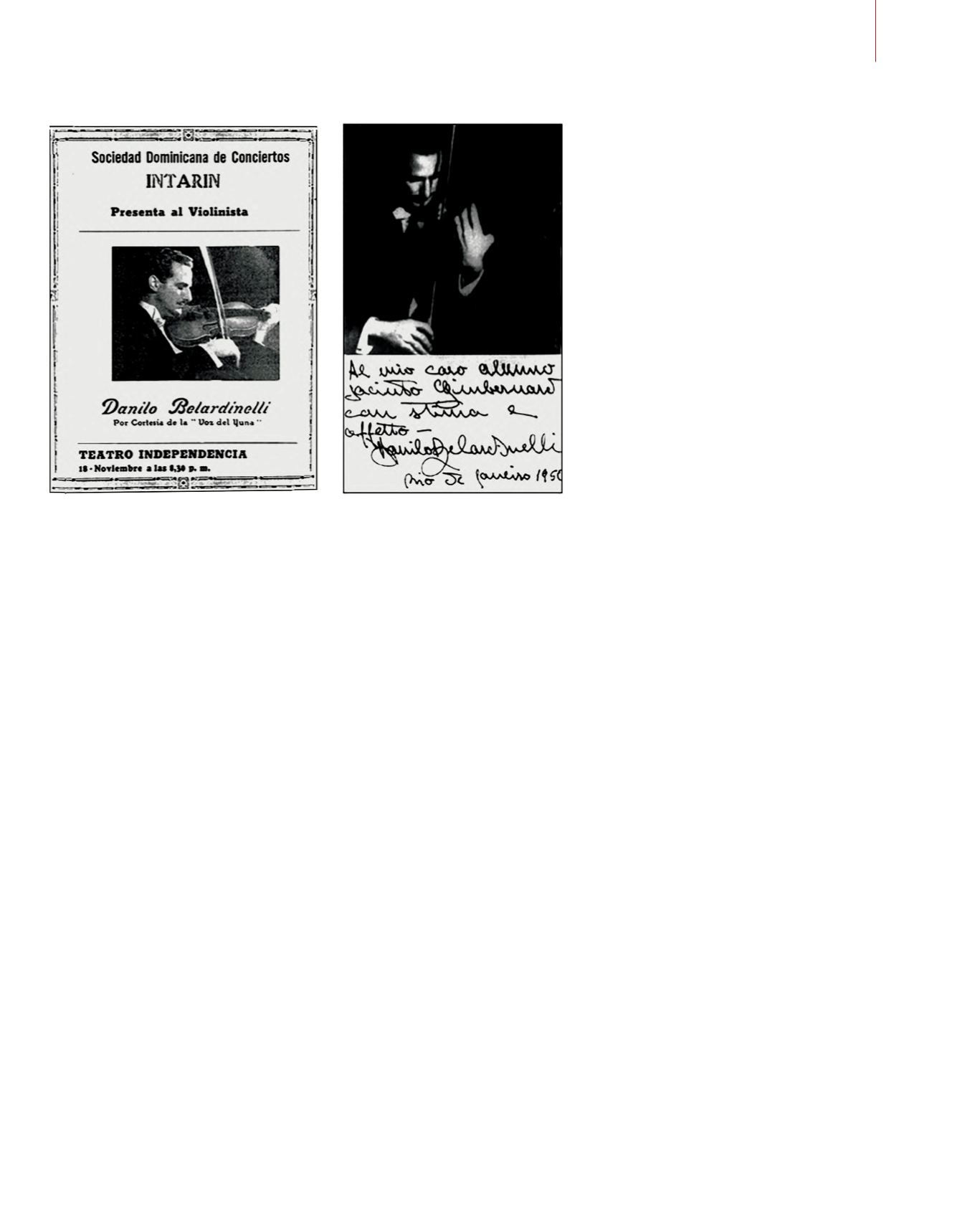
Invitation for the
concert of the Italian
violinist Danilo
Belardinelli, scheduled
for November 18,
1948 at Teatro
Independencia. On
one side of the card,
there is a dedication
from the teacher
“to my dear student
Jacinto Gimbernard.”
© Blanca Delgado