


 369 / 540

THE ITALIAN LEGACY IN THE DOMINICAN REPUBLIC
368
with symphonic works by Dominican authors, through the Italian radio and television consortium (RAI). “I
conducted this concert,” said Caggiano, “with my heart fixed on this country that I love so much, and which
I consider my second homeland. I was very flattered when the audience enthusiastically applauded the com-
positions of Dominican musicians. The resonance of the concert in Italian musical circles filled me with great
satisfaction and pride, in that the musical talent of this country was revealed.”
In 1959, Caggiano conducted his farewell concert on three occasions with selections from Handel’s
Messiah
, with the participation of the National Choir, the National Symphony Orchestra, and the soloists Olga
Azar, Ivonne Haza, and Arístides Inchustegui, together with Francisco Montelli (violin), François Bahuaud
(cello), and Lilliam Columna (harp).
Mario Carta
(1906) was born in Mandas, Cagliari (Sardinia). He began his studies under the tutelage of his father
and then went on to study harmony with Mario Pilati and Cesare Dobici. At the Conservatorio di Santa Cecilia,
in Rome, he graduated from piano and composition under the guidance of teachers Silvestri and Petrassi. He was
a brilliant concert pianist, recitalist, conductor, and arranger, and he also composed music for films.
As half of the piano duo of Carta and Cabiati, Carta gave concerts at major music venues in Europe and
the United States, including Carnegie Hall, Town Hall, Constitution Hall in Washington, D.C., and the Amer-
ican Academy of Music in Philadelphia.
He also did extraordinary work at La Voz Dominicana, where he was an exclusive artist for several years,
beginning in 1947. The Carta-Cabiati duo had a special show on that radio station, which garnered a consider-
able audience. A truly talented arranger, he guided the first steps of the great Dominican musician Bienvenido
Bustamante, who never forgot Carta’s sage advice. He was also responsible for the finest moments in the
exceptional career of the Dominican tenor Napoleón Dihmes.
For the 1951 Anniversary Week of La Voz Dominicana, he led a choir made up of artists from the station
to perform seventeenth-century music, along with arrangements of contemporary works by Dominican com-
posers. The soloists were Guarionex Aquino and Jesús Faneyte. On this occasion, the choir received unquali-
fied applause; without the need for accompanying instruments, it had managed to achieve quite novel effects
based on onomatopoeia, echoing the sounds of the güira, the tambura (a traditional two-headed drum), and
the accordion. Mario Carta also added the trumpet blast to the official interpretation of the Dominican Na-
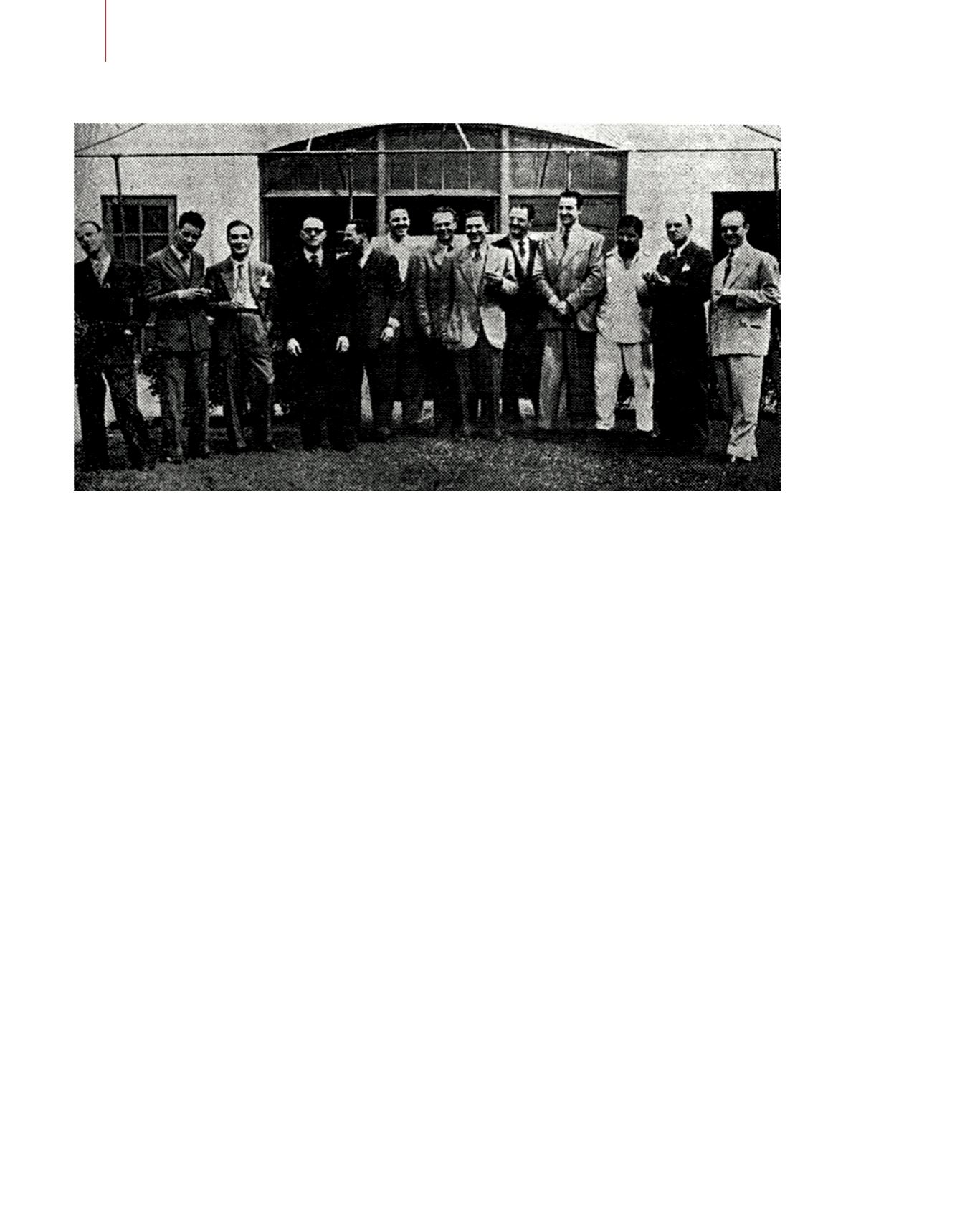
The group of 10
Italian musicians
hired by La Voz del
Yuna is welcomed by
the musical director
of the radio station,
Ángel Bussi (third
from right), and by an
unidentified official.
© Blanca Delgado