


 368 / 540

367
THE ITALIAN LEGACY IN DOMINICAN MUSIC AND CULTURE
did not come to fruition, it was followed by the creation of the Orquesta de Arcos, which Caggiano directed,
made up of Italian musicians at the service of the company, who presented a special program weekly through
this important radio station. In 1949, at the end of his two-year contract, Caggiano returned to Italy, but the
following year he was back in Santo Domingo, on directions of José Arismendi Trujillo so that he could as-
sume direction of the National Symphony Orchestra, which had fallen into a critical period under the direction
of the Mexican Abel Eisenberg.
In an interview with Manuel Rueda in 1983, Caggiano recalled that the nearly ten years he spent conduct-
ing the Symphony had been the most inspiring period of his life. There he had found friends and musicians of
great artistic and human value, who joined in his efforts with the authorities to raise the salaries of musicians
and who supported him in his initiative to defend affordable programs for a nascent group that ultimately
achieved great success due to his professionalism.
From his first public concert as co-director of the NSO, on December 21, 1950, at the Social Worker’s Cen-
ter, the plan this brilliant director had outlined proved a success—to improve the orchestra, and move from
the simple to the complex, thereby gradually encompassing the great works of the repertoire, based on the
technical progress that the different sections were making.
On June 1, 1951, Roberto Caggiano was appointed principal conductor of the National Symphony Or-
chestra, and on October 30 of that same year, he presented the first Opera Night in the country at the Teatro
Olimpia, in a groundbreaking gala event sponsored by the General Directorate of Fine Arts, with scenes from
the operas
Rigoletto
,
Aida
,
La Traviata,
and the overture of
La Forza del Destino
by Giuseppe Verdi, in which
seven solo voices and a choir of eleven male voices participated. The event was repeated at the Teatro Julia in
Santo Domingo, and then went on to San Cristóbal, San Pedro de Macorís, and Barahona.
On October 7, 1955, the news was published that the maestro Caggiano had presented a concert in Rome
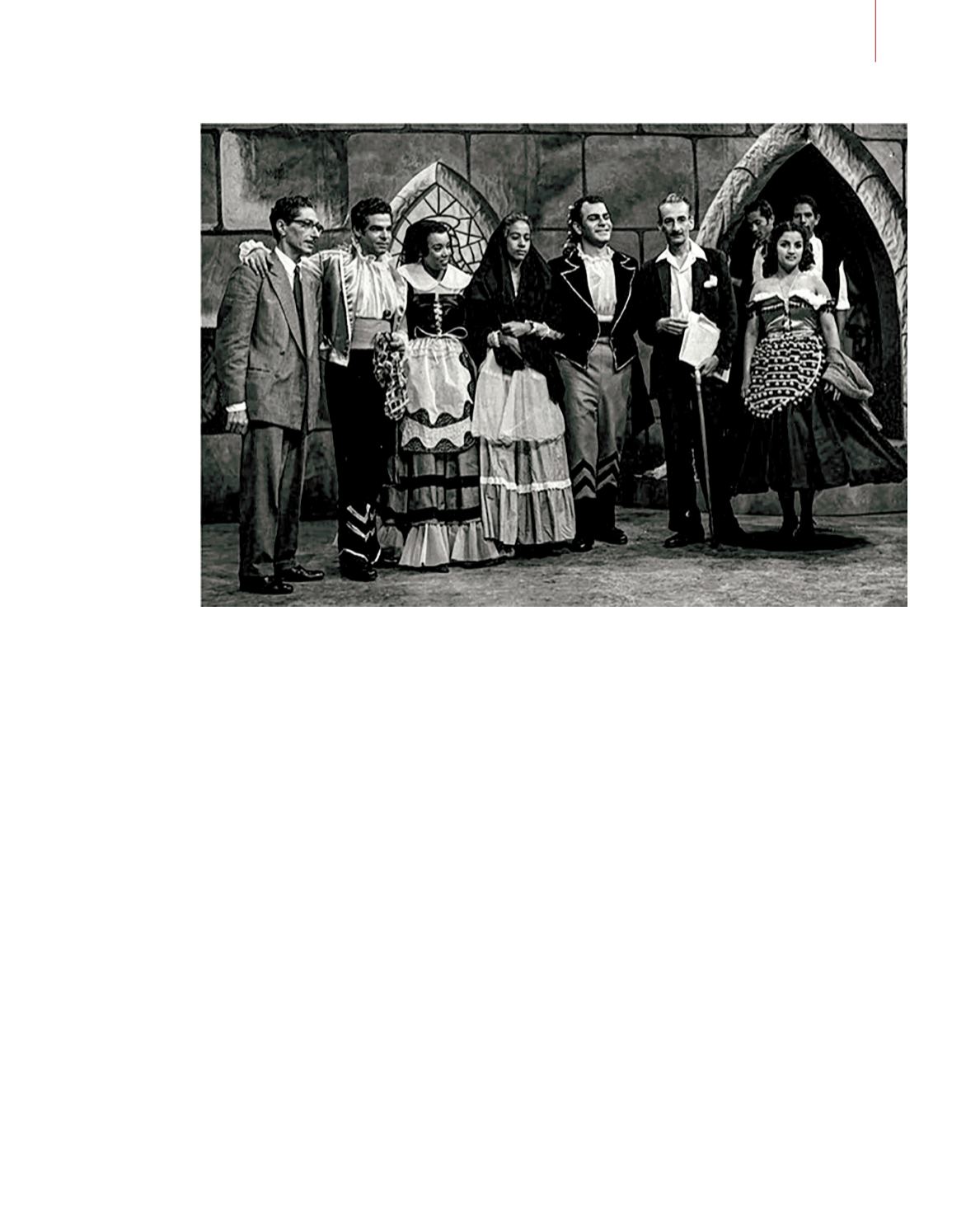
Actors posing
at Teatro Olimpia.
© Blanca Delgado