


 363 / 540

THE ITALIAN LEGACY IN THE DOMINICAN REPUBLIC
362
Fernando Geraldes Siragusa
(Conductor)
(Ciudad Trujillo, November 10, 1959). Ger-
aldes studied piano and violin and orchestral
conducting in Europe (1977). He served as
pianist and choral director of the Saint-Ger-
main-des-Près Church (1989) and artistic di-
rector of the Musici Europeae Choir, Paris.
He was awarded the title of Honorary Citi-
zen of Montlhéry in France (July 14, 1998),
and the Medal of the Upper House of the
Assembly, within the framework of the 9th
ed. of the Week of Latin America and the
Caribbean in France. Artistic director and
teacher at the Thomery Conservatory, con-
ductor of the Nemours Vocalys choir, and
leader of the ensemble Verseaux du Loing.
Vicente Grisolía
, who made his proclivity
for the piano known from the age of six,
studied piano under Alicia Menard and Enriqueta Zafra and made his public debut at the age of 15 at the Te-
atro Apolo in Puerto Plata, his hometown.
In 1939, he completed a teaching degree in piano at the Liceo Musical de Santo Domingo, and when he
moved to the capital in 1944, he began advanced studies in piano at the National Conservatory of Music and
Recital in the class of Paula Marx de Abraham, graduating in 1946 at the age of 22.
In New York City he was a student of Hedwig Kanner-Rosenthal, and in Rome he studied Advanced Rep-
ertory under Germano Arnaldi. Upon returning to the Dominican Republic in 1964, he began a fruitful career
teaching advanced piano courses at the National Conservatory of Music.
With the National Symphony Orchestra, Grisolía performed works by Beethoven, Chopin, Delgadillo,
Liszt, and Luis Rivera. He played duets with both Elila Mena and Ramón Díaz, Jr., and he performed to re-
sounding acclaim as a soloist in the United States.
For more than twelve years he performed on Dominican Radio and Television, along with violinist Jacinto
Gimbernard in a program titled
Música de los Grandes Maestros
(Music of the Great Maestros), which marked a
milestone in the cultural life of the country.
Grisolía performed in New York at Carnegie Hall, Steinway Hall, Carl Fischer Hall, and Avery Fischer
Hall. In Puerto Rico, he performed in San Juan on Cultural Television and at the Casa Blanca, in addition to
the University of Puerto Rico at Mayagüez. In El Salvador, he has played in the Concert Hall of the Conser-
vatory of Music of San Salvador.
He has been referred to as a highly professional pianist, the quintessential accompanist for singers and
instrumentalists.
Carlos Alberto Piantini Espinal
was born on May 9, 1927, in San Carlos de Tenerife, near Santo Domingo,
where his Italian great-grandfather, José Eugenio Piantini (1791-1871), originally settled.
He began his music theory studies at the age of seven under Josefita Heredia, and shortly thereafter, he
studied violin under Guillermo Jiménez. At the age of ten, he gave his first public performance, and beginning
in 1938 he was a student of the Austrian violinist and educator Willy Kleinberg, during the three years that
this renowned maestro was living in the Dominican Republic. He then continued his studies with the Czech
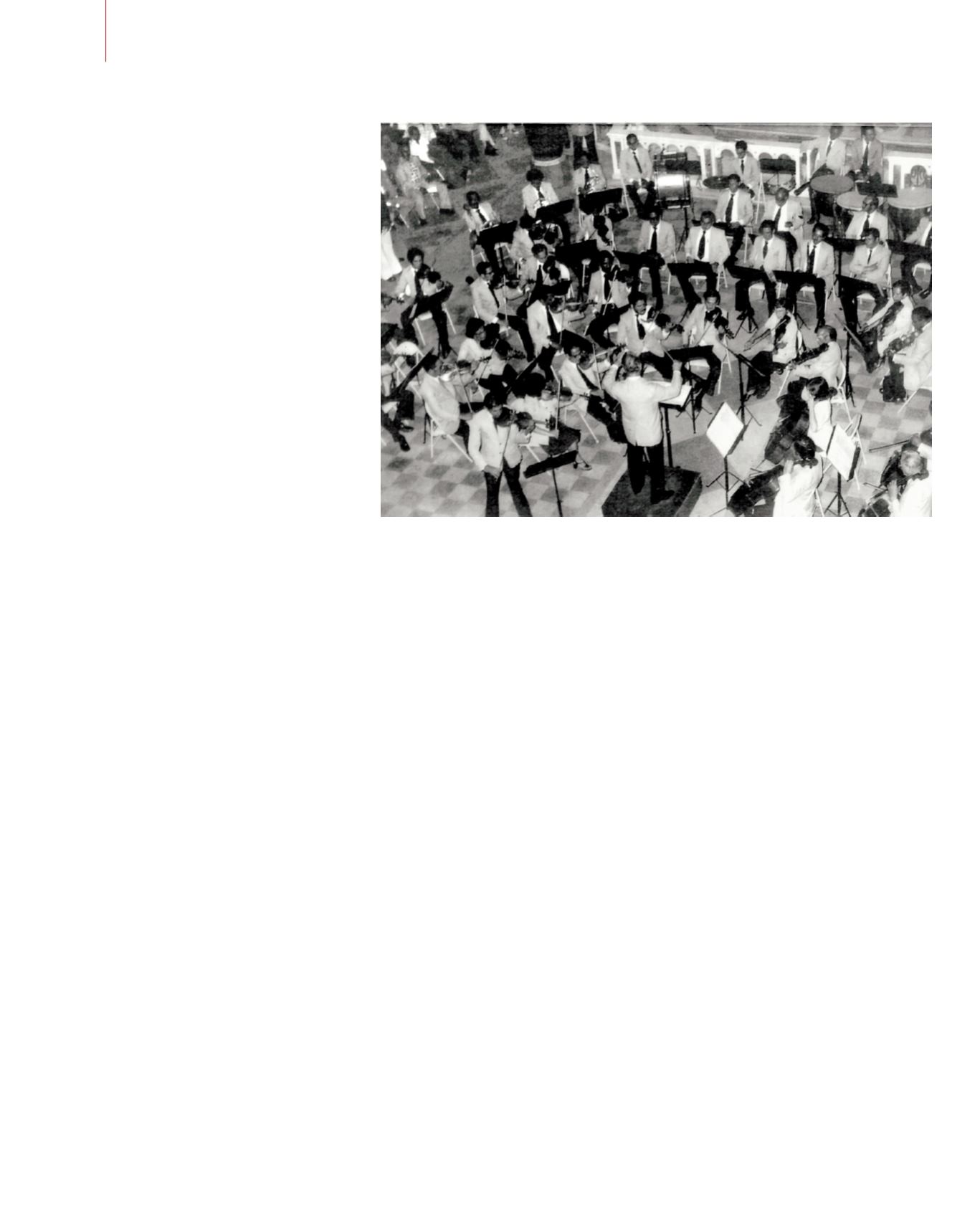
The National
Symphony Orchestra
with its director
Roberto Caggiano
in 1951 in the main
hall of the General
Directorate of Fine
Arts, today known
as The Royal Houses
Museum.
© Blanca Delgado
.