


 119 / 540

THE ITALIAN LEGACY IN THE DOMINICAN REPUBLIC
118
covered, also engaged in pedagogical activity: he was the author of
a transcribed epigram found in an anthology by Pere Carbonell, the
well-known Catalan humanist, in which he praises the beauty of the
writings of the notary from Barcelona. The author of the epigram is
presented as follows: “Alessandro Geraldinus, Ferrandi filiarum His-
paniae regis praeceptor egregius.”
These were the years when Alessandro Geraldini first came into
contact with Christopher Columbus. In truth, the extent of this rela-
tionship and the actual importance of Geraldini’s role in the business
affairs of the Genoese explorer are far from clear: Geraldini stated that
he had greatly influenced the sovereigns in their favorable judgment
of the admiral. Columbus, meanwhile, never mentioned Alessandro
Geraldini in his writings. However, Geraldini was present at the fa-
mous Capitulations of Santa Fe, in the first months of 1492, and tells
us (
Itin.
XIV 10 - 15) that they maintained, in contradiction with the
doctrine of Saint Augustine and Nicholas of Lyra, that it was indeed
possible, according to the experiences of Portuguese navigators, that
human beings lived beyond the “Torrid Zone” (
i.e.,
the southern
hemisphere). Their argument was based on the fact that while both
Augustine and Nicholas of Lyra had been great theologians, they
nonetheless had little knowledge of geography.
(
Itin.
XIV 10 - 15)
[He went to King Ferdinand and Queen Isabella, who, in turn
moved by the authority of such a distinguished man], sent for Co-
lumbus. When the great men of the Court met in a few days in
Council, the opinions were divided to the point that some Spanish
Bishops considered him a heretic, because, according to Nicholas
of Lyra, the entire structure of the human Earth, which extended
over the sea from the Fortunate Islands to the East, had no sides that bend at the bottom of the sphere,
and Saint Augustine had affirmed that there was no Antipodes. Then I, fortunately a young man who
was retained, went to Diego de Mendoza, Cardinal of the Holy Roman Church, an illustrious man for
his lineage, integrity, prudence, knowledge of things, and for all his moral attributes of a clear nature,
telling him that while Nicholas of Lyra had been a most excellent expositor of Theology, and Augus-
tine a man exalted for his doctrine and holiness, but that, nevertheless, they had known nothing of
Cosmography since the Portuguese had gone to the lower parts of the other hemisphere so that they
had discovered, after leaving our Arctic, the other Antarctic, beneath the other pole; and they had
found the entire Torrid Zone filled with villages and had seen new stars on the axis of the Antipodes.
Luis de Santángel, the Valencian treasurer, then asked Columbus what sum of money and how many
ships were necessary for such a long navigation. Which, as he replied that 3,000 doubloons of gold and
two ships and the other immediately stated that he wished to undertake this expedition himself and
also provide that sum, Queen Isabella, with that greatness of soul that was natural to her, most liberal-
ly assigned the ships, the crew and the money needed to discover a new world for humanity.
Later, Columbus, aware of the help he had received, bestowed the name of the Geraldini brothers’ moth-
er, Graziosa, on one of the islands (Bequia, in the archipelago of the Grenadines, in the Lesser Antilles) discov-
ered on his third voyage along the Venezuelan coast.
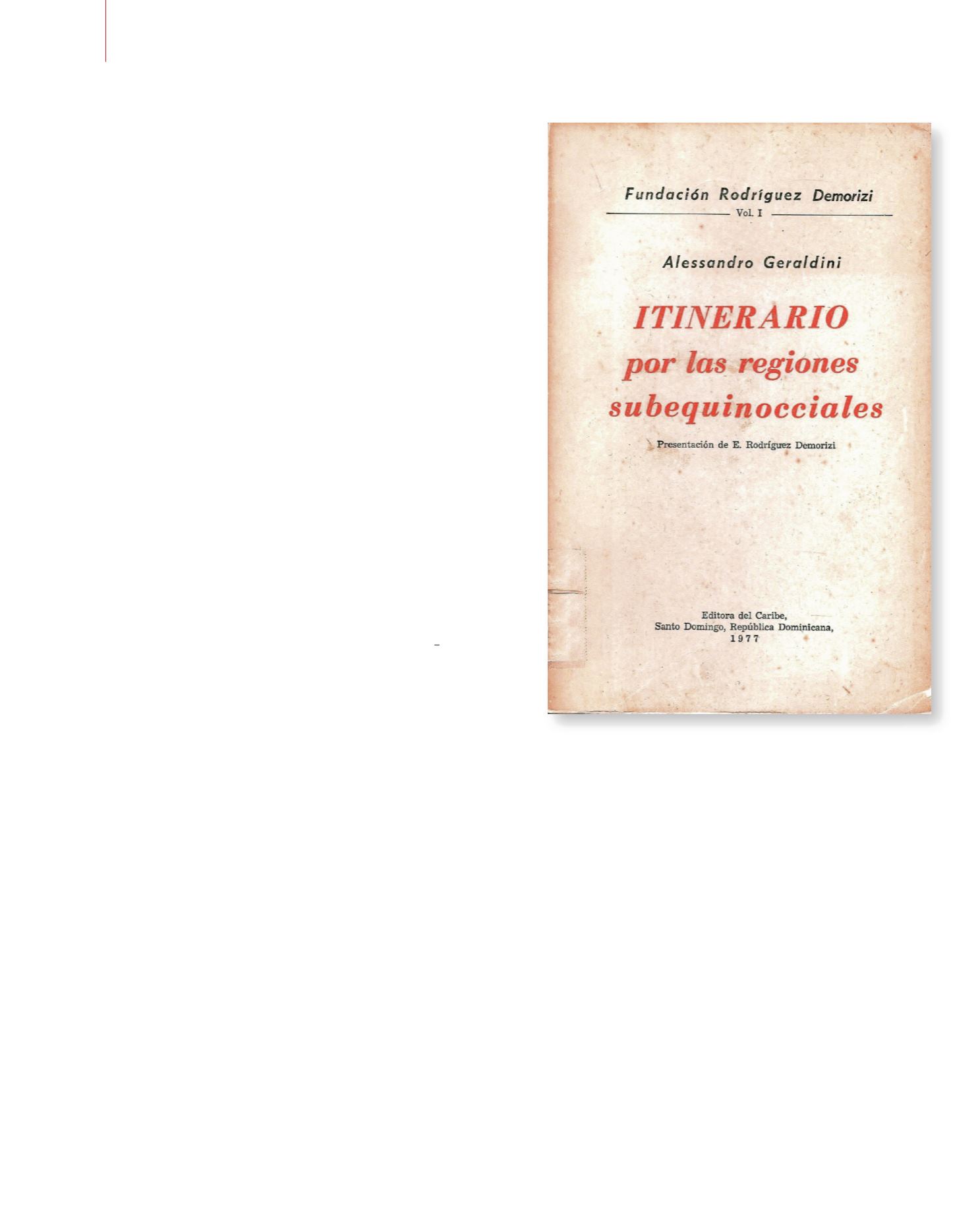
Cover of the book
by Emilio Rodríguez
Demorizi,
Itinerario
por las regiones
subequinocciales
(Itinerary through
the Subequinoctial
Regions) by
Alessandro Geraldini.
© Library of the Academia
Dominicana de la Historia
Opening page:
Graciosa Island. Paolo
Forlani,
Descrittione
di tutto il Perù
(Description of
All of Peru), Venice
1564, pl. 87 (Rome,
Biblioteca Nazionale,
Collection 71.6.G.3).
© Edoardo D’Angelo