


 115 / 540

THE ITALIAN LEGACY IN THE DOMINICAN REPUBLIC
114
was suspended and subject to disbarment proceedings.
14
The royal decree to Admiral Diego Colón, viceroy
and governor of Hispaniola, states “that here [in Spain], Hon. Figueroa’s poor governance on the island has
been made known. Therefore, Cristóbal Lebrón shall be dispatched to take over his positions. He is thus en-
dorsed and shall be supported and assisted in these proceedings.”
15
It is not surprising if one considers the bishop of Santo Domingo’s various initiatives as pastor an ideologi-
cal contradiction or, worse still, “good preaching and penance” (to the point that Jesús Paniagua and Carmen
Vázquez even believe that some of the passages of
Itinerarium
could have been interpolated).
16
However,
his ideological swings are easily explained in terms of the specific needs of the day-to-day operation of such
a troubled diocese. Geraldini’s attitude toward the phenomenon of slavery is at least binary (theory/praxis),
if not even “plural.” This is demonstrated by what he claims within a very short space in two passages at the
beginning of book XII of
Itinerarium
: in XII 3, the bishop criticizes the inhabitants of Guinea for selling their
relatives to foreign merchants, yet in XII 9, he says that there are captured African sailors in the hold of his ship.
Christian solidarity and the rejection of gratuitous violence were coupled with economic and logistical
needs. It is one thing to force the indigenous peoples to work (underpaid), but another to starve or kill them
for no reason. The cry of pity and anger of the first resident bishop of the Americas still seems to resonate (
Itin.
XVI 25): “I add, Your Holiness [Pope Leo X], that for nothing more than to satisfy their abominable lust, they
kidnapped children from the wombs of miserable mothers, citing some pretext; and with inexorable violence,
in front of their own mothers, they beat them against a beam or a stone, and they killed there and then what
they wanted from the mothers who were still wailing.”
The words of Francisco Ozoria Acosta, Archbishop of Santo Domingo, are emblematic. During the
Te
Deum
held at the cathedral on September 19, 2019, as part of the events taking place for the quincentennial of
Geraldini’s arrival in the Americas, he underscored how the Italian bishop was influential in the founding of
the Church, not only in Santo Domingo or Hispaniola, but in its birth, its true baptism throughout the Ame-
ricas. As Geraldini himself imagined (ep. 19.21), inscribing on the walls of “his” cathedral, from that moment
on, “the mighty gods defeated by Pope Leo X, and sent from the equatorial region by Bishop Alessandro Ge-
raldini, are now silent; but, they once spoke.”
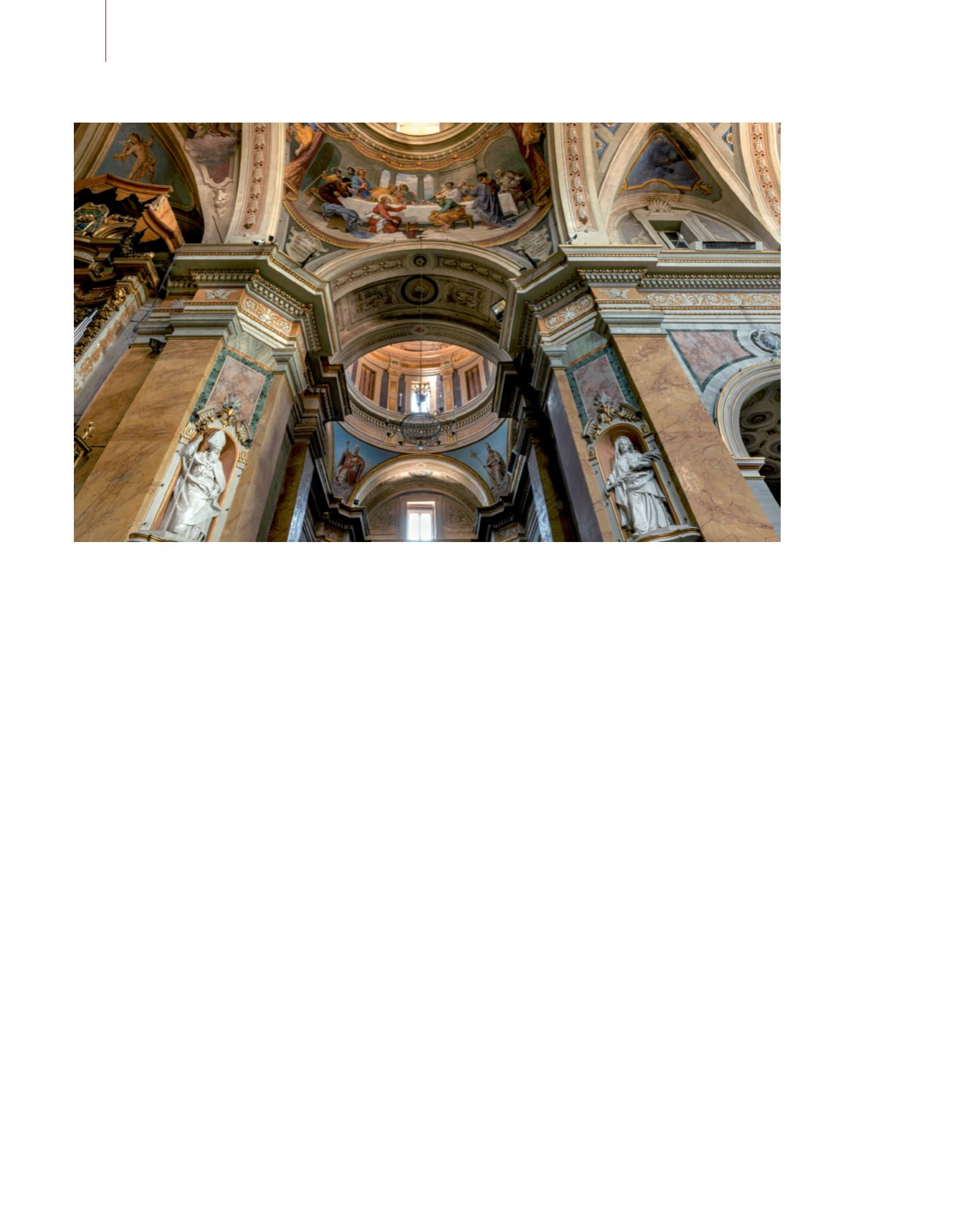
The Bell Tower
(also known as the
Civic Tower) of the
Cathedral of Santa
Firmina in Amelia.
© Andrea Vierucci