


 122 / 540

121
addressed to the pontiff himself (June
1516: the papal bull was issued the fol-
lowing November 6). Actually, it was
in Rome that most of the New World
designations were decided, and Ger-
aldini was an outspoken supporter of
the pope, as is evidenced in his corre-
spondence.
The economic, political, social,
and religious potential of the Spanish
colonies of the NewWorld were limit-
less, and Geraldini was fully aware that
a new Church was to be built there,
both spiritually and materially. The
diocese of Santo Domingo had only
been created in 1504, by Pope Alexan-
der VI, with the bull
Illius fulciti prae-
sidio
, and its rights were defined, especially with regard to the Spanish Crown, only by Julius II in 1510 with
the bull
Eximiae devotionis
. In the Spanish Indies there were three dioceses, which were under the direction of
Seville: in addition to Santo Domingo, there was Concepción de la Vega (also on the island of Hispaniola) and
Puerto Rico. Family lineage, a solid education and culture, and political and diplomatic experience gained over
decades of work for the Spanish court and for the papal Curia made Alessandro Geraldini fully prepared for the
task. He himself felt that that role might lead him to become the organizer of the entire New World Church.
The potential benefits, which we might understand as professional, of course, also coincided with financial
ones: the idea of
El Dorado
, of the unlimited wealth of the Indies, is certainly one of the factors that may have
impelled Geraldini to his courageous decision. The enormous latitude presented by a newly created ecclesias-
tical organization give him the opportunity to surround himself with trustworthy figures, particularly relatives
and close collaborators. Thus, in 1517, he sent two men from among his close confidants to Hispaniola: his
direct nephew Onofrio (Geraldini), an Amelian clergyman, as episcopal vicar (ep. 1, 2 and 22) and the servant
Diego del Río, of the clergy of Segovia, having them accepted as canons of the Chapter of the Cathedral of
Santo Domingo. Along with these, his niece Isabella (daughter of his brother Costantino) and her husband
(ep. 18) also arrived in Hispaniola. Another distant nephew, Andrea Geraldini, also appeared in the Americas:
in 1519, his father Scipione claimed for another of his sons the canonry that was vacated by Andrea’s death,
which occurred while he was serving the Rev. Bishop Alessandro, in Santo Domingo, “apud novas insulas.”
Aboard the ship that transported the bishop to the New World, there was the faithful Francisco Ribera, who
knew the dialects of the Caribbean (“Ribera meus” as he is referred to in
Itin
. III 40), and, apparently, the Af-
rican priest Rangaano, recommended to Geraldini by Naassamon, a priest of Barbazina in Western Africa, for
his excellent knowledge of the Portuguese and tropical regions of Africa. And in February 1517, a royal decree
addressed to the Viceroy of Hispaniola, Diego Columbus, to his lieutenant, and to the commissioned judges of
the “Indies,” ordered the island’s authorities to deliver the income of the bishops to the two envoys (Onofrio
and Diego), until the bishop had personally arrived on the island. However, Geraldini would not arrive at the
diocese until two years later, in September 1519.
Geraldini’s attitude can be seen in how he understood his role as a bishop in pre-Tridentine terms, insofar
as he was not in a hurry to assume his position. And this caused a stir among the commission of Hieronymite
friars appointed by Cardinal Cisneros. The absence of bishops was one of the reasons why the Spaniards expe-
rienced so many difficulties in the New World. On July 22, 1517, a royal office urged the new bishop of Santo
Domingo to delay no further in taking possession of the bishopric. The answer to these tensions is probably
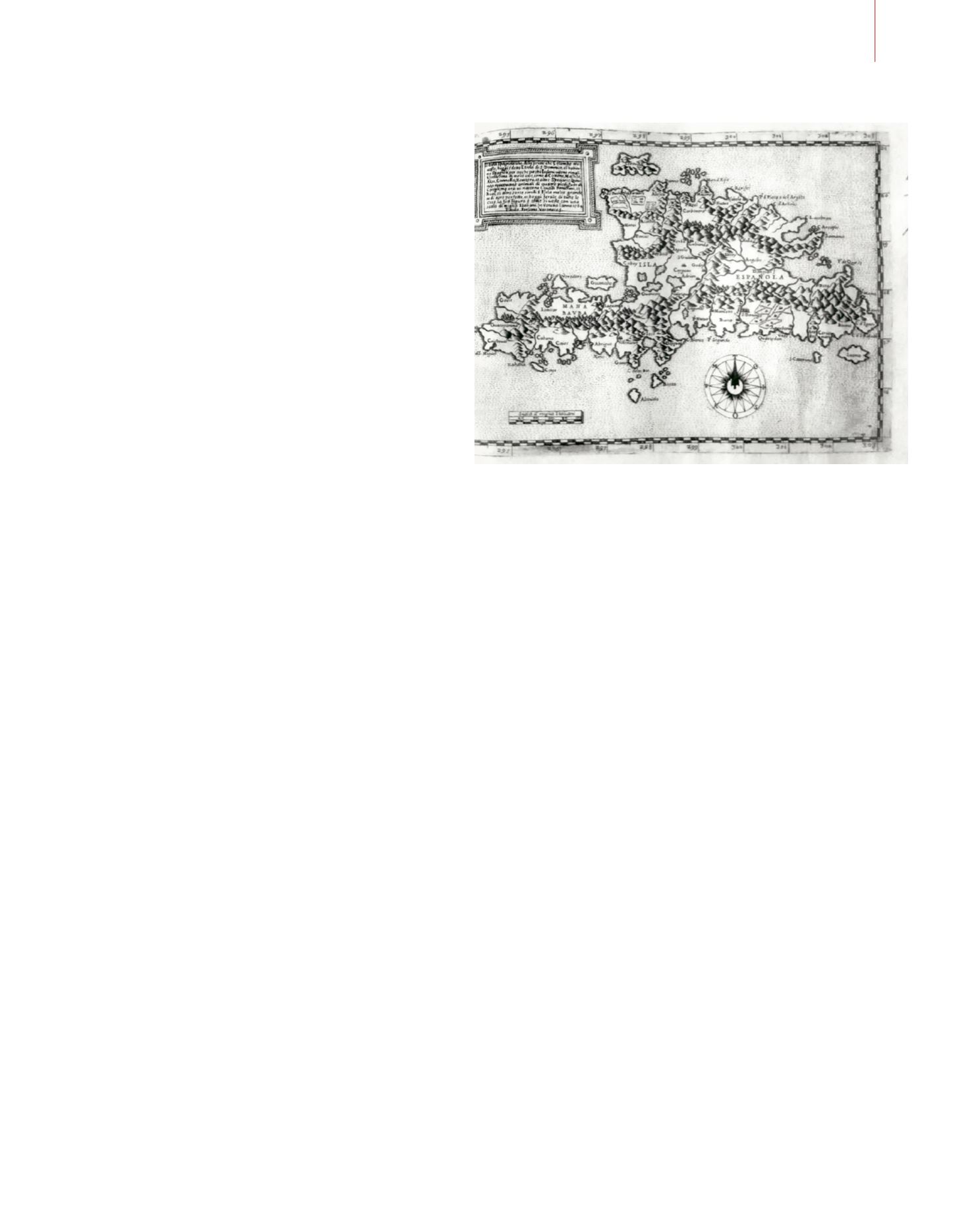
Española Island. Paolo
Forlani,
Descrittione
di tutto il Perù
(Description of
All of Peru), Venice
1564, pl. 72 (Rome,
Biblioteca Nazionale,
collection 71.6.G.3).
© Edoardo D’Angelo
“THE ITINERARIUM AD REGIONES SUB EQUINOCTIALI PLAGA CONSTITUTAS” OF ALESSANDRO GERALDINI D’AMELIA