


 123 / 540

THE ITALIAN LEGACY IN THE DOMINICAN REPUBLIC
122
in ep. 1: the bishop was unable to immediately depart
due to a commitment to preach the crusade by order
of Pope Leo X.
In those months between 1516 and 1517, Gerald-
ini was in northern Europe paying a visit to various
European capitals, by order of Leo X, in defense of the
Christian cause against the Turks.
In Spain, the situation was somewhat tense. In the
period between the death of King Ferdinand (January
1516) and the accession to the throne of the new sov-
ereign, Charles V (Ferdinand’s grandson), the country
was being run largely by Cardinal Cisneros, who felt
impelled to conduct aggressive and despotic policies.
As for the situation in the New World, he attempted
to counter the institution of indigenous enslavement
quite forcefully (he also attacked the mismanagement
of Christopher Columbus). Previously, he had or-
ganized a series of missionary expeditions, especially
among the Franciscans, for the conversion of the na-
tives (1500, 1502, and 1508), establishing a set of rules
that would protect the well-being of indigenous peo-
ples. Later, he tried to find a solution to the thorny
problem of the
encomiendas,
1
and on November 1516
he sent a commission to Santo Domingo made up of
three friars from the Order of Saint Jerome (Bernardi-
no di Manzanedo, Luigi de Figueroa and Alfonso de
Santo Domingo) with the task of reorganizing the indigenous peoples and administering the new territories.
However, this commission sparked opposition among the powerful officials who administered the Indies,
as well as the
encomenderos,
2
so much so that the Hieronymite commission was forced to withdraw to Spain
shortly after the summer of 1519. It was then that the investiture documents to officially present Geraldini to
Pope Leo X as Bishop of Santo Domingo were quickly drafted.
Alessandro Geraldini was aware of all these difficulties. In a brief drafted and revised between 1519 and
1520, and addressed to the Council of the Crown (ep. 16), he requested the power to control the assignment
of Christianized natives to the Spanish colonists, a key aspect for an economy that was entirely dependent on
indigenous labor; the appointment of a presiding magistrate for the Real Audiencia (the highest political and
judicial body in Santo Domingo); and the organization of education for the children of the
caciques
(traditional-
ly the heads of the tribal communities in Latin America), already initiated by the Hieronymite friars. However,
as indicated above, the Hieronymites had just departed from the island when Geraldini arrived, without being
able to put a stop to the violence and abuses of the Spaniards against the indigenous people. Only the requests
relating to the issues of education and canonical appointments were accepted by the Spanish authorities (for
trusted persons). That same letter serves as a detailed and lucid report on a series of key points in the life and
problems of Geraldini’s diocese, and the intuition that the problems stemmed above all from the kinds of Eu-
ropeans who were arriving in the New World: “deterrimae pessimarum gentium illuviones” (ep. 16.13),
i.e.,
“a flood of the worst criminals.” By the end of July 1519, he asked King Charles to provide adequate buildings
for the Dominican diocese, because “ego episcopus nullum tugurium, nullum tegumen habeo”
3
(ep. 20.5),
while also demanding the 8000 ducats that King Ferdinand had intended for the construction of the cathedral,
and which at that time were in the hands of the royal treasurer of Hispaniola, Miguel de Pasamonte. Several
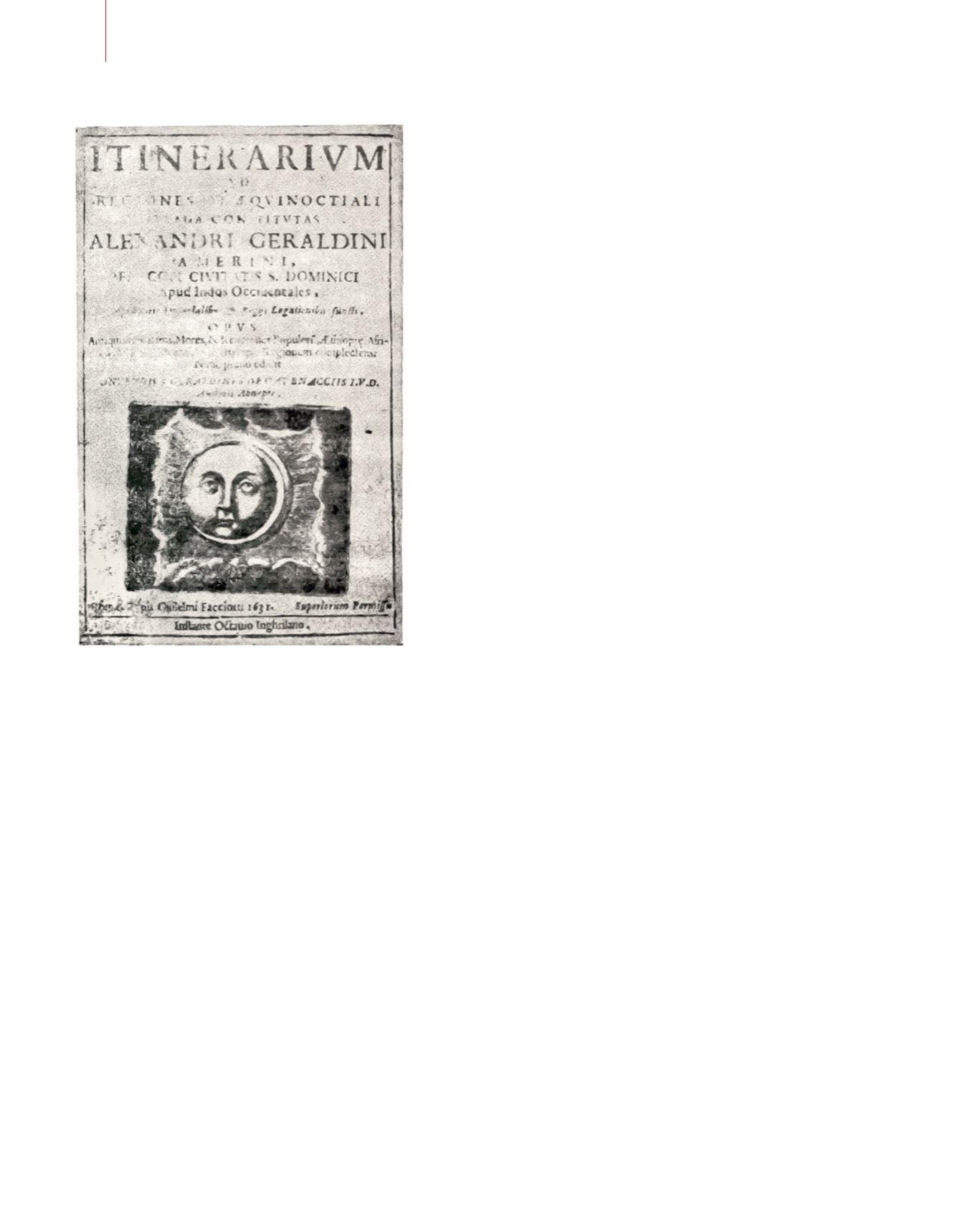
Cover of
Itinerario
por las regiones
subequinocciales
(Itinerary through the
Subequinoctial Regions)
of Alessandro Geraldini.
© Library of the Dominican
Academy of History