


 124 / 540

123
letters from these first months of 1519 were dis-
patched in search of funding to pay the debts that
he contracted both in Italy and in Germany and
England (ep. 12.2): even with the Vatican he had
incurred debts, since he did not pay for the release
of the papal bull.
Geraldini departed for Hispaniola from Cádiz
on July 13, 1519, arriving in Santo Domingo on
the following September 17 (ep. 7.11). The situa-
tion on the island was extremely difficult, and the
newly arrived bishop immediately encountered
all the complexities of his office. Economic and
organizational problems overlapped with pastoral
and spiritual difficulties—all of this in the absence
of cooperation, whenever hostilities would arise,
from the Spanish civil authorities. The pressing
matter for the bishop was, above all, the absence
of a cathedral. What existed was too small for the
needs, both practical and symbolic, of the diocese,
and not even a proper rectory existed. Geraldini
worked diligently to find the necessary funding:
between 1521 and 1523 he managed to initiate
construction on a cathedral; however, the struc-
ture would not be completed until several years
after his death.
The other great New World problem, particu-
larly severe at the time of Geraldini’s arrival, involved the abuses and violence perpetrated by the Europeans
against the indigenous inhabitants, which inevitably led to the decimation of this population. Furthermore,
the situation was further aggravated in Hispaniola by the recent shift in Spain’s focus from the Caribbean is-
lands to the hemispheric mainland, after the launch of Cortés’s Mexican colonizing enterprises. Furthermore,
the two dioceses into which the territory of Hispaniola was divided, Santo Domingo and Concepción de la
Vega, were tremendously poor, and to such a degree that Geraldini’s successor, Sebastiano Ramírez de Fuen-
leal, would fuse them under his mandate.
Geraldini’s position in favor of the indigenous people was the cause for great hostility and mistrust, which
continued to be an issue among the Spanish authorities on the island, in particular the presiding judge of the
Audiencia (1519-1520), Rodrigo de Figueroa.
It should be noted that the handwritten tradition of the
Itinerarium
indicates that there were no “interpo-
lated” parts, as one scholar has suggested. The
Itinerarium
arrived in the way desired by the author. And the
epistles also survived not interpolated, as shown in ep. 7 (the first written in Santo Domingo), which was trans-
mitted in an almost identical way by two completely independent testimonials (the Borghesian manuscript
I.215, and the copy present in the General Archive of the Indies in Seville, Royal Patronage, 174.R.14).
In late spring of 1520, the threats and violent confrontations between Figueroa and Geraldini reach a
pitch: in a letter dated May 1520 (ep. 25), Geraldini openly accused the
de facto
governor of having established
a dictatorial regime on the island, one marked by true tyranny, with violence, injustices and theft committed
daily against the natives and clergy of the Caribbean city. To defend himself, Figueroa wrote from Madrid,
denouncing the limited capacities on the island, and even accusing the bishop of reasoning “like a child,” and
in his own way recounting the memorable night that they spent as governor and bishop vehemently disput-
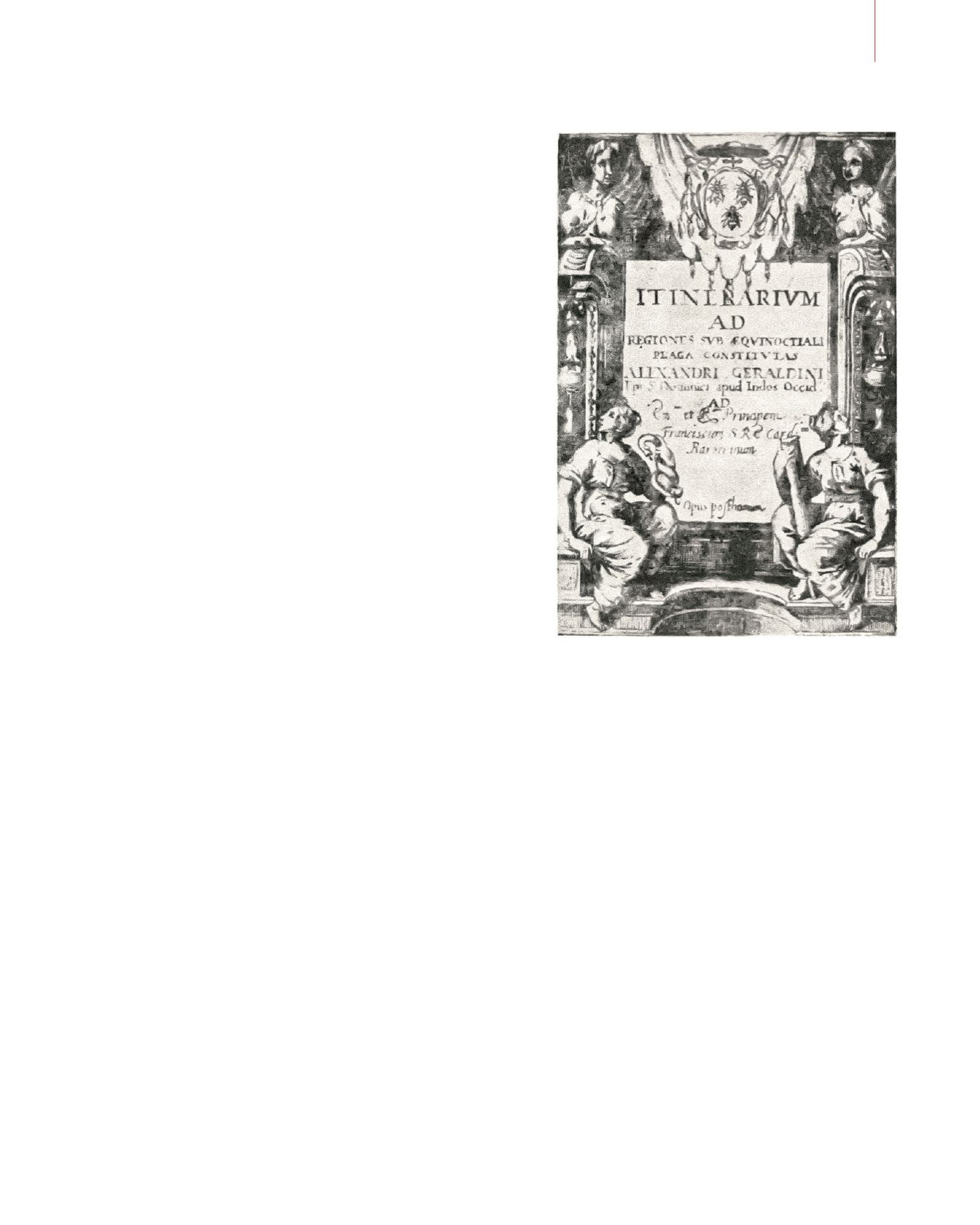
Cover of
Itinerario
por las regiones
subequinocciales
(Itinerary through the
Subequinoctial Regions)
of Alessandro Geraldini.
© Library of the Dominican
Academy of History
“THE ITINERARIUM AD REGIONES SUB EQUINOCTIALI PLAGA CONSTITUTAS” OF ALESSANDRO GERALDINI D’AMELIA