



 47 / 540

THE ITALIAN LEGACY IN THE DOMINICAN REPUBLIC
46
to the service of the fledgling Dominican nation, and with them
they established the first flotilla consisting of three ships for the
Dominican Navy. The Provincial Governing Board selected Juan
Bautista Cambiaso to lead it and appointed him as an admiral
with such incredible success that on April 23, 1844, the Domini-
can ships fought a successful battle against several Haitian vessels
at the site of Tortuguero, in Ocoa Bay, sinking three of them.
Cambiaso commanded the schooner named the Separación
Dominicana; Maggiolo, the schooner María Chica; and Acosta,
the schooner Leonor. (Acosta was a Dominican Criollo born in
Baní.) Ten years later, in 1854, under the command of Cambiaso,
these three sailors with three new ships (named Cibao, Merced,
and General Santana), brought the navy to the northern coast
of Haiti to provide support for the Dominican troops that were
preparing for the famous Battle of Beler.
Among other Ligurian merchants established in Santo Do-
mingo, special mention is due to the brothers Nicolás and Anto-
nio Canevaro, natives of the town of Zoagli, near Genoa, who
were also the owners of multiple schooners, and were closely
connected to the Cambiaso brothers. Nicolás de Canevaro ded-
icated himself to the exportation of leather and precious timber
and to the importation of European goods. Others, like the broth-
ers Luis and Juan Bautista Cambiaso and Juan Bautista Maggiolo
were owners of schooners and brigantines. Still, others like Juan
Bautista Pellerano, were government moneylenders, and others
were dedicated to commerce and artisanal products.
Canevaro also had ships and was a well-known merchant in
the capital of the nascent Dominican Republic. In the books and
records of the General Treasury Division kept as of 1853, there
are many notes about Canevaro’s commercial and naval exploits. In these documents, it states that Canevaro
was the owner of at least one schooner and two brigantines that made continual trips abroad, exporting ma-
hogany and carrying goods. These ships operated for many years. The schooner was named “Dos Amigas,”
and the brigantines were named “Sardo Palestra” and “Julio César.”
The Cambiaso brothers were partners at a company named Cambiaso y Ventura. As can be gleaned from
the ledger books for the Ministry of the Treasury—which recorded sales of provisions to the government—they
also had considerable commercial influence during the First Republic. The Cambiasos continued with this busi-
ness after the Dominican Restoration War, as did Canevaro, who continued operating as a shipowner, import-
er, exporter, and occasional supplier for the government. In April of 1869, the Cambiasos went a step further
and asked the government for the long-term lease agreement for a depot at the old customs office for the port
of Santo Domingo. Having their own depot as customers gave the Cambiasos a clear operational advantage.
In that year, Juan Bautista Cambiaso was the owner of numerous seafaring vessels. One of them was the
schooner Dos Amigas, formerly the property of Canevaro. The others were the schooners Rodolfo and Citania,
and the brigantine Rodolfo, as well as the three-masted schooner Luis Cambiaso, which made trips with timber
to Genoa. The schooners Rodolfo and Citania had a load capacity of 68 and 53 tons respectively. Years later,
the Cambiasos were also agents for the first steamships that operated in the port of Santo Domingo. Being the
owner of ships contributed to the fact that Canevaro and the Cambiasos were able to offer goods at lower prices
than other merchants, since they could sell their shipments without incurring certain brokerage costs.
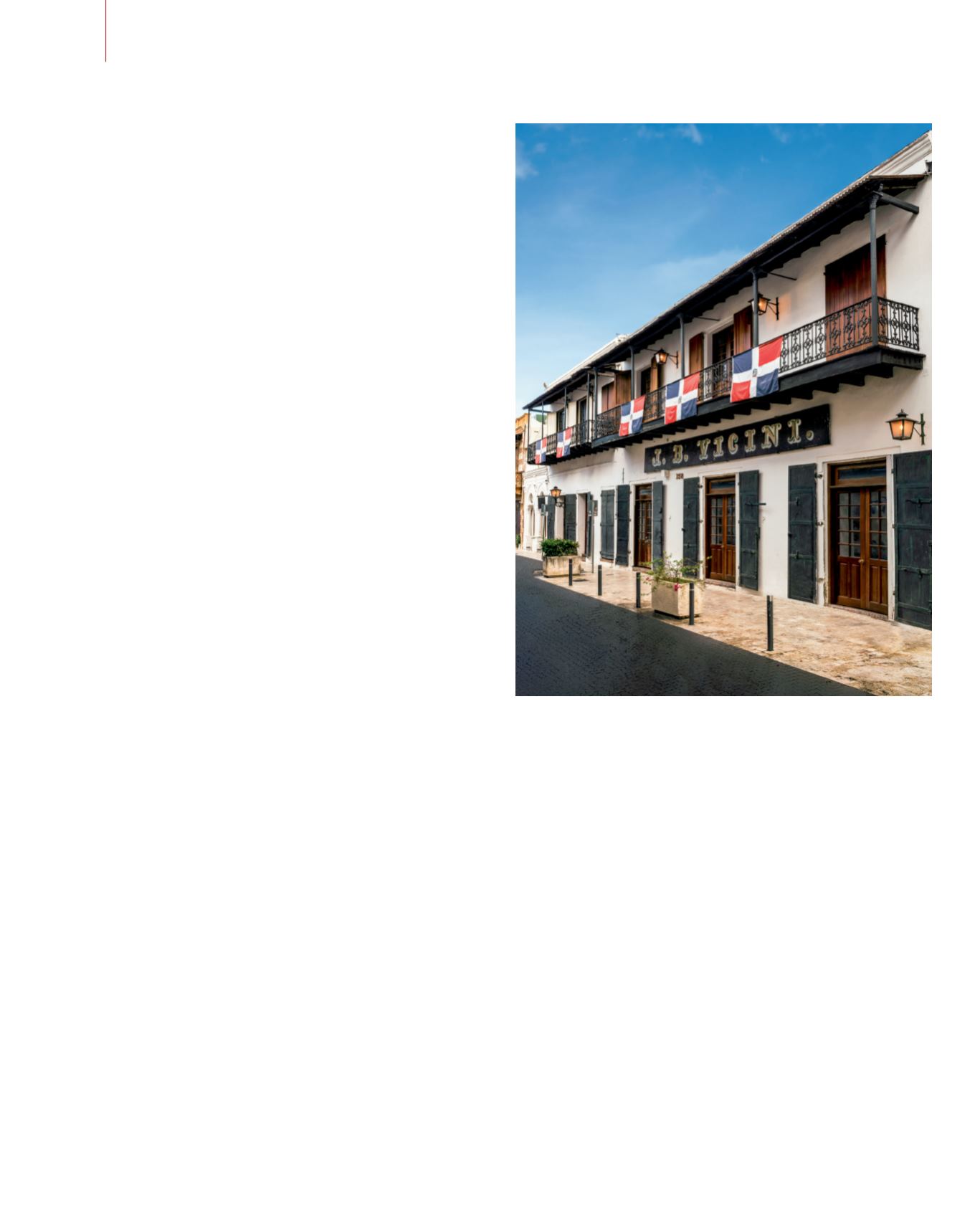
Casa Vicini served as
the headquarters for
all companies owned
by Juan Bautista Vicini,
as well as partner
companies, for four
generations of the
family. Meetings were
held there since before
1879. The house
was connected to the
warehouses in the port
of Santo Domingo,
by means of a tram,
which eventually
extended all the way
to calle El Conde.
© Giovanni Cavallaro /
Casa Vicini / Inicia